 By James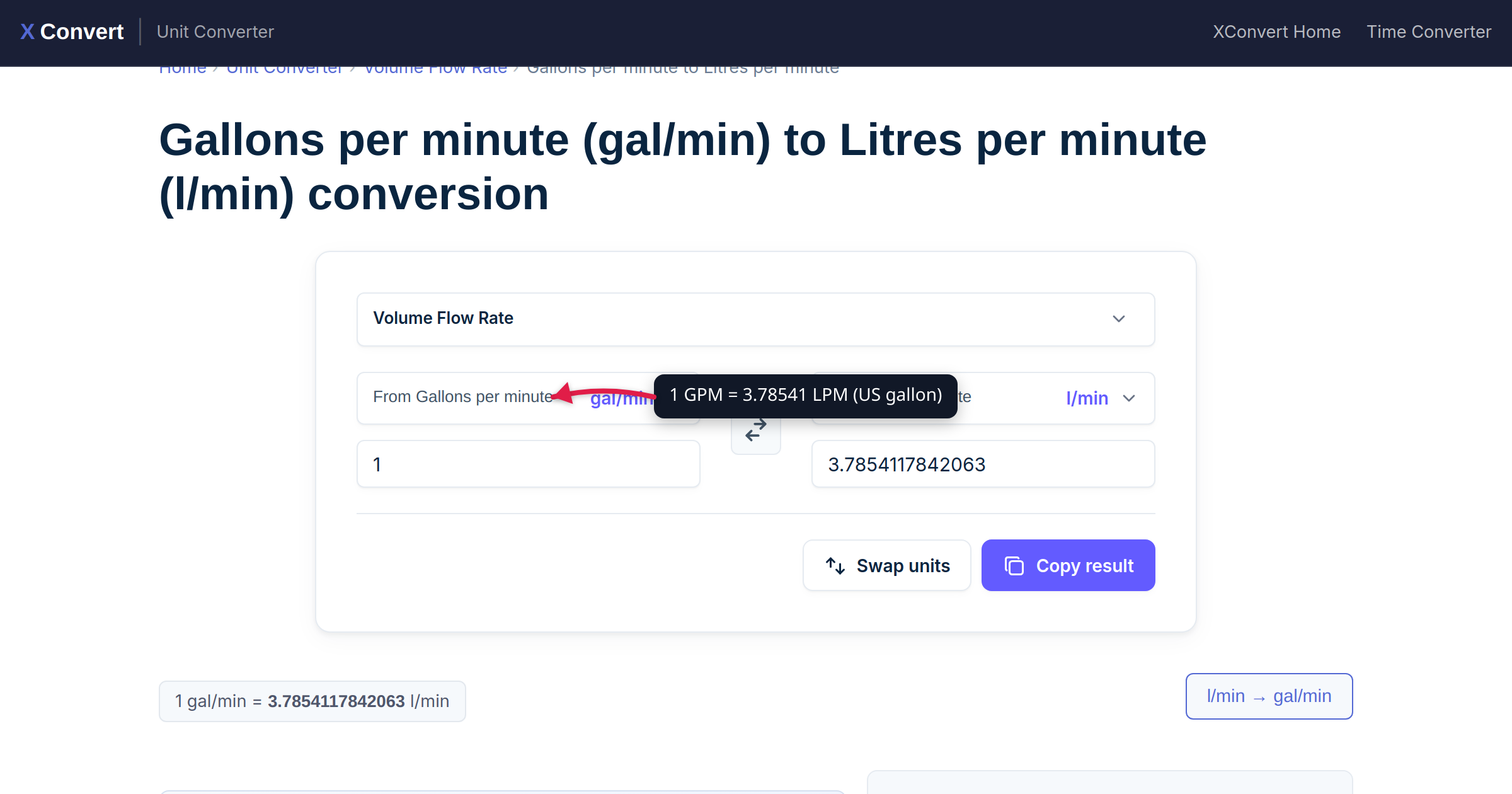
If you’ve grabbed a flow rate from a US-spec pump and need to compare it to a European product, you’ve hit the GPM-to-LPM problem. The conversion isn’t hard — it’s a single multiplication — but two different gallons are in common use, and most calculators silently assume one of them. Pick the wrong one and your spec is off by ~20%.
This guide gives you the exact formula for both gallon types, a worked example, a reference table covering 0.1 to 1000 GPM, and a quick decision tree for which gallon to use.
Quick answer: Multiply GPM × 3.7854 = LPM (US gallons) or GPM × 4.546 = LPM (UK/imperial gallons). 10 US GPM = 37.85 LPM. The US-vs-UK gallon difference is 20% — large enough to matter for pump and meter spec sheets.
Jump to a section
- The two-gallon problem (and which one to use)
- The formula
- Worked example: sizing a pool pump
- Quick reference table
- Common pump and plumbing flow rates
- FAQ
The two-gallon problem (and which one to use)
There are two “gallons” in everyday engineering use, and they’re meaningfully different:
| Gallon | Volume | Where it’s used |
|---|---|---|
| US gallon | 3.78541 L | United States — plumbing, irrigation, automotive, residential pumps |
| Imperial / UK gallon | 4.54609 L | United Kingdom, parts of the Caribbean, Canadian fuel economy figures |
The two differ by roughly 20% (the Imperial gallon is 20.1% larger than the US gallon — equivalently, the US gallon is 16.7% smaller than the Imperial) — enough to size a pump wrong if you ignore it. The litre is the same everywhere (defined by SI), so the divergence is entirely on the gallon side.
Which one to use? Almost always the US gallon. Every US-built pump, water meter, and shower head is rated in US GPM. The Imperial gallon shows up mainly in older British equipment specs and Canadian fuel-economy figures. If a spec sheet says “GPM” without qualifying, default to US. If you’re reading a UK plumbing standard or rating an older British pump, switch to Imperial.
The formula
For US gallons (the common case):
LPM = GPM × 3.78541For Imperial gallons:
LPM (imp) = GPM × 4.54609In both cases the “per minute” part stays put — only the volume unit changes. To go the other way:
GPM (US)  = LPM ÷ 3.78541   (or × 0.264172)
GPM (imp) = LPM ÷ 4.54609   (or × 0.219969)
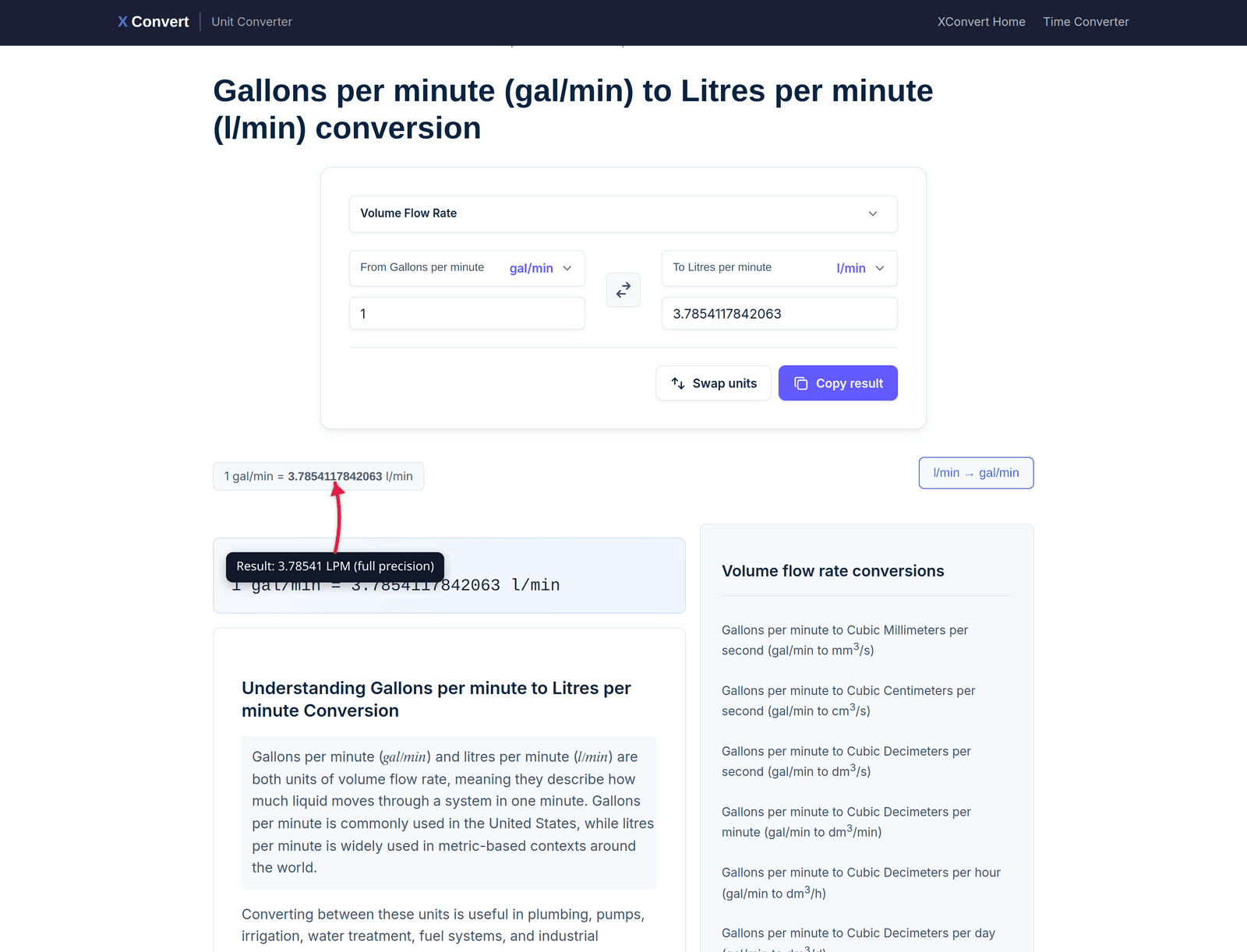
xconvert’s GPM-to-LPM converter uses the US gallon by default, accurate to 13 decimal places.
Worked example: sizing a pool pump
Suppose you’re shopping for a pool pump and the US-built model lists 40 GPM at the rated head. You want to compare it to a European model rated at 150 LPM. Which is bigger?
Step 1 — Convert the US flow to LPM:
40 GPM × 3.78541 = 151.4 LPMStep 2 — Compare:
US model:   151.4 LPM
EU model:   150.0 LPM
The pumps are within 1% of each other. For most residential pool applications, that’s effectively the same. If the difference came out to 10% or more, you’d revisit pump curves and run a more careful analysis at your operating head, not just at the rated point.
Quick reference table
Common GPM values converted to LPM (US gallons, four decimal places). For the full table from 0 to 1,000,000 GPM, see the table on the converter page.
| GPM | LPM | Typical use |
|---|---|---|
| 0.5 | 1.89 | Drip irrigation emitter (single zone) |
| 1.5 | 5.68 | Low-flow showerhead (US federal max 2.5 GPM) |
| 2.5 | 9.46 | Standard residential showerhead |
| 5 | 18.93 | Garden hose at typical pressure |
| 10 | 37.85 | Small utility pump |
| 15 | 56.78 | Submersible well pump (low end) |
| 25 | 94.64 | Pool circulation pump (small inground) |
| 40 | 151.42 | Pool pump (medium inground) |
| 60 | 227.12 | Whole-house water service line at peak |
| 100 | 378.54 | Light commercial booster pump |
| 250 | 946.35 | Industrial process pump |
| 500 | 1,892.71 | Mid-size irrigation main |
| 1,000 | 3,785.41 | Large agricultural irrigation, fire pump |
Common pump and plumbing flow rates
A few benchmark numbers you’ll meet repeatedly when reading specs:
- US shower head federal maximum: 2.5 GPM = 9.46 LPM (since 1992 EPAct)
- WaterSense low-flow showerhead: 2.0 GPM = 7.57 LPM
- WaterSense bathroom (lavatory) faucet: 1.5 GPM = 5.68 LPM (federal max for kitchen faucets is 2.2 GPM; no WaterSense kitchen-faucet spec)
- Standard garden hose at 40 psi: ~5 GPM = ~19 LPM
- Typical residential well pump: 8–25 GPM = 30–95 LPM
- Pool pump (residential inground): 30–80 GPM = 113–303 LPM
- Fire sprinkler head (residential): 10 GPM minimum = 38 LPM
- NFPA 13 light-hazard sprinkler design density: 0.10 GPM/ft² = 4.07 LPM/m² over 1500 ft² (NFPA 13D residential is the lower 0.05 GPM/ft²)
When a manufacturer publishes one number, that’s usually the rated flow at the design head. Real flow varies with system head, age of the pump, and water temperature.
Frequently Asked Questions
Why is GPM × 3.78541 and not exactly 3.79?
3.78541 is the precise definition of the US liquid gallon: exactly 231 cubic inches, which works out to 3.785411784 litres. Rounding to 3.79 introduces a 0.01% error — negligible at small flows, but at 10,000 GPM that’s a 12.5 LPM discrepancy. xconvert’s converter uses 13 decimal places to keep the error below detection.
Is “gpm” always the US gallon?
In US specifications, yes. In UK or older Commonwealth specifications, “gpm” can mean Imperial gallons per minute, and the conversion factor is 4.54609 instead of 3.78541. When in doubt, look at the country of origin of the spec sheet. If a UK manufacturer publishes flow in “gallons,” default to Imperial.
How do I convert LPM back to GPM?
Divide by 3.78541, or equivalently multiply by 0.264172. So 100 LPM ÷ 3.78541 ≈ 26.4 GPM. xconvert offers the LPM-to-GPM reverse converter directly.
What about gallons per second or hour?
Same factors, just multiplied or divided by 60. For instance, 5 gallons per second = 5 × 60 = 300 GPM = 1135.6 LPM. xconvert has dedicated converters for GPS, GPH, and other time bases.
Do I need to worry about water temperature?
For everyday plumbing and pump sizing — no. Water density changes by less than 4% from 0 °C to 100 °C, and flow rate is volume-based, not mass-based. The US gallon is defined as a fixed volume regardless of temperature. If you’re working with cryogenic fluids or measuring mass flow, that’s a different problem entirely.
How accurate does the conversion need to be for plumbing?
For residential and most commercial plumbing, three significant figures is plenty. A 30 GPM pump rounded to 113.6 LPM (instead of 113.5623) is well within the noise of pump-curve uncertainty and aging. For laboratory or process-engineering work, use the full 3.78541 factor.
Try it now
Convert any GPM value to LPM (or back) with the xconvert GPM-to-LPM converter — full precision, no sign-up. For the reverse, use LPM to GPM. Need other flow-rate units? See Volume Flow Rate for the full catalog (m³/h, L/s, ft³/min, and more).
Related guides
- Flow Rate Conversion: GPM, LPM, m3/h, CFM Explained
- L/s to GPM Calculator: Convert Industrial Flow Rates
- Pump Sizing: Convert Flow Rates Between Imperial and Metric
Sources
Last verified 2026-05-19.
- NIST Special Publication 811 — Unit Conversions
- BIPM — The International System of Units (SI Brochure)
- Hydraulic Institute — Pump industry standards