 By James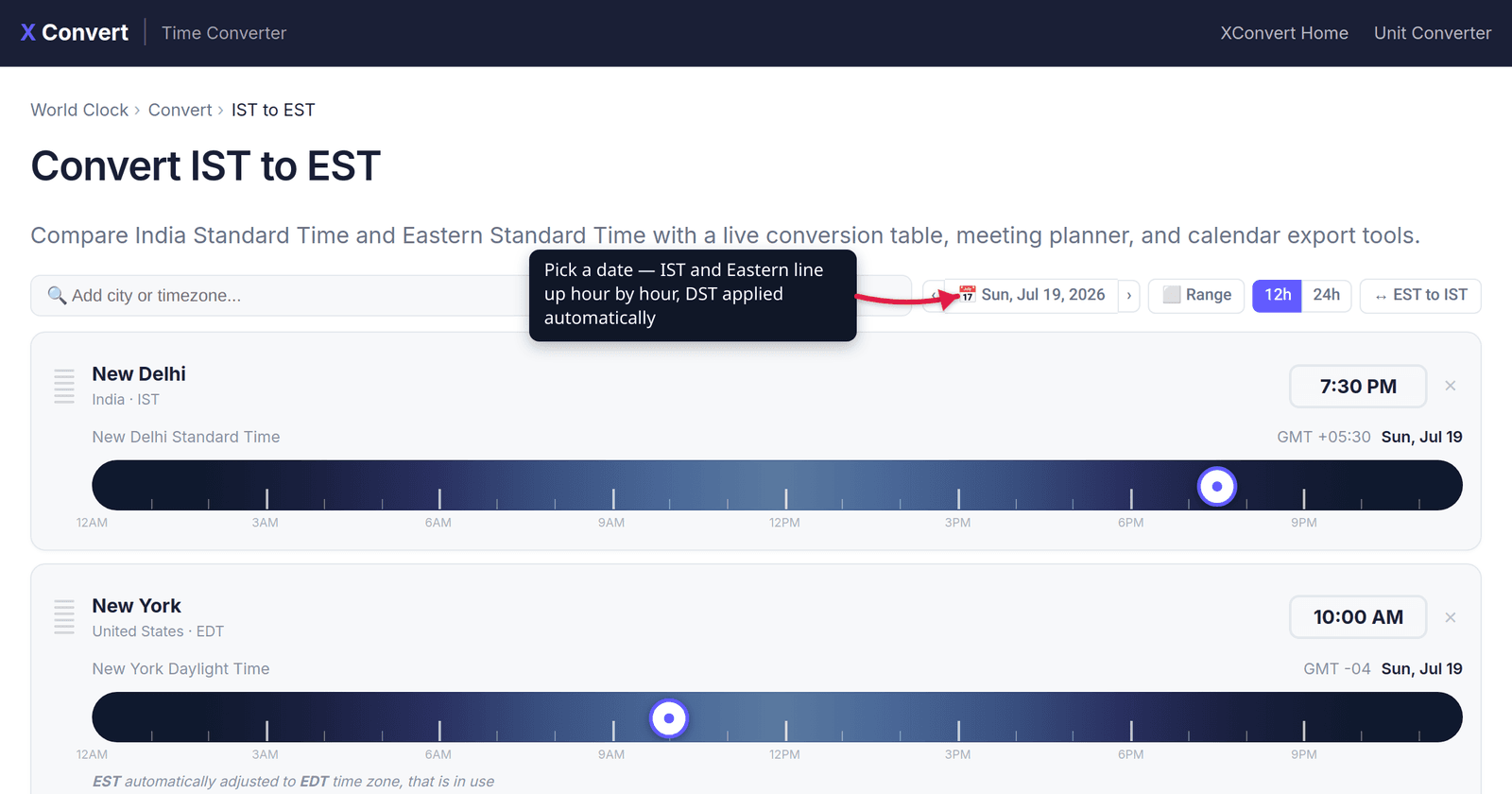
It’s 9:00 a.m. on a Monday in New York, and your teammate in Bengaluru is already finishing dinner. Coordinating between India and the US East Coast is one of the most common — and most fumbled — scheduling problems in remote work, because the gap isn’t a tidy round number and it changes twice a year even though India’s clocks never move. This guide gives you the exact difference in both seasons, a conversion table you can sanity-check invites against, and the meeting windows that actually work for both sides. Every offset and date below is verified against NIST’s daylight-saving rules and the IANA timezone data.
Quick answer: India Standard Time (IST) is UTC+5:30 all year — India has no daylight saving. New York uses EST (UTC−5) in winter and EDT (UTC−4) in summer, so India is 10 hours 30 minutes ahead of New York in winter and 9 hours 30 minutes ahead in summer (in 2026, “summer” = March 8 to November 1). The best recurring meeting window is 8:00–11:00 a.m. Eastern, which lands at 5:30–9:30 p.m. in India.
Jump to a section
- What IST and EST actually are
- The time difference, season by season
- Quick conversion table
- Best meeting times for India–US East teams
- Convert IST to EST on xconvert
- FAQ
What IST and EST actually are
IST — India Standard Time — is UTC+5:30, year-round. All of India runs on a single time zone (in force since 1906, based on the 82.5°E meridian), and India does not observe daylight saving time, so the offset never changes. The half-hour offset surprises people, but it’s simply where India’s central meridian falls; the IANA timezone database records it as Asia/Kolkata.
EST — Eastern Standard Time — is UTC−5. It’s the winter half of US Eastern Time, used by New York, Toronto, Boston, Atlanta, Miami and the rest of the Eastern zone from early November to early March. In summer those places switch to EDT (Eastern Daylight Time, UTC−4). Under the rules set by the Energy Policy Act of 2005 (verified via NIST), US daylight saving runs from the second Sunday in March to the first Sunday in November — in 2026, March 8 to November 1.
One trap worth naming: in everyday usage people write “EST” all year, even in July when New York is actually on EDT. If an American colleague says “3 p.m. EST” in summer, they almost always mean 3 p.m. New York time (EDT). The abbreviation IST is ambiguous too — it also stands for Irish Standard Time (UTC+1, Ireland’s summer time) and Israel Standard Time (UTC+2). In this article IST means India.
The time difference, season by season
Because India’s offset is fixed and New York’s changes, the gap has two values:
| Season | New York is on | Difference (India ahead) |
|---|---|---|
| Early Nov → early Mar (winter) | EST (UTC−5) | 10 hours 30 minutes |
| Early Mar → early Nov (summer) | EDT (UTC−4) | 9 hours 30 minutes |
In 2026 the switchover dates are March 8 (US clocks spring forward, gap shrinks to 9:30) and November 1 (US clocks fall back, gap widens to 10:30). India’s clocks do nothing on those dates — the change is entirely on the US side, which is why a recurring 9:00 a.m. New York meeting silently moves an hour for everyone in India twice a year.
Quick conversion table
Both directions, both seasons — noon here is not noon there:
| New York | India (summer, EDT) | India (winter, EST) |
|---|---|---|
| 7:00 AM | 4:30 PM | 5:30 PM |
| 9:00 AM | 6:30 PM | 7:30 PM |
| 12:00 PM | 9:30 PM | 10:30 PM |
| 3:00 PM | 12:30 AM (next day) | 1:30 AM (next day) |
| 6:00 PM | 3:30 AM (next day) | 4:30 AM (next day) |
And from the India side:
| India | New York (summer, EDT) | New York (winter, EST) |
|---|---|---|
| 9:00 AM | 11:30 PM (previous day) | 10:30 PM (previous day) |
| 12:00 PM | 2:30 AM | 1:30 AM |
| 3:00 PM | 5:30 AM | 4:30 AM |
| 6:00 PM | 8:30 AM | 7:30 AM |
| 9:00 PM | 11:30 AM | 10:30 AM |
Note the date line in the schedule sense: an Indian morning is still the previous evening in New York. That’s why “Tuesday 10 a.m. IST” is Monday night for a US East Coast attendee — always state the day alongside the time.
Best meeting times for India–US East teams
There is exactly one comfortable overlap, and it’s US morning / India evening:
- 8:00–11:00 a.m. Eastern = 5:30–9:30 p.m. IST (summer) or 6:30–9:30 p.m. IST (winter). This is the standard India–US East standup window: inside US business hours, end-of-day but reasonable in India.
- The earlier you go in the ET morning, the kinder it is to India: 8:00 a.m. ET is 5:30/6:30 p.m. IST, while 11:00 a.m. ET already pushes India to 8:30/9:30 p.m.
- The reverse overlap — India morning — lands at 10:30 p.m.–1:30 a.m. in New York and is only for genuine emergencies.
- A second, less common option is US evening / India early morning: 8:30–10:00 p.m. ET is roughly 6:00–7:30 a.m. IST the next day. Some India-based teams prefer one early call over a late one — ask, don’t assume.
Two scheduling rules that prevent most mistakes: pin recurring meetings to one named city (e.g. “9:30 a.m. New York time”), not to an abbreviation; and re-check any India↔US series in the weeks after March 8 and November 1, because that’s when every recurring invite shifts by an hour on the Indian side.
Convert IST to EST on xconvert
The xconvert IST to EST converter lays both zones out as horizontal hour rows for the same date, so you can see the overlap instead of doing +9:30 arithmetic in your head:
- Open xconvert.com/time-converter/ist-to-est-converter — New Delhi (IST) and New York (Eastern) are pre-loaded on a 24-hour comparison grid.
- Pick your meeting date with the ‹ › arrows or the 📅 date button. The grid applies US daylight saving automatically — when EDT is in force the page tells you so (“EST automatically adjusted to EDT”).
- Toggle 12h / 24h display to match how your team writes times.
- Click + Add City to bring a third location (say, London or Bengaluru’s client site) onto the same grid.
- Found a slot? Use 📅 Add to Cal to download an ICS file, or 🗓 Google Cal to send it straight to Google Calendar, or 🔗 Share Link so the other side sees the identical comparison.
For the opposite direction — starting from a US Eastern time and reading off India — use the EST to IST converter, and for a reference card on the Eastern zone itself see the EST time zone page. DST rules and historical changes are tracked from the IANA timezone database, so past and future dates stay correct.
FAQ
How far ahead is India of New York right now?
In July, 9 hours 30 minutes — New York is on EDT (UTC−4) and India is on IST (UTC+5:30). From November 1, 2026 the gap returns to 10 hours 30 minutes until March of the following year.
Why is India’s time zone offset by half an hour?
India uses a single national time zone based on the 82.5°E meridian, which sits halfway between the UTC+5 and UTC+6 zone meridians — so the country standardized on UTC+5:30 rather than splitting into two zones. It has worked that way since 1906.
Does India observe daylight saving time?
No. IST is UTC+5:30 every day of the year. All seasonal variation in the IST–Eastern gap comes from the US side switching between EST and EDT.
What time is 9:00 a.m. EST in India?
9:00 a.m. EST (winter) is 7:30 p.m. IST the same day. If it’s summer and the speaker really means 9:00 a.m. EDT, it’s 6:30 p.m. IST.
Is the difference always 10.5 hours?
No — only in winter. From the second Sunday in March to the first Sunday in November (March 8 – November 1 in 2026), New York is on EDT and the gap is 9.5 hours.
Does IST mean India, Ireland, or Israel?
All three exist: India Standard Time (UTC+5:30), Irish Standard Time (UTC+1, summer only) and Israel Standard Time (UTC+2). Context usually disambiguates, but for anything that matters, write the city or the UTC offset.
Sources
Last verified 2026-07-19.
- NIST — Daylight Saving Time rules — US DST runs second Sunday in March → first Sunday in November (2:00 a.m. local); Energy Policy Act of 2005; 2026 dates March 8 / November 1.
- timeanddate — India Standard Time (IST) — IST is UTC+5:30 with no daylight saving.
- Wikipedia — Time in India — single national zone since 1906, 82.5°E central meridian, IANA
Asia/Kolkata(aggregator; cross-checked with timeanddate).