 By James
 A 2026 Tesla Model Y Performance is listed as 460 HP on the US configurator and 343 kW on the EU spec sheet — identical car, identical motor, different number. A BMW M340i sold as a “382 HP sedan” in America is a “285 kW / 387 PS” sedan in Germany. Three numbers for the same engine. This isn’t ambiguity — it’s three different conventions all describing the same physical quantity, with the difference between them mattering most when you’re cross-shopping cars or comparing an EV motor spec to an industrial pump.
Quick answer: 1 kW = 1.341 mechanical HP = 1.360 metric HP (PS). EVs lead with kW, ICE cars lead with HP (US/UK) or PS (Germany/France). The three “horsepower” definitions differ by ~1.4%, which is enough to make a 400-kW car look like 537 HP, 544 PS, or 536 electrical HP depending on which standard the spec sheet uses.
Jump to a section
- The exact conversion (and which HP)
- Three kinds of horsepower
- EV vs ICE: which unit dominates and why
- SAE J1349 vs DIN 70020 vs ECE-R85: the 3–5% test-standard gap
- Peak vs continuous: where boost numbers come from
- Side-by-side: same car in kW, HP, PS
- 2026 EV motor ratings table
- Common ICE motor ratings table
- Industrial applications: where HP persists outside cars
- Use the xconvert kW to HP tool
- FAQ
The exact conversion (and which HP)
kW × 1.34102 = HP (mechanical, "imperial", US/UK)
kW × 1.35962 = PS (metric horsepower, German DIN, French CV)
kW × 1.34048 = HP (electrical, used in some US EV contexts)
HP (mech) × 0.7457 = kW
PS         × 0.7355 = kW
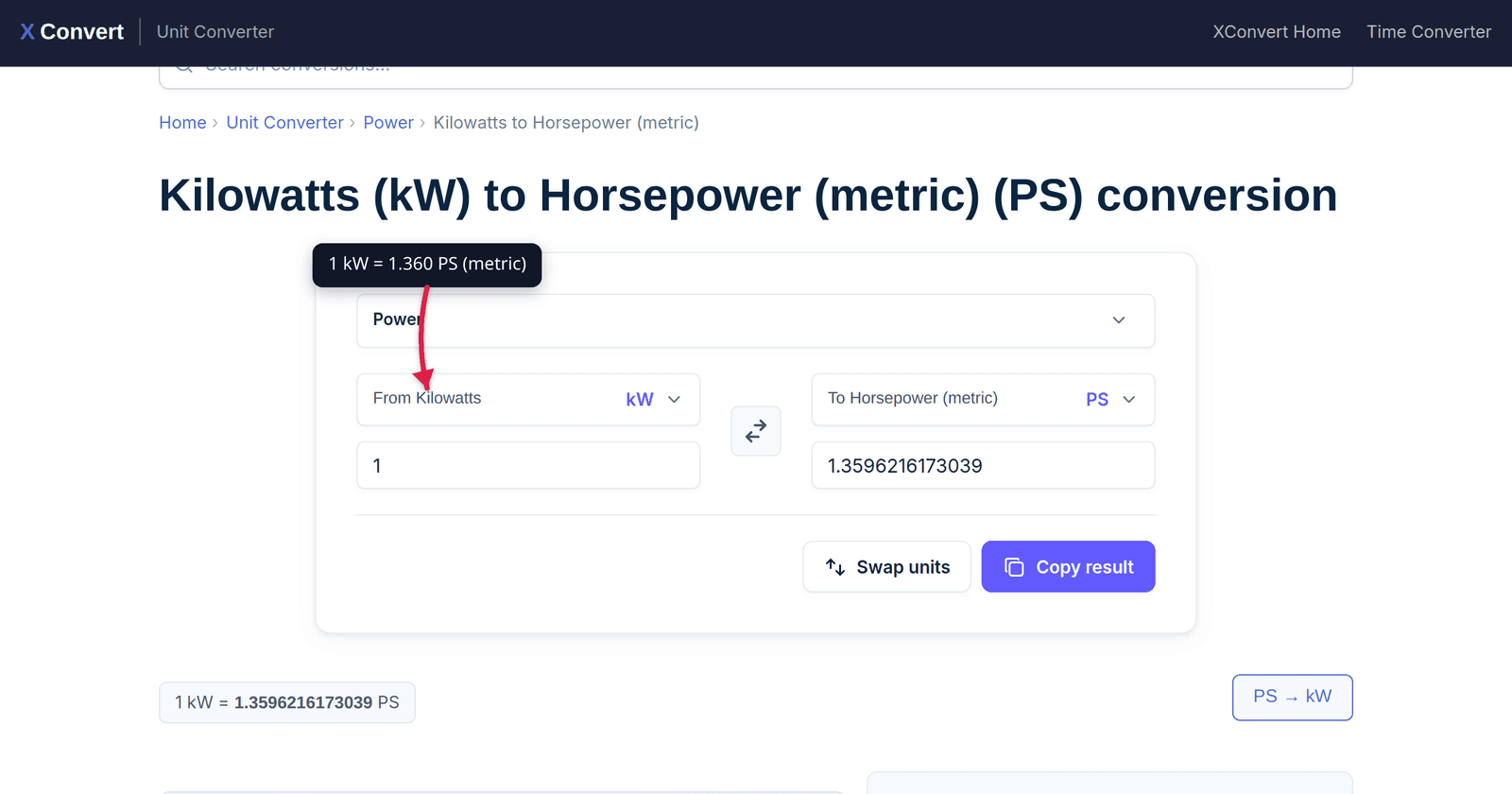
The xconvert kW to HP (British/mechanical) and kW to HP (Metric / PS) tools compute these to full precision (the metric-HP converter shows the constant 1.3596216173039).
The difference between mechanical HP and metric PS is 1.4% — invisible for casual comparison but large enough to confuse a car-shopping spreadsheet. The difference between mechanical and electrical HP is 0.04% — invisible for any practical purpose.
Three kinds of horsepower
There are three “horsepowers” in active use in 2026:
| Type | Watts per HP | Convention | Where used |
|---|---|---|---|
| Mechanical horsepower (HP, BHP, SAE HP) | 745.69987 | 33,000 ft-lb/min (James Watt, 1782) | US/UK car ads, lawnmowers, pumps, “BHP” |
| Metric horsepower (PS, CV, ch, DIN HP) | 735.49875 | 75 kgf-m/s (Continental Europe) | German PS, French CV, Italian CV — older catalogs and bike specs |
| Electrical horsepower (eHP, hpE) | 746 (exact) | NEMA convention for electric motors | US industrial electric motors; rarely in EV marketing |
So the same 100-kW motor is:
- 134.10 mechanical HP (US convention)
- 135.96 metric HP / PS (German / French)
- 134.05 electrical HP (NEMA)
If a spec sheet says “200 HP” without qualifying which kind, assume mechanical in any US/UK market context, assume metric PS in any continental EU/Japan context for ICE cars, and check the test standard footnote for anything important. EV ratings overwhelmingly use kW as primary and mechanical HP as conversion; PS is rarely shown on US-market EV pages even when the same model lists PS in Europe.
EV vs ICE: which unit dominates and why
The mid-2020s shift to electric drivetrains has changed the default. Three patterns:
1. EVs lead with kW. Tesla, Porsche Taycan, BMW i-series, Hyundai Ioniq, Lucid Air — internal engineering and EU spec sheets are kW. US marketing translates to mechanical HP for buyer-familiarity reasons, but the underlying engineering language is kW. The reason is internal consistency: battery capacity is kWh, charging speed is kW, motor power is kW — everything in one unit.
2. ICE cars lead with HP (or PS). A Mustang spec sheet is HP. An Aston Martin is HP. A BMW M340i in Germany is PS; in the US it’s HP. The combustion-engine industry is conservative about marketing units because the entire customer base has decades of HP intuition. A “300 HP gas car” lands easily; “224 kW” doesn’t.
3. The cross-shopper sees both. A buyer comparing a Tesla Model 3 Performance (510 HP / 380 kW) to a BMW M3 Competition (503 HP / 375 kW) needs both numbers to feel apples-to-apples. Manufacturer cross-region spec sheets publish both; review sites usually do too.
The exception worth noting: commercial fleets and industrial buyers specify in kW even for ICE engines, because diesel-genset and industrial-pump procurement has always used kW. Only consumer-facing marketing fights to keep HP visible.
SAE J1349 vs DIN 70020 vs ECE-R85: the 3–5% test-standard gap
Three power-measurement standards govern engine and motor ratings:
| Standard | Region | Test conditions | Typical effect |
|---|---|---|---|
| SAE J1349 | North America | 99 kPa, 25 °C dry air, all accessories engaged | Conservative baseline |
| DIN 70020 | Germany (older) | 101.3 kPa, 20 °C, accessory status unspecified | Reads ~3–5% higher than SAE for same engine |
| ECE-R85 | EU homologation | 101.3 kPa, 25 °C, similar accessory rules to SAE | Close to SAE but uses metric units |
| JIS D 1001 | Japan | Local Japanese protocol; varies | Generally within ~2% of SAE |
The takeaway: a “300 HP” engine on a German DIN catalog isn’t quite the same as a “300 HP” engine on a US SAE spec sheet. Convert across both unit and test-standard differences when cross-shopping cars from different markets — that 3–5% gap on top of the 1.4% HP-vs-PS gap can add up to 5–7% difference between a US and German figure for the same engine.
Modern publications usually note the standard (“300 HP @ 6,500 rpm per SAE J1349”) in the fine print. If a spec sheet doesn’t, the country of measurement is the best guess: US figures default to J1349, European to ECE-R85 or DIN.
Peak vs continuous: where boost numbers come from
EV motors and modern turbo ICEs both have a peak rating (short-burst) and a continuous / sustained rating (long-duration). Marketing usually quotes the peak; engineering and homologation use the continuous.
The headline gap is enormous on performance EVs:
- Porsche Taycan Turbo S — peak 700 kW (~938 HP) in overboost launch mode, sustained ~460 kW (~617 HP).
- Porsche Taycan Turbo GT Weissach — peak 1,034 HP in overboost; sustained ~580 HP.
- Hyundai Ioniq 5 N — 641 HP in NGB boost; 601 HP sustained.
- Tesla Model S Plaid — 1,020 HP claimed peak; sustained well below.
Why such large gaps on EVs: electric motors can produce 20–40% above their continuous rating for 10–30 seconds before thermal limits force a derate. ICE turbos have similar transient overboost behaviour but the multiplier is smaller (5–15%).
For real-world driving feel, the continuous rating is what matters. For 0–60 time, peak matters because most launches happen in under 4 seconds. Both numbers are honest; reading just one paints an incomplete picture.
Side-by-side: same car in kW, HP, PS
Same motor, three numbers:
| Make / Model | kW (EU spec) | HP (US spec) | PS (DIN) | Notes |
|---|---|---|---|---|
| BMW M340i (2024) | 285 | 382 | 387 | xDrive sedan |
| BMW M5 (G99, hybrid) | 535 | 717 | 727 | Combined system output |
| Mercedes E 350 | 220 | 295 | 299 | Sedan |
| Porsche 911 Carrera S | 353 | 473 | 480 | Coupe |
| Audi RS6 Avant | 463 | 621 | 630 | Wagon |
| VW Golf GTI | 195 | 261 | 265 | 2024 EU spec |
| Tesla Model Y Performance (2026) | 343 | 460 | 466 | Three-motor, US spec dominant |
| Lucid Air Sapphire | 908 | 1,217 | 1,234 | Continuous, three motors |
The PS column is consistently 1.4% higher than the mechanical-HP column. The kW column converts to either using the factors at the top of this article.
2026 EV motor ratings table
Common 2026 EV models and their published power. Sustained / continuous unless noted otherwise:
| Model | kW | HP (mech) | Battery | Notes |
|---|---|---|---|---|
| Tesla Model 3 RWD (LFP) | 208 | 279 | 60 kWh | Single rear motor |
| Tesla Model 3 Performance | 380 | 510 | 79 kWh | Highland refresh |
| Tesla Model Y RWD | 220 | 295 | 60 kWh | 2026 spec |
| Tesla Model Y Long Range AWD | 280 | 375 | 75 kWh | 2026 spec |
| Tesla Model Y Performance | 343 | 460 | 79 kWh | 2026 spec |
| Tesla Model S Plaid | 760 | 1,020 | 100 kWh | Peak figure |
| BMW i4 M60 xDrive | 442 | 601 | 84 kWh | All-wheel drive |
| BMW i7 M70 | 485 | 650 | 105.7 kWh | Flagship sedan |
| Mercedes EQS 580 4MATIC | 430 | 585 | 108 kWh | 2024+ |
| Audi e-tron GT RS | 475 | 637 | 84 kWh | Performance variant |
| Porsche Taycan GTS (2025) | 522 | 700 | 105 kWh | Continuous rating |
| Porsche Taycan Turbo GT Weissach | 770 | 1,034 | 105 kWh | Overboost peak |
| Lucid Air Sapphire | 908 | 1,217 | 118 kWh | Three motors, continuous |
| Rivian R1T (Quad) | 625 | 835 | 135 kWh | Quad-motor pickup |
| Hyundai Ioniq 5 N | 448 | 601 | 84 kWh | Sustained; 478 kW / 641 HP boost |
| Kia EV6 GT | 430 | 576 | 77.4 kWh | |
| VW ID.4 Pro | 150 | 201 | 82 kWh | Single rear motor |
| Ford Mustang Mach-E GT | 358 | 480 | 91 kWh | Performance edition |
For an EV-focused deep dive on the kW / HP relationship and why charging speed lives in the same unit as motor power, see HP to kW for Electric Vehicles.
Common ICE motor ratings table
For cross-reference with the EV table — common ICE cars in 2026 model year:
| Model | kW | HP (SAE) | PS (DIN) | Notes |
|---|---|---|---|---|
| Toyota Camry XLE | 167 | 225 | 227 | 2.5L hybrid |
| Honda Civic Si | 149 | 200 | 203 | 1.5L turbo |
| Ford F-150 (3.5L EcoBoost) | 298 | 400 | 405 | High-output spec |
| Chevy Corvette Stingray | 369 | 495 | 502 | 6.2L V8 |
| Porsche 911 Turbo S | 478 | 640 | 650 | 3.8L flat-six |
| Lamborghini Huracán Tecnica | 471 | 631 | 640 | 5.2L V10 |
| Ferrari 296 GTB | 610 | 818 | 829 | V6 + hybrid system |
| Bugatti Chiron Super Sport | 1,177 | 1,578 | 1,600 | 8.0L quad-turbo W16 |
The high-end pattern: hypercars now match top performance EVs on raw HP, but EV launch torque differs (instant from 0 RPM vs ICE peak in the 5,000+ rpm band). For European cars and the kW–PS–HP conversion specifically, see KW to HP: Reading European Car Specs.
Industrial applications: where HP persists outside cars
In US industrial procurement, HP remains dominant for:
- Pumps and compressors — water-treatment pumps, HVAC blower motors, air compressors all spec in HP. EU equivalents spec in kW.
- Construction equipment — excavators, loaders, cranes, agricultural tractors. John Deere, Caterpillar, and Komatsu publish HP first for US markets; kW first for European.
- Marine engines — outboard and inboard marine engines (Yamaha, Mercury, Honda Marine) spec in HP universally, even on international markets, because the recreational boating industry standardised on HP early.
- Generators — diesel and natural-gas gensets spec in kW for prime/standby ratings (engineering convention) but advertise HP for the engine itself.
Inside the same plant or fleet, mixing units happens constantly: a “100 HP pump motor” runs on a “75 kW VFD.” Most operators just internalise “100 HP ≈ 75 kW” and move on. For precise sizing — pumps especially — use the exact factor.
Use the xconvert kW to HP tool
Three precise converters cover the common cases:
- KW to HP (British / mechanical, 745.7 W per HP) — US/UK car specs, Tesla / Ford / GM EV ratings, industrial pumps.
- KW to HP (Metric / PS / DIN, 735.5 W per HP) — German DIN PS, French CV, Italian CV, older European spec sheets.
- HP (British) to KW — reverse direction for cross-shopping a US car against EU competitors.
For a deeper EV-focused explainer on why charging speed and motor power share the same unit (and why a 600-kW Porsche peak isn’t the same as a 600-kW continuous motor), see HP to kW for Electric Vehicles. For reading European car catalogs in particular, see KW to HP: Reading European Car Specs.
Related explainer articles on the xconvert blog:
- MPa vs Bar vs PSI: Pressure Units Explained — same kind of multi-region unit puzzle for pressure.
- MPH to KM/H for Driving in Europe — speed-unit equivalent of the kW/HP divide.
- kJ vs kcal: Reading Food Labels Without a Calculator — energy-unit explainer with the same US-vs-Europe history.
FAQ
Why does my EV feel faster than its HP suggests?
EV motors deliver peak torque from 0 RPM. A 200 HP gas engine reaches peak torque at 3,000–5,000 RPM — meaning low-speed acceleration is constrained by gear ratios and torque curves. A 200 HP electric motor delivers full torque instantly, so 0–60 mph times are dramatically faster than HP-equivalent gas cars. A 280 HP EV often feels quicker than a 350 HP gas sedan in everyday driving.
What’s the difference between BHP, SAE HP, DIN HP, and PS?
- BHP (Brake Horsepower): Measured at the crankshaft, before transmission losses. Older British convention; not used for production-car ratings today.
- SAE HP (J1349 net): US standard for production vehicles. Measured at the wheels (or estimated) with all accessories engaged, per the SAE J1349 protocol.
- DIN HP / PS: German standard. Metric horsepower (735.5 W) measured under DIN 70020 conditions (slightly cooler air, higher pressure than SAE).
- ECE-R85: EU type-approval standard. Similar methodology to SAE J1349 but reports kW as primary; HP-equivalent uses metric PS.
For modern US shopping, SAE HP is enough. For German imports, expect PS (1.4% higher than US HP for the same engine).
Is “kilowatt” the same as “kilowatt-hour”?
No. Kilowatts (kW) measure power — the rate of doing work. Kilowatt-hours (kWh) measure energy — the amount of work done over time. A 100-kW motor running for 1 hour consumes 100 kWh of energy from the battery. The same 100-kW motor running for 30 minutes consumes 50 kWh. EV battery capacity is in kWh; motor power is in kW. They’re related but different.
What about “torque” — is that the same as power?
No. Power (kW or HP) is the rate of doing work. Torque (Nm or lb-ft) is rotational force. They’re related by RPM: Power (kW) = Torque (Nm) × RPM ÷ 9,549. EV motors produce high torque at zero RPM (instant launch). Diesel engines produce high torque at low RPM (good for towing). Both characteristics affect performance separately from peak HP.
Do “PS” and “ch” mean the same thing?
Yes — both are metric horsepower. PS is German (Pferdestärke), ch is French (cheval-vapeur), CV is Italian (cavalli vapore). All three equal 735.5 watts. A French car spec listing “200 ch” and a German listing “200 PS” describe identical power.
Why do some Tesla / Lucid / Rivian specs use HP, not kW, in the US?
Marketing translation for buyer familiarity. Internal engineering at Tesla / Lucid / Rivian uses kW. The US configurator publishes HP because American buyers expect HP for cross-shopping with ICE alternatives. The same car on Tesla’s German configurator publishes kW first.
What’s the SAE definition I should use for sizing an electric motor for an industrial pump?
For pump-motor matching, use kW for the pump’s hydraulic requirement (the universally engineered unit) and kW for the motor’s continuous rating to match. HP is a marketing/legacy number on US pump nameplates; the SI engineering unit is kW. Convert if your supplier publishes only HP — see the pump sizing guide for the full procedure.
Sources
Last verified 2026-05-25.
- SAE International — J1349 Engine Power Test Code — US automotive power-rating standard.
- NIST Special Publication 811 — Conversion Factors — primary US reference for unit conversion.
- EUR-Lex — Regulation (EC) 715/2007 on motor vehicle type approval — EU vehicle homologation framework that references ECE-R85 for power measurement.
- BIPM — The International System of Units (SI Brochure) — definition of the watt.
- DIN Deutsches Institut für Normung — issuer of the DIN 70020 standard.
- EV Database — comprehensive EV specifications aggregator — cross-reference for kW / HP / battery numbers across manufacturers.
- Porsche — Taycan model specifications — vendor primary source for Taycan power figures.