 By James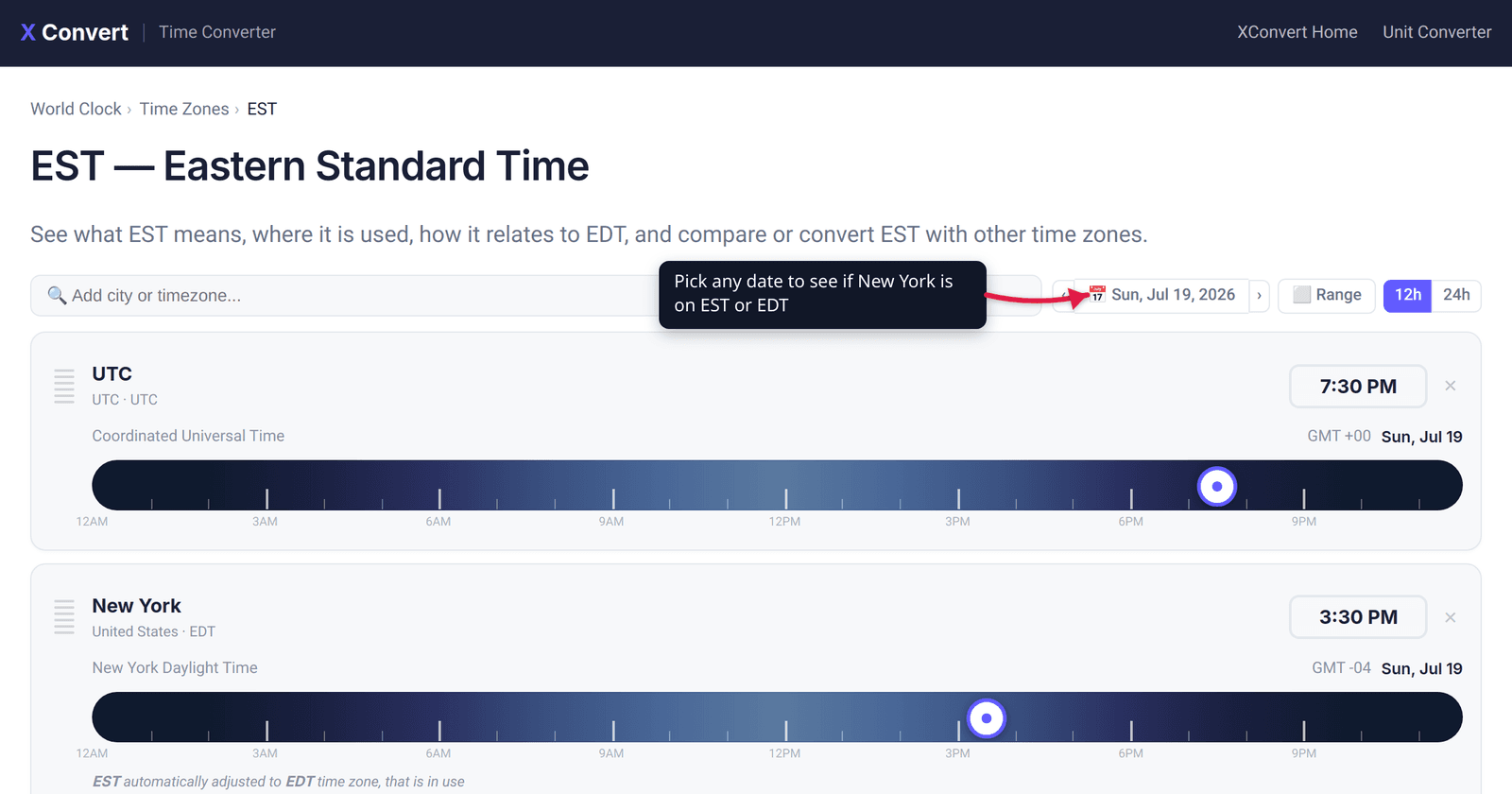
You schedule a call for “4 p.m. EST” in July, your counterpart’s calendar says 4 p.m. New York time, and somehow you still end up an hour apart. The culprit is a three-letter subtlety: EST and EDT are two different clocks, and New York only ever uses one of them at a time. This guide explains which one is in force right now, the exact 2026 switch dates, why the “wrong” abbreviation usually still works, and which places really do stay on EST all year. Dates and offsets are verified against NIST and the IANA timezone data.
Quick answer: Right now — July 2026 — New York is on EDT, Eastern Daylight Time (UTC−4). EST, Eastern Standard Time (UTC−5), is the winter clock. In 2026, New York runs EDT from March 8 to November 1 and EST the rest of the year. If you mean “New York time, whatever the season,” the safe term is Eastern Time (ET) — or pin the invite to the city and let the calendar convert.
Jump to a section
- EST and EDT: two halves of Eastern Time
- Which one is New York on right now?
- Why saying “EST” in July usually still works
- Places that really are on EST all year
- Check Eastern Time on xconvert
- FAQ
EST and EDT: two halves of Eastern Time
Eastern Standard Time (EST) is UTC−5. Eastern Daylight Time (EDT) is UTC−4 — the same region with its clocks pushed one hour ahead for daylight saving. Together they make up what American English simply calls Eastern Time (ET): New York, Toronto, Boston, Washington DC, Atlanta, Miami.
The schedule comes from the Energy Policy Act of 2005 (verified via NIST): daylight time begins the second Sunday in March at 2:00 a.m. (clocks jump to 3:00) and ends the first Sunday in November at 2:00 a.m. (clocks fall back to 1:00). That means the daylight clock, EDT, is actually in force for nearly eight months of the year — EST, despite being the “default” in everyone’s vocabulary, runs only from early November to early March.
Which one is New York on right now?
For 2026:
| Period (2026) | New York is on | UTC offset |
|---|---|---|
| January 1 – March 8, 2:00 a.m. | EST | UTC−5 |
| March 8 – November 1 | EDT | UTC−4 |
| November 1, 2:00 a.m. – December 31 | EST | UTC−5 |
So in July 2026: EDT, UTC−4. A quick self-check that never fails: daylight saving = summer = one hour ahead = EDT; standard = winter = EST. If it’s between early March and early November, Eastern locations are on the D.
The same pattern repeats every year (second Sunday of March, first Sunday of November), so 2027’s dates are March 14 and November 7 — derivable from the rule, no lookup needed.
Why saying “EST” in July usually still works
Most people write “EST” year-round, and most of the time nothing breaks. Two reasons:
- Humans read it as “Eastern Time.” When a New Yorker says “3 p.m. EST” in July, everyone on the call understands “3 p.m. in New York,” which is technically 3 p.m. EDT. The abbreviation is wrong; the intended moment is clear.
- Software ignores abbreviations entirely. Calendars and operating systems use IANA zone IDs like
America/New_York, which encode the full DST schedule. An invite pinned to New York converts correctly for every attendee, whatever label the organizer typed. xconvert’s own EST page does the same thing — in summer it displays “EST automatically adjusted to EDT,” because that’s the zone actually in use.
Where it does break: instructions that a human converts manually. “The webinar is at 14:00 EST” published in June is genuinely ambiguous — a UK reader doing arithmetic may add 5 hours instead of 4 and join an hour late. The rule of thumb: write ET (or the city) for humans, use the IANA zone for machines, and reserve “EST”/“EDT” for when you specifically mean the winter or summer clock. The same trap exists in Britain, where “GMT” quoted in summer usually means BST.
Places that really are on EST all year
A handful of places use UTC−5 with no daylight saving, so “EST” is accurate there in every season:
- Jamaica — UTC−5 year-round, no clock changes.
- Cayman Islands — UTC−5 year-round.
- Panama — UTC−5 year-round.
(Within the US, the year-round holdouts are in other zones: most of Arizona — except the Navajo Nation — and Hawaii skip daylight saving, per US DST rules.) Cuba, by contrast, is UTC−5 in winter but does observe daylight saving — its clock effectively tracks New York’s; the full story is in CST can mean three time zones.
The practical takeaway: a 9 a.m. call between Kingston and New York moves by an hour twice a year even though neither party “did” anything — Jamaica stands still while New York shifts around it.
Check Eastern Time on xconvert
The xconvert EST time zone page answers the “which clock is New York on?” question visually, for any date:
- Open xconvert.com/time-converter/est-time-zone — Eastern Time loads as a row on a 24-hour comparison grid alongside UTC, and the header shows the offset actually in force (e.g. “New York · EDT, GMT−4” in summer).
- Pick any date with the ‹ › arrows or the 📅 date button — set it to March 8 or November 1, 2026 to see the switch happen; the page notes “EST automatically adjusted to EDT” whenever daylight time applies.
- Toggle 12h / 24h display.
- Click + Add City to add London, Kingston, or Delhi and read your meeting time straight off the grid — mismatched DST calendars are handled for you.
- Export the chosen slot with 📅 Add to Cal (ICS) or 🗓 Google Cal, or send 🔗 Share Link so everyone sees the same rows.
Offsets come from the IANA timezone database, so historical dates show the offset that actually applied — useful when auditing a timestamp from last winter.
FAQ
Is New York on EST or EDT right now?
In July 2026, EDT (UTC−4). New York uses EDT from March 8 to November 1, 2026, and EST (UTC−5) the rest of the year.
Is EDT ahead of EST?
Yes, by one hour. EDT is UTC−4, EST is UTC−5 — during daylight saving the clock reads one hour later. Noon EST and noon EDT are different moments: noon EDT is 11:00 a.m. EST.
What does ET mean?
Eastern Time — the season-neutral name covering both EST (winter) and EDT (summer). It’s the safest abbreviation for schedules read by humans, because it’s correct all year.
When does New York go back to EST?
November 1, 2026, at 2:00 a.m., when clocks fall back an hour. Daylight time returns on the second Sunday of the following March (March 14, 2027).
Which places use EST all year with no daylight saving?
Jamaica, the Cayman Islands, and Panama stay at UTC−5 permanently. Most of the US Eastern zone switches to EDT each summer; the well-known US non-observers (most of Arizona, and Hawaii) are in other zones.
How far is New York from London and India?
London: normally 5 hours ahead — but only 4 during the DST mismatch windows (March 8–29 and October 25–November 1 in 2026). India: IST is 9:30 ahead of New York in summer, 10:30 in winter — the full tables are in IST vs EST: time difference and best meeting times.
Sources
Last verified 2026-07-19.
- NIST — Daylight Saving Time rules — DST from the second Sunday in March (2:00 a.m.) to the first Sunday in November (2:00 a.m.); Energy Policy Act of 2005; 2026 dates March 8 / November 1.
- timeanddate — Most of Arizona Has No Daylight Saving Time — Arizona (except the Navajo Nation) does not observe DST.
- timeanddate — Time Zones in Cayman Islands — UTC−5 with no DST; Jamaica and Panama likewise per their timeanddate zone pages.