 By James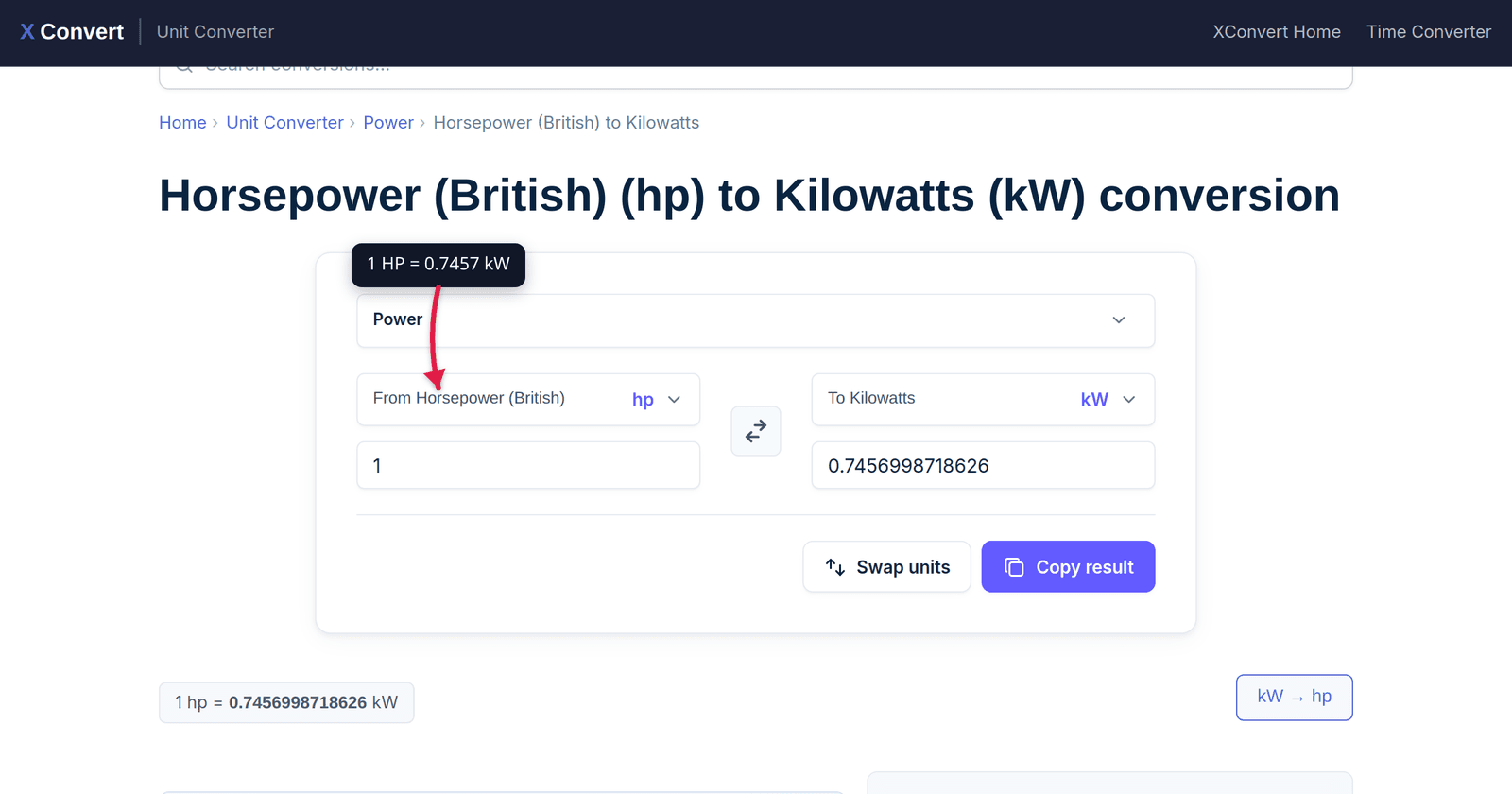
A Tesla Model Y Performance is rated at 456 HP. The equivalent in metric: 340 kW. Same car, same motor, same instant-torque feel — different units. EVs occupy a strange spot where the marketing keeps the legacy “horsepower” number for US buyers but the engineering uses “kilowatts” because everything else about the powertrain (charging speed, battery capacity, regenerative braking) is also measured in kW. This guide untangles HP and kW for EVs specifically: how they convert, why electric HP is technically different from mechanical, and what the kW number tells you about charging.
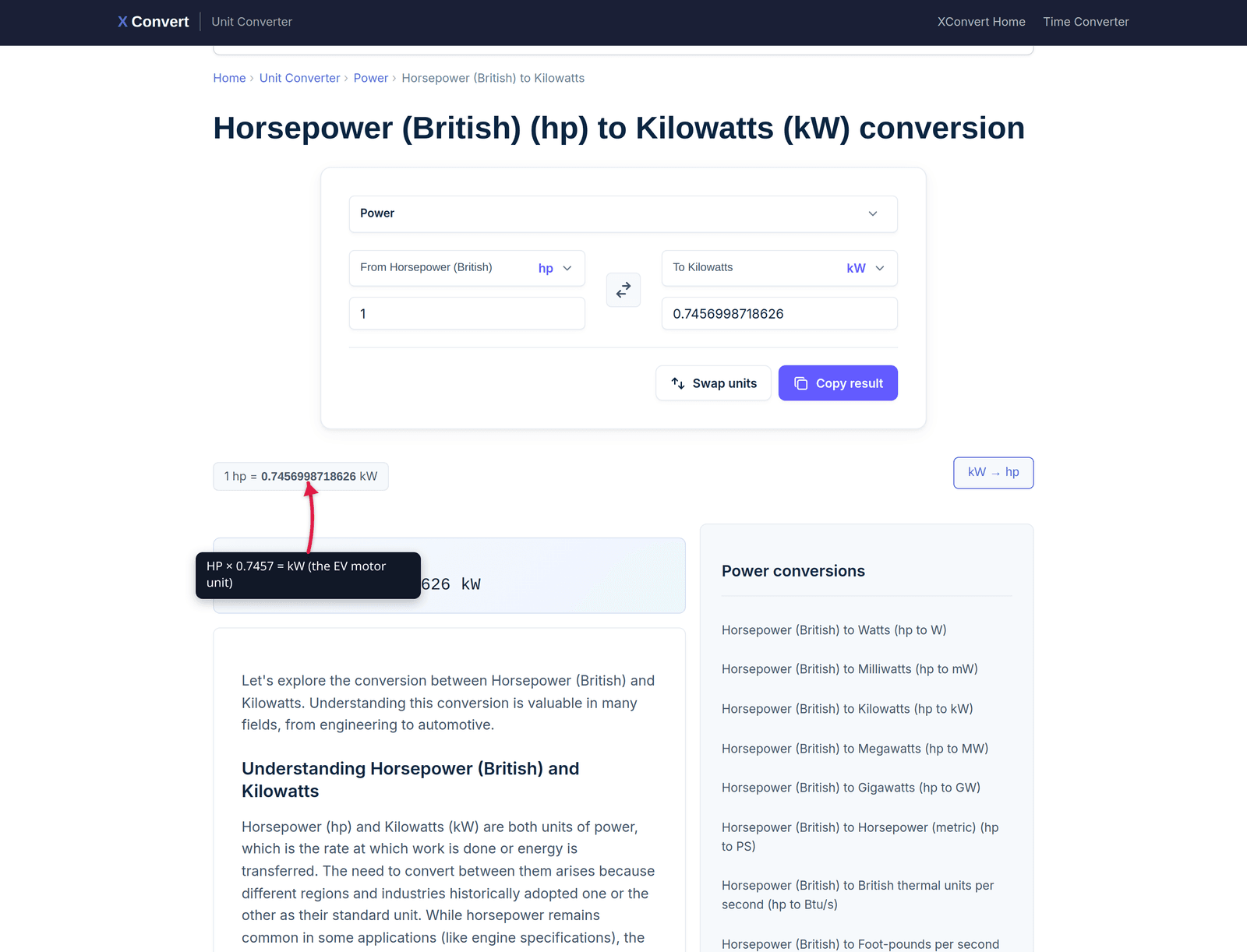
Quick answer: Multiply HP × 0.7457 = kW (mechanical horsepower, US/UK standard). A 456 HP Tesla Model Y = 340 kW. For metric/PS (German DIN), divide by 1.359 instead. The difference between electric and mechanical HP is 0.04% — invisible in practice.
Jump to a section
- The conversion (and why electric HP is different)
- EV models: HP and kW side by side
- Why EVs are described in kW more than HP
- What does kW mean for charging?
- FAQ
The conversion (and why electric HP is different)
HP (mechanical) = kW × 1.34102
HP (electric)   = kW × 1.34048
kW              = HP × 0.7457
The difference between mechanical and electric horsepower is 0.04% — invisible for any practical use. EV manufacturers and journalists generally use mechanical HP for the published number because that’s what consumers expect. The xconvert HP to KW converter uses the mechanical (745.7 W) standard.
A Tesla Model Y Performance: 340 kW × 1.341 = 456.0 HP. The published US rating of 456 HP matches this exactly.
EV models: HP and kW side by side
Popular EVs and their published power ratings (sustained / continuous, not peak):
| Make / Model | kW | HP | Battery (kWh) | Notes |
|---|---|---|---|---|
| Tesla Model 3 RWD (LFP) | 208 | 283 | 60 | Single rear motor |
| Tesla Model 3 Performance | 338 | 510 | 79 | Highland refresh, 2024 |
| Tesla Model Y Performance | 340 | 456 | 79 | |
| Tesla Model S Plaid | 760 | 1020 | 100 | Three motors |
| BMW i4 M50 | 400 | 536 | 84 | Performance trim |
| BMW i7 M70 | 485 | 650 | 105.7 | Flagship sedan |
| Mercedes EQS 580 4MATIC | 430 | 585 | 108 | 2024+ spec |
| Mercedes EQS 53 AMG | 484 | 649 | 108 | Base; up to 560 kW / 761 hp with AMG Dynamic Plus boost |
| Audi e-tron GT RS | 475 | 637 | 84 | |
| Porsche Taycan Turbo S | 700 | 938 | 105 | 2024+ overboost; pre-2024 was 560 kW / 750 hp |
| Lucid Air Sapphire | 908 | 1234 | 118 | Three motors; final production spec |
| Rivian R1T (Quad) | 625 | 835 | 135 | Quad-motor pickup |
| Hyundai Ioniq 5 N | 478 | 641 | 84 | Boost; sustained 448 kW / 601 hp |
| Kia EV6 GT | 430 | 576 | 77.4 | |
| VW ID.4 Pro | 150 | 201 | 82 | Single rear motor |
| Polestar 2 LR Dual | 310 | 416 | 82 | |
| Ford Mustang Mach-E GT | 358 | 480 | 91 | Performance edition |
| Chevy Silverado EV RST | 495 | 664 | 205 | RST trim; 754 hp peak in WOW (Wide Open Watts) mode |
The pattern: roughly 300–500 kW is “powerful EV territory” today, with high-end performance EVs pushing 700–800+ kW peak.
Why EVs are described in kW more than HP
Three reasons:
1. Charging speed. A DC fast charger is rated in kW (150 kW, 250 kW, 350 kW). Saying your car charges at “170 kW peak” is meaningful because that number directly compares to the charger spec. “228 HP” of charging would be confusing — HP is a power measurement but it’s not how charging infrastructure is described.
2. Battery capacity. Battery is in kWh (kilowatt-hours). Car energy is in kWh, motor power is in kW — internally consistent units. A 75 kWh battery delivering 300 kW for 15 minutes lets you do the math directly: 300 × 0.25 = 75 kWh consumed.
3. Regulatory paperwork. EU vehicle homologation specifies engine power in kW. Manufacturers publish the kW number for compliance regardless of marketing convention.
The HP number persists because consumers (especially US buyers) expect to see HP for cross-comparing with combustion vehicles. A 456 HP electric car feels familiar to someone shopping against a 400 HP gas car. “340 kW” feels foreign.
What does kW mean for charging?
Charging speed is measured in kW (rate of energy transfer). Same unit as motor power, but different practical meaning.
| Charger type | Typical kW | Time to charge 60 kWh battery 10–80% |
|---|---|---|
| Level 1 (120V household) | 1.4 kW | 30 hours |
| Level 2 (240V home / public) | 7–22 kW | 3–6 hours |
| DC fast (CCS / Tesla) | 50–250 kW | 18–60 minutes |
| Ultra-fast (next-gen) | 350–500 kW | 12–18 minutes |
The car can only accept charge at its maximum acceptance rate — even on a 350 kW charger, a Tesla Model 3 RWD peaks at 170 kW. Manufacturers publish the peak acceptance rate in their charging spec.
So a “300 kW motor” and “170 kW peak charging” coexist in the same EV — the motor outputs more power than the charging infrastructure delivers, which is why charging takes longer than driving.
Frequently Asked Questions
Why does my EV feel faster than its HP suggests?
EV motors deliver peak torque from 0 RPM. A 200 HP gas engine reaches peak torque at 3000-5000 RPM — meaning low-speed acceleration is constrained by the gear ratio and torque curve. A 200 HP electric motor delivers full torque instantly, so 0–60 mph times are dramatically faster than HP-equivalent gas cars. This is why a 280 HP EV often feels quicker than a 350 HP gas sedan in everyday driving.
What’s the difference between motor power and battery output?
The motor’s rated power is what the motor can produce at the wheels. The battery’s output power is what the battery pack can deliver to the motor. They have to match, and one constrains the other. A car might be rated as “300 kW motor” but only 250 kW peak from the battery — meaning the motor can pull at most 250 kW for short bursts even though it’s a more capable motor.
Why do some EV specs say “boost” or “peak” power?
EV motors can briefly exceed their continuous rating. A 300 kW continuous motor might briefly produce 400 kW for 10–30 seconds during launch control before thermal limits kick in. Marketing literature sometimes leads with the peak number; engineering literature uses the sustained / continuous rating. For real-world driving feel, the continuous rating is what matters.
How does HP compare across an EV and gas car?
For 0–60 acceleration: an EV with the same HP as a gas car is significantly faster because of instant torque. For top speed: gas cars often win because they can sustain peak power across a wider RPM range. For overall driveability and tractability in city / suburban use: EVs win on perceived responsiveness even at lower HP.
Should I prefer kW over HP for EV shopping?
For US buyers, both numbers work — manufacturers publish both. The kW number makes more sense if you’re comparing charging speed, battery capacity, and motor power on the same scale (everything in kW). The HP number makes more sense if you’re cross-shopping with gas cars. Pick whichever number is most familiar to you; they convey identical information.
What’s the relationship between kW and EV range?
Direct: more efficient EVs use fewer kWh per mile/km. A car using 0.25 kWh/mi with a 75 kWh battery has a theoretical range of 75/0.25 = 300 miles. EPA / WLTP / NEDC range estimates account for real-world losses and roughly equal 70–85% of theoretical maximum. Higher-power motors don’t directly reduce range, but heavy-footed driving with high power demand does.
Is there a “horsepower equivalent” for charging speed?
Mechanically, a 250 kW DC fast charger delivers 250 × 1.341 = 335 HP of power. This is meaningless in practice (chargers don’t have RPM, gears, or torque curves) but technically correct. Use kW for charging — it’s the universal language of EV infrastructure.
Try it now
US/UK car specs use mechanical (British) HP — 745.7 W per HP — so use HP (British) to kW converter for Tesla, Lucid, BMW i, and Mercedes EQ specs. For German PS / DIN HP (735.5 W per metric HP, occasionally seen on EU spec sheets), use HP (Metric) to kW. For the reverse: KW to HP (British). For European combustion-engine spec interpretation (BMW, Mercedes, Volvo), see KW to HP for European Engine Specs. For speed-related conversions (driving abroad), see MPH to KM/H for Driving in Europe.
Related guides
- KW to HP: Reading European Car Specs (BMW, Mercedes, Volvo)
- MPH to KM/H for Driving in Europe: Speed Limit Reference
- MPa vs Bar vs PSI: Pressure Units Explained — the pressure equivalent of the HP / kW cross-region unit puzzle.
- kJ vs kcal: Reading Food Labels Without a Calculator — same cross-region unit puzzle in a different domain — energy on food packaging.
Sources
Last verified 2026-05-19.
- NIST Special Publication 811 — Conversion Factors
- UN ECE — Vehicle Regulations
- SAE J1349 — Engine power test code