 By James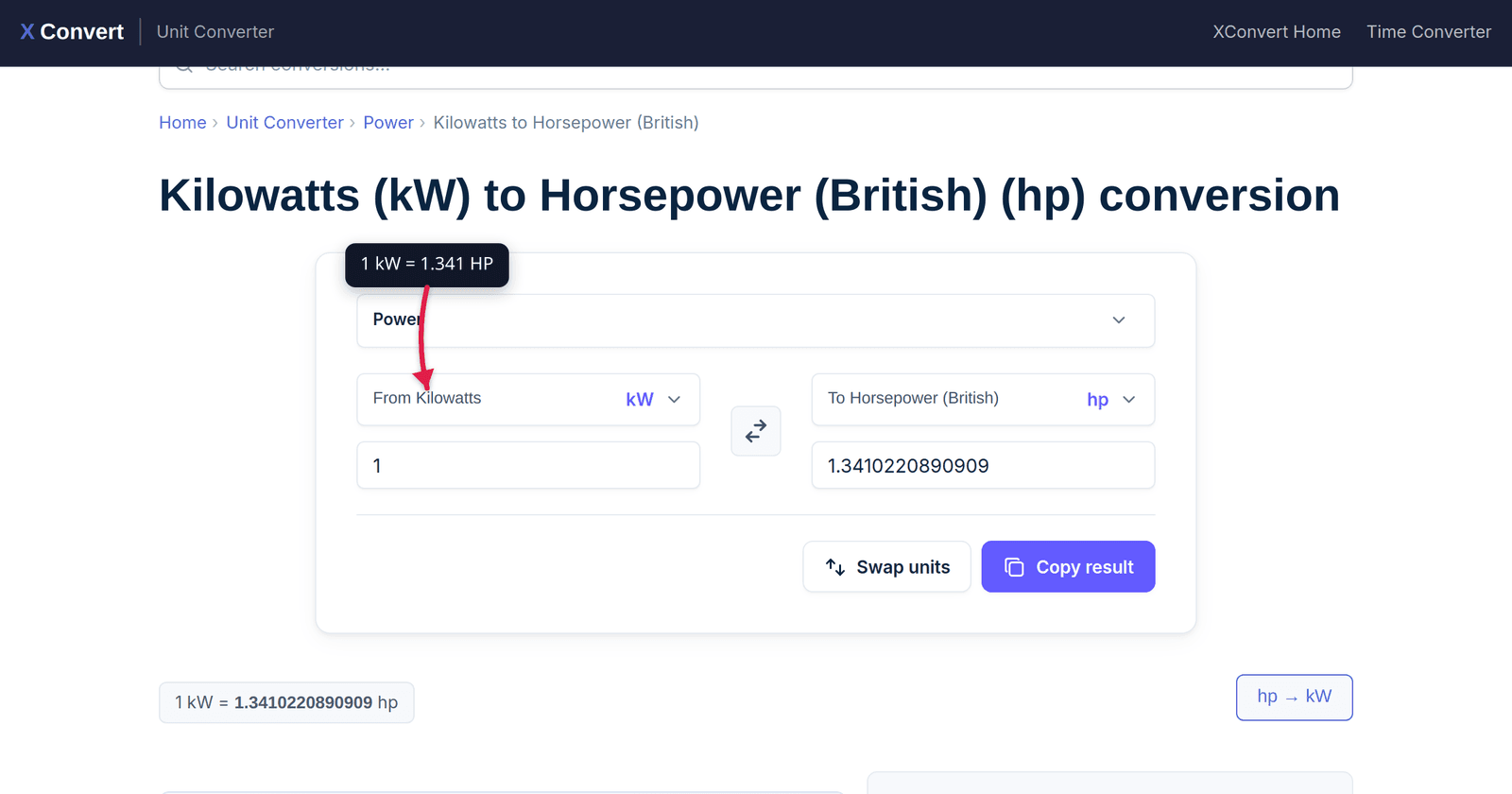
A BMW M340i spec sheet says 285 kW. The US version of the same car is sold as a 382 HP vehicle. Same engine. Different units. If you’re shopping for a European or import car, comparing across markets, or just trying to figure out what “kW” means on your friend’s new EV, this guide gives you the formula, a model table for popular cars, and the surprisingly subtle difference between three kinds of “horsepower” still in use.
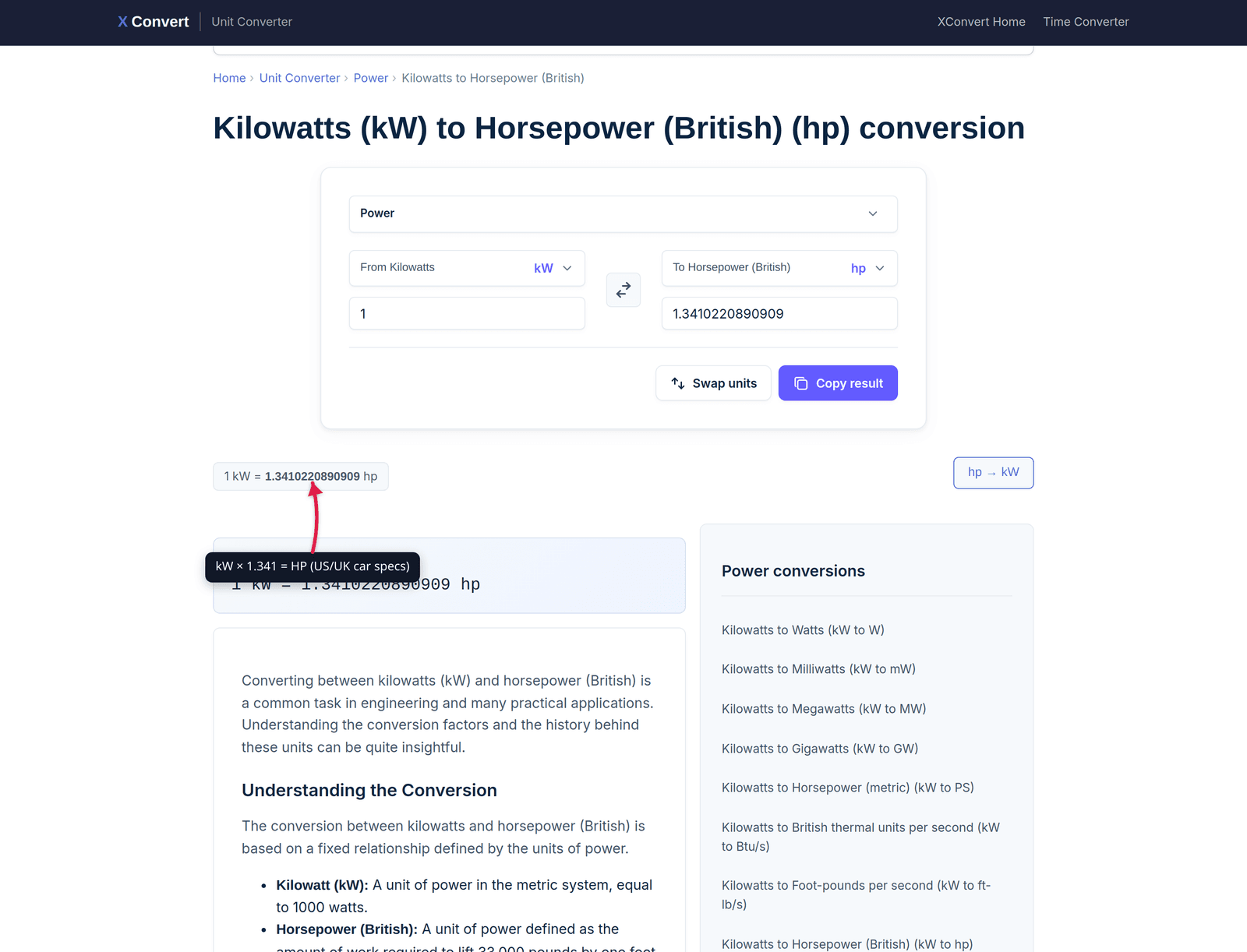
Quick answer: Multiply kW × 1.341 = HP (mechanical, used in US/UK ads). A BMW M340i at 285 kW = 382 HP. For German PS (metric horsepower), use × 1.359 instead. Mechanical HP and metric PS differ by ~1.4%, large enough to confuse car shopping.
Jump to a section
- The formula
- Three kinds of horsepower (and which one matters)
- Model-by-model spec table for popular cars
- Quick reference table
- Why European catalogs use kW
- FAQ
The formula
HP (mechanical) = kW × 1.34102
kW              = HP × 0.7457
Worked: 285 kW × 1.34102 = 382.2 HP (the BMW M340i value). The conversion is exact for mechanical (imperial) horsepower — the standard used in US automotive specs. xconvert’s KW to HP converter handles the math at full precision.
Three kinds of horsepower (and which one matters)
There are three different definitions of “horsepower” still in active use:
| Type | Watts per HP | Where used |
|---|---|---|
| Mechanical horsepower | 745.69987 | US automotive (this is what “382 HP” means on a Mustang) |
| Metric horsepower (PS / CV / DIN HP) | 735.49875 | German, French, Italian engine ratings (older catalogs) |
| Electrical horsepower | 746 (exact) | EV motor ratings in some US contexts |
The three differ by under 1.5% — small but real. A 100 kW car is:
- 134.10 mechanical HP (US standard)
- 135.96 metric HP (German “PS” / French “CV”)
- 134.05 electrical HP
For practical car shopping in 2026, mechanical HP is the dominant US figure. Metric horsepower (PS) appears on European spec sheets for older / non-electrified vehicles — newer EU specs lead with kW. The difference between them (~1.4%) is rarely important for buying decisions.
Model-by-model spec table for popular cars
Powerful European and global cars commonly cross-shopped:
| Make / model | EU spec (kW) | US/UK spec (HP) | PS (metric) | Notes |
|---|---|---|---|---|
| BMW M340i | 285 kW | 382 HP | 387 PS | xDrive sedan, 2024 |
| BMW M5 (G99) | 535 kW | 717 HP | 727 PS | F1 hybrid system |
| Mercedes E 350 | 220 kW | 295 HP | 299 PS | Sedan |
| Mercedes EQS 580 | 385 kW | 516 HP | 523 PS | All-electric flagship |
| Audi RS6 Avant | 463 kW | 621 HP | 630 PS | Wagon |
| Audi e-tron GT | 350 kW | 469 HP | 476 PS | All-electric |
| Porsche 911 Carrera S | 353 kW | 473 HP | 480 PS | Coupe |
| Porsche Taycan Turbo S | 700 kW | 938 HP | 952 PS | 2024+ overboost spec; pre-2024 was 560 kW / 750 hp |
| Volvo XC40 Recharge | 300 kW | 402 HP | 408 PS | EV |
| VW Golf GTI | 195 kW | 261 HP | 265 PS | 2024 European spec |
| Hyundai Ioniq 5 N | 478 kW | 641 HP | 650 PS | Performance EV |
| Tesla Model S Plaid | 760 kW | 1,020 HP | 1,033 PS | Reported peak |
The BMW M5’s “535 kW = 717 HP = 727 PS” tells you the difference: same car, three numbers depending on which standard you’re reading. PS is consistently 1.4% higher than mechanical HP because the metric horsepower’s per-unit watts (735.5) is smaller.
Quick reference table
For typical car-shopping conversions:
| kW | HP (mech) |
|---|---|
| 50 | 67 |
| 75 | 101 |
| 100 | 134 |
| 125 | 168 |
| 150 | 201 |
| 175 | 235 |
| 200 | 268 |
| 225 | 302 |
| 250 | 335 |
| 275 | 369 |
| 300 | 402 |
| 350 | 469 |
| 400 | 537 |
| 500 | 671 |
| HP | kW |
|---|---|
| 100 | 75 |
| 150 | 112 |
| 200 | 149 |
| 250 | 186 |
| 300 | 224 |
| 350 | 261 |
| 400 | 298 |
| 500 | 373 |
| 600 | 447 |
| 700 | 522 |
| 800 | 597 |
| 1000 | 746 |
Mental math: kW × 4 / 3 ≈ HP. (Actual factor is 1.341, but 4/3 = 1.333 is close.)
- 200 kW × 4/3 = 267 HP (actual: 268)
- 300 kW × 4/3 = 400 HP (actual: 402)
For higher precision, use the full factor or xconvert’s calculator.
Why European catalogs use kW
The kilowatt is the SI unit for power — internationally standardized, unambiguous, and consistent with the rest of EU regulatory framework. EU vehicle homologation rules (which standardize what manufacturers must publish) specify engine power in kW. Manufacturers use kW because regulators require it; consumers across Europe have learned to read kW for that reason.
The US never adopted the SI unit standard for automotive power, so HP persists. UK regulations recently shifted to kW for new homologations, but consumer-facing literature still leads with HP because that’s what buyers expect.
For comparison shopping across regions, both numbers are usually published — manufacturer websites with EU and US versions of the same model show kW in EU pages and HP in US pages of the same spec sheet.
Frequently Asked Questions
Why is mechanical HP slightly different from metric HP (PS)?
Historical accident. The original definition of horsepower (James Watt, 1782) used 33,000 ft-lb/min as “the rate at which one horse can do work.” That converts to 745.7 watts. The metric horsepower defined later (Continental Europe) used a different reference work amount — 75 kgf-m/s — which converts to 735.5 watts. The difference is 1.4% and has no practical effect on car performance — it’s purely a unit-system divergence.
What about EV motors? Do they use mechanical or electrical HP?
Either, depending on the manufacturer. Tesla, Rivian, and Lucid use mechanical HP for marketing in the US. Porsche, BMW, and Audi tend to use metric HP (PS) in EU markets and mechanical HP in US markets. The difference is 0.04% (electrical 746 vs mechanical 745.7) — invisible for any practical purpose.
Are HP and torque the same thing?
No. Power (HP / kW) is the rate of doing work. Torque is rotational force. They’re related but separate. A diesel truck might have low HP but enormous torque. An electric motor has high low-end torque and high HP at the rated RPM. Both numbers matter for performance, but they describe different things.
Why does my European spec say one kW number but the US version reports a higher HP?
Most often it’s peak (boost) vs continuous. Manufacturers sometimes publish optimistic peak numbers that exceed the SAE-net continuous rating: e.g., the Porsche Taycan Turbo S sustains around 460 kW but reaches 700 kW (938 hp) for short bursts under launch control. EU type-approval generally lists the continuous rating; US marketing often quotes the peak. The conversion math is the same (× 1.341); the gap is which operating point each spec is reporting.
Should I convert N (Newtons) for towing too?
For towing capacity, you’ll see ratings in kg, lb, or tons (units of mass). For pulling force, you’ll see kgf or N. Conversions: 1 kgf = 9.807 N = 2.205 lb-force. xconvert has a N to lb-force converter for force-specific conversions.
What’s the difference between BHP, SAE HP, and DIN HP?
- BHP (Brake Horsepower): Measured at the crankshaft, before transmission losses. Older British convention.
- SAE HP (SAE J1349 net): US standard for production vehicles. Measured under realistic operating conditions (with accessories, exhaust system, etc.).
- DIN HP / PS: German standard, similar methodology to SAE but using metric horsepower (735.5 W = 1 PS). Roughly equivalent to SAE HP for most engines.
For modern US car shopping, all you need is SAE HP. For European spec sheets, kW is the regulator-specified unit; PS is the colloquial conversion.
How does kW compare to torque (Nm)?
Power (kW) = Torque (Nm) × RPM / 9549A 200 Nm engine at 4000 RPM produces 200 × 4000 / 9549 = 83.8 kW. For comparison purposes between engines: peak torque at peak RPM gives you peak power. EV motors deliver high torque at zero RPM (instantly), which is why a 300 kW EV feels punchier than a 300 kW gas engine even if peak HP is the same.
Try it now
For US/UK “HP” (the mechanical horsepower most car ads use, 745.7 W per HP), use KW to HP (British) converter. For the German “PS” / DIN HP variant (735.5 W per metric HP), use KW to HP (Metric) converter. For the reverse: HP (British) to kW. For EV-specific power conversions, see HP to kW for Electric Vehicles. For driving-related conversions (speed limits in Europe), see MPH to KM/H for Driving in Europe.
Related guides
- HP to kW for Electric Vehicles: Why EVs Use Both Units
- MPH to KM/H for Driving in Europe: Speed Limit Reference
- MPa vs Bar vs PSI: Pressure Units Explained — tire pressure, boost pressure, and the bar/psi swap that catches every US-to-Europe car shopper.
- kJ vs kcal: Reading Food Labels Without a Calculator — the kJ-vs-kcal label divide is the same cross-region puzzle as kW vs HP, in a different unit system.
Sources
Last verified 2026-05-19.
- NIST Special Publication 811 — Conversion Factors
- UN ECE — Vehicle Regulations
- SAE J1349 — Engine power test code (US convention)