 By James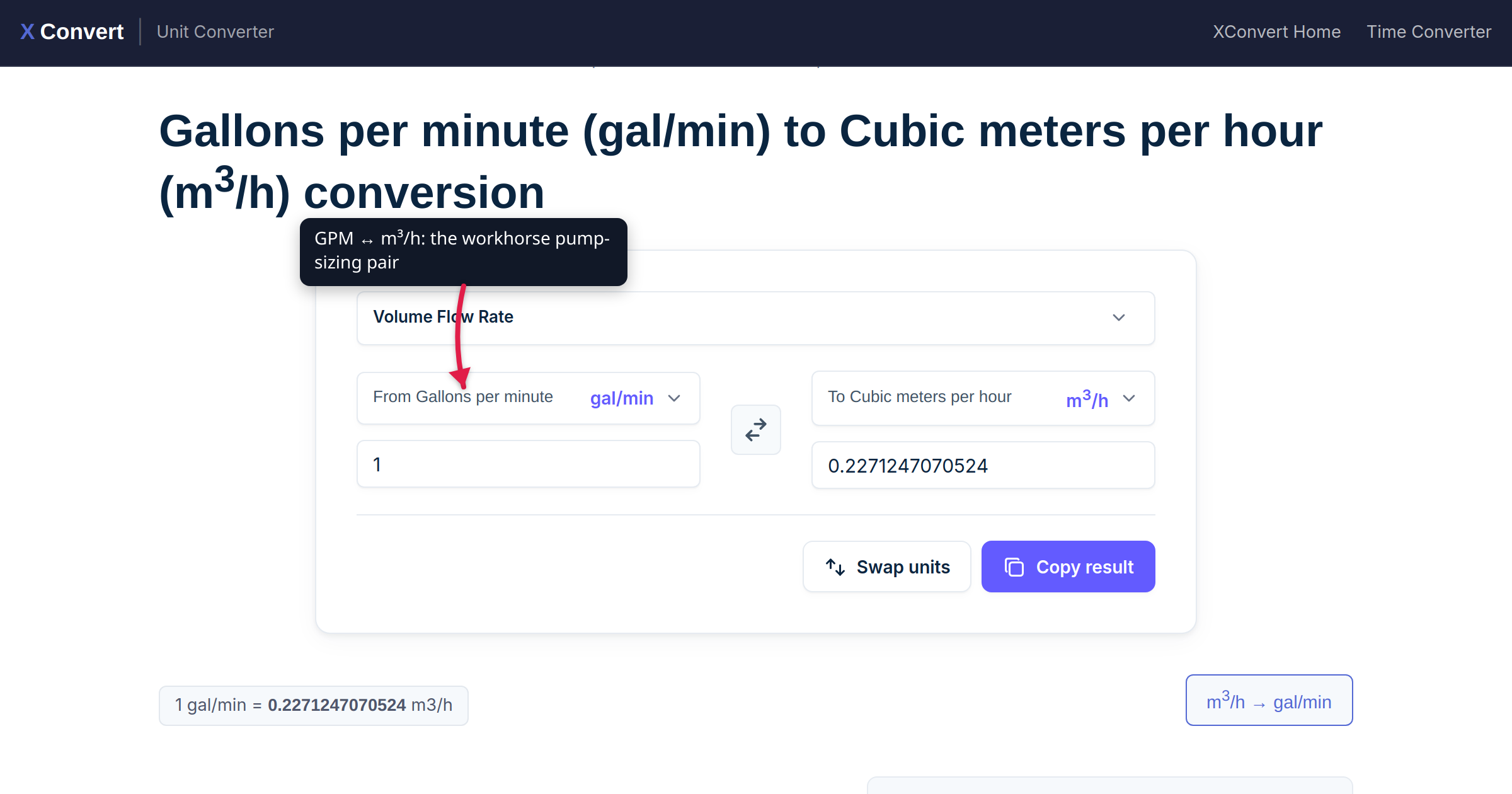
When the pump on your spec sheet was designed in Denmark and the system you’re replacing was built in Texas, the units don’t line up. European catalogs lead with m³/h and meters of head; US ones lead with GPM and feet of head. Get the conversion wrong (or confuse US and Imperial gallons — the Imperial gallon is ~20% larger) and you’ll under- or oversize the pump. This guide walks you through doing it right, with real model numbers from Grundfos, Pentair, Goulds, and Wilo.
Quick answer: Three multipliers cover most pump catalogs: GPM × 3.7854 = LPM, LPM × 0.0167 = m³/h, m³/h × 4.403 = US GPM. A 1% rounding error can push you into the wrong impeller size — use xconvert’s calculator for spec-sheet precision.
Jump to a section
- The four conversions you need
- Reading a US pump curve
- Reading a metric pump curve
- Worked example: replacing a Bell & Gossett with a Grundfos
- Worked example: spec’ing a metric Wilo for a US system
- Common mistakes that cost you 10–20%
- FAQ
The four conversions you need
Pump catalogs publish four numbers that matter. To compare specs across regions, you need to convert all four:
| Quantity | US units → metric | Metric → US units |
|---|---|---|
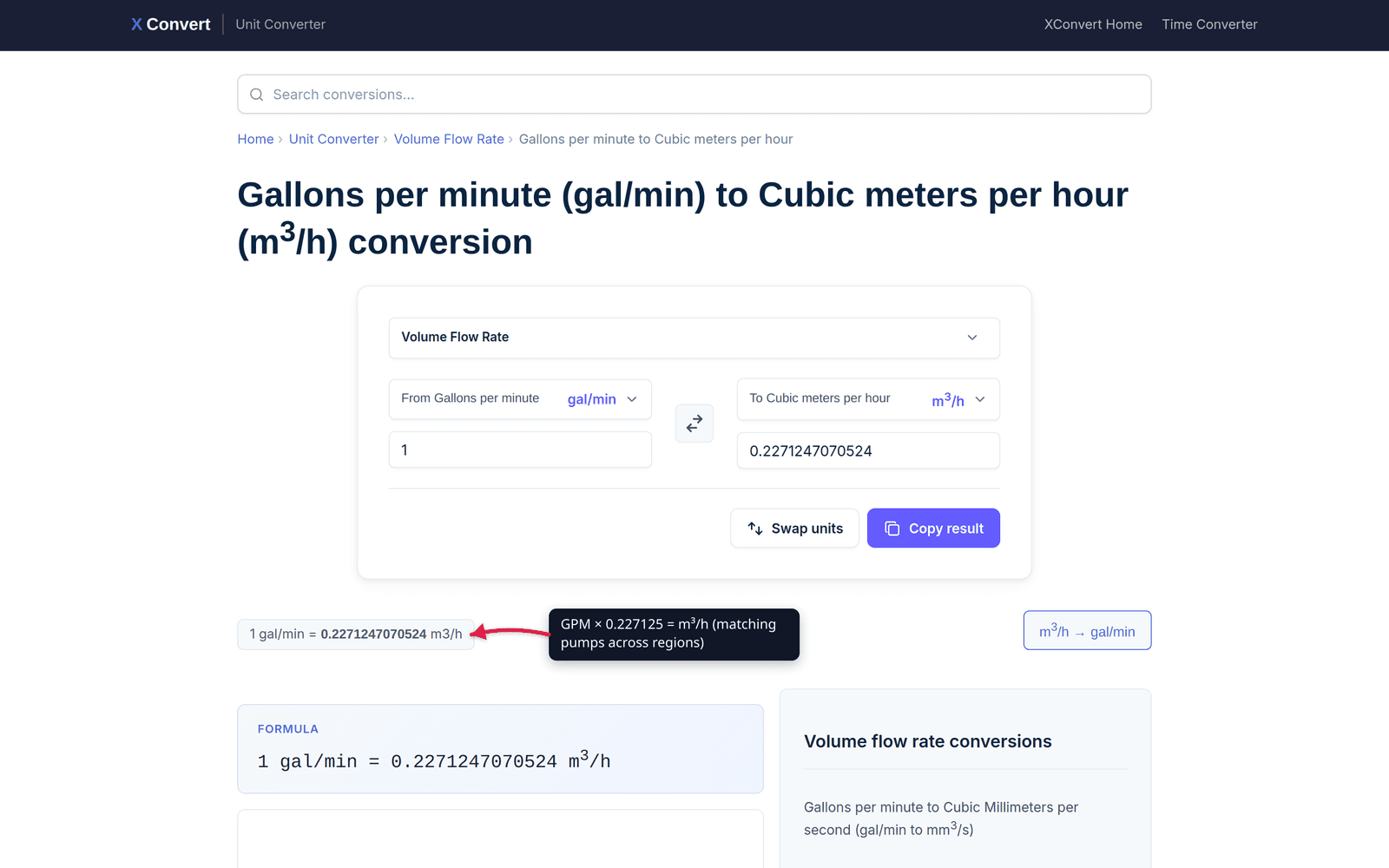
| Flow rate | GPM × 0.227125 = m³/h | m³/h × 4.40287 = GPM |
| Head | ft × 0.3048 = m | m × 3.2808 = ft |
| Power (motor) | HP × 0.7457 = kW | kW × 1.34102 = HP |
| Pressure (system) | psi × 6.89476 = kPa | kPa × 0.145038 = psi |
Use xconvert flow-rate calculators for the flow conversions and Length / Power / Pressure for the rest.
A practical rule: never compare just one operating point. A pump curve is a curve — two pumps that match at one flow can diverge significantly at another. Always convert and compare at the actual system operating point, not just the rated point.
Reading a US pump curve
A typical US-format pump curve plots:
- X-axis: GPM (flow)
- Y-axis (left): Head, in feet of water column
- Y-axis (right): Efficiency, percent
- Curves: One per impeller diameter, plus a “system curve” overlaid
Example: A Bell & Gossett 1510-3BC with a 7.5" impeller curve passes through 80 GPM at 30 ft of head and 75% efficiency. The motor is rated 1 HP. To compare to a European candidate, convert all four:
80 GPM × 0.227125 ≈ 18.17 m³/h
30 ft × 0.3048   ≈ 9.14 m
1 HP × 0.7457    ≈ 0.746 kW
So this US point is equivalent to 18.17 m³/h at 9.14 m head, with a 0.75 kW motor.
Reading a metric pump curve
A European catalog plots:
- X-axis: m³/h (or sometimes L/s for smaller pumps)
- Y-axis (left): Head, in meters
- Curves: One per impeller trim
- Power table: Motor rating in kW, often with a “P2” (shaft) and “P1” (electrical) value
Example: A Grundfos UPS 32-80 N circulator at 18 m³/h passes 9 m of head with the larger impeller; rated 0.18 kW shaft. To express in US terms:
18 m³/h × 4.40287 ≈ 79.3 GPM
9 m × 3.2808     ≈ 29.5 ft
0.18 kW × 1.34102 ≈ 0.24 HP
Now you can compare the two pumps at the same operating point: ~80 GPM at ~30 ft of head, with the Grundfos using significantly less motor (0.24 HP vs 1 HP). That isn’t apples-to-apples, though — the B&G 1510 is a base-mounted end-suction pump, the UPS is an inline circulator. Topology matters at least as much as the head/flow numbers.
Worked example: replacing a Bell & Gossett with a Grundfos
You’re replacing an aging B&G 1510-3BC in a closed-loop hydronic chiller plant. The system curve hits the pump at:
- 80 GPM at 30 ft of head
- 460 V, 3-phase, 1 HP motor
You need a Grundfos equivalent to specify. Walk through it:
Step 1 — Convert the operating point.
80 GPM × 0.227125 = 18.17 m³/h
30 ft × 0.3048    = 9.14 m
Step 2 — Find a Grundfos with that point on its curve.
Looking at the Grundfos catalog: the TPE2 32-100/2 family covers 5–25 m³/h at heads from 4–13 m. The 32-100/2 with the largest impeller hits ~18 m³/h at ~9.5 m head — slightly above the operating point, which is what you want (system curve will balance just below the pump curve).
Step 3 — Match the motor.
The TPE2 32-100/2 ships with a 0.55 kW motor. In HP: 0.55 × 1.34102 ≈ 0.74 HP. The B&G uses 1 HP. The difference is partly efficiency (Grundfos’s IE5-rated PM motor is more efficient than a typical 1990s-vintage induction motor) and partly conservative oversizing in the original spec.
Step 4 — Verify the system curve still hits in the safe zone.
Plot the system curve on the Grundfos curve. The operating point should land in the middle 60% of the flow range, away from both deadhead and run-out. If it lands at 90% of the run-out flow, go up one frame size to keep cavitation margin.
This is where unit conversion matters: if you’d compared “1 HP” to “0.55 kW” without converting, you’d think the Grundfos was undersized. It isn’t — the conversion shows it’s roughly 0.74 HP equivalent, which is appropriate for an 80 GPM @ 30 ft duty.
Worked example: spec’ing a metric Wilo for a US system
You’re sourcing pumps for a chilled-water plant in a building partly designed in Germany. The system curve passes through 40 m³/h at 14 m of head. You want to confirm a Wilo Stratos PICO is the right size.
Step 1 — Convert to US units to sanity-check against US pump curves you’re familiar with.
40 m³/h × 4.40287 = 176 GPM
14 m × 3.2808     = 45.9 ft
Step 2 — Compare against the Wilo curve.
The Stratos PICO 30/0.5-12 model maxes out around 12 m³/h. That’s 53 GPM — way too small for a 176 GPM duty. You need to step up to the Wilo IL or CronoLine in-line pump series, which cover 50+ m³/h.
Looking at the Wilo IL 50/130-2.2/2: rated for 60 m³/h at 13 m head. Convert:
60 m³/h × 4.40287 = 264 GPM at 42.6 ft headSlightly above the duty (176 GPM at 45.9 ft). With variable-speed control, this pump can ride down its curve to the 40 m³/h operating point and run efficiently there. Good match.
Common mistakes that cost you 10–20%
A few mistakes that recur in pump-sizing work, and how to avoid them:
1. Using UK gallons when the spec is US. The Imperial gallon (UK) is 4.54609 L; the US gallon is 3.78541 L — the Imperial is ~20% larger than the US gallon (equivalently, the US gallon is 16.7% smaller than the Imperial). UK pump catalogs and older Commonwealth specs sometimes write “GPM” without qualifying it. If you’re matching a UK pump to a US system, double-check the gallon definition.
2. Treating “head” and “pressure” as interchangeable. They aren’t. Head depends only on the pump and is measured in length units (ft or m). Pressure depends on the fluid density — for water at 4 °C, 1 ft of head = 0.433 psi, but for diesel or oil the same head produces less pressure. If you’re pumping anything other than water, convert head to pressure using the actual fluid density.
3. Comparing rated-flow points instead of operating points. A pump’s “rated flow” is the design point at maximum efficiency. The system curve might run at 60% of rated flow — that’s a different head, different efficiency, and different power draw. Always convert and compare at the actual operating point.
4. Forgetting that NPSH-A is in absolute units. Net Positive Suction Head Available is given in feet absolute (US) or meters absolute (metric). The conversion is straightforward (× 0.3048 or × 3.2808), but NPSH-Required from the manufacturer is in the same units as the pump curve’s head axis — so they must match before subtracting.
5. Ignoring the variable-frequency-drive math. A pump on a VFD scales flow, head, and power with the affinity laws (linear, square, and cube respectively). When converting units across a VFD-controlled system, do all the unit conversions FIRST, then apply the affinity laws — not the other way around.
Frequently Asked Questions
What’s the conversion factor between GPM and m³/h?
1 GPM = 0.227125 m³/h, and 1 m³/h = 4.40287 GPM. xconvert’s GPM to m³/h converter gives precise results. For mental math: m³/h ≈ GPM ÷ 4.4, or GPM ≈ m³/h × 4.4.
Why do US pumps use HP and European pumps use kW?
Conventional inertia. The mechanical horsepower (745.7 W) was defined in 18th-century Britain by James Watt to compare steam engines to draft horses. The metric horsepower (735.5 W) emerged in mainland Europe at roughly the same time but with a slightly different definition. Both have been formally replaced by the SI watt, but motor manufacturers still publish in HP for the US market because that’s what specifiers expect. 1 HP ≈ 0.7457 kW (mechanical) or 0.7355 kW (metric horsepower).
Are pump curves linear after conversion?
Yes. Unit conversion is multiplication by a constant, which preserves the shape of any curve. A US pump curve plotted against GPM-and-feet looks identical to the same curve plotted against m³/h-and-meters — just with different axis labels. The operating point lands at the same percent of run-out flow either way.
How do I convert a centrifugal pump’s affinity-law math when units differ?
The affinity laws relate flow (Q), head (H), and power (P) to speed (N): Q ∝ N, H ∝ N², P ∝ N³. The proportionality is unit-independent. So if you have a pump curve at 1750 RPM and want to predict the curve at 1450 RPM:
- Q_new = Q_old × (1450 / 1750)
- H_new = H_old × (1450 / 1750)²
- P_new = P_old × (1450 / 1750)³
Apply the ratios in whatever units you’re in. The conversion to other units (GPM ↔ m³/h, etc.) happens separately and doesn’t interact with the affinity laws.
What’s the difference between “duty point” and “rated point”?
The rated point is what the manufacturer prints on the pump nameplate — typically the best-efficiency point. The duty point is where your system actually runs the pump, defined by the intersection of the pump curve and the system head curve. They should be close (ideally within 80–110% of rated flow), but they’re rarely identical.
Why do European pump catalogs sometimes use bar instead of meters?
For pressure-rated equipment (boosters, pressure tanks, water-treatment skids), pressure in bar is more useful than head in meters because the rating doesn’t change with fluid density. Conversion: 1 bar = 10.197 m of water column = 14.504 psi. xconvert has a bar/psi converter for the inevitable mixed-unit datasheets.
Try it now
Convert any pump-curve number directly: GPM to m³/h, feet to meters, HP to kW, psi to bar. For an overview of which flow-rate units each industry uses, see Flow Rate Conversion for HVAC and Plumbing.
Related guides
- Flow Rate Conversion: GPM, LPM, m3/h, CFM Explained
- GPM to LPM: Formula, Calculator, US vs UK Gallons
- L/s to GPM Calculator: Convert Industrial Flow Rates
Sources
Last verified 2026-05-19.
- NIST Special Publication 811 — Unit Conversions
- BIPM — SI Brochure
- Hydraulic Institute — Pump Standards