 By James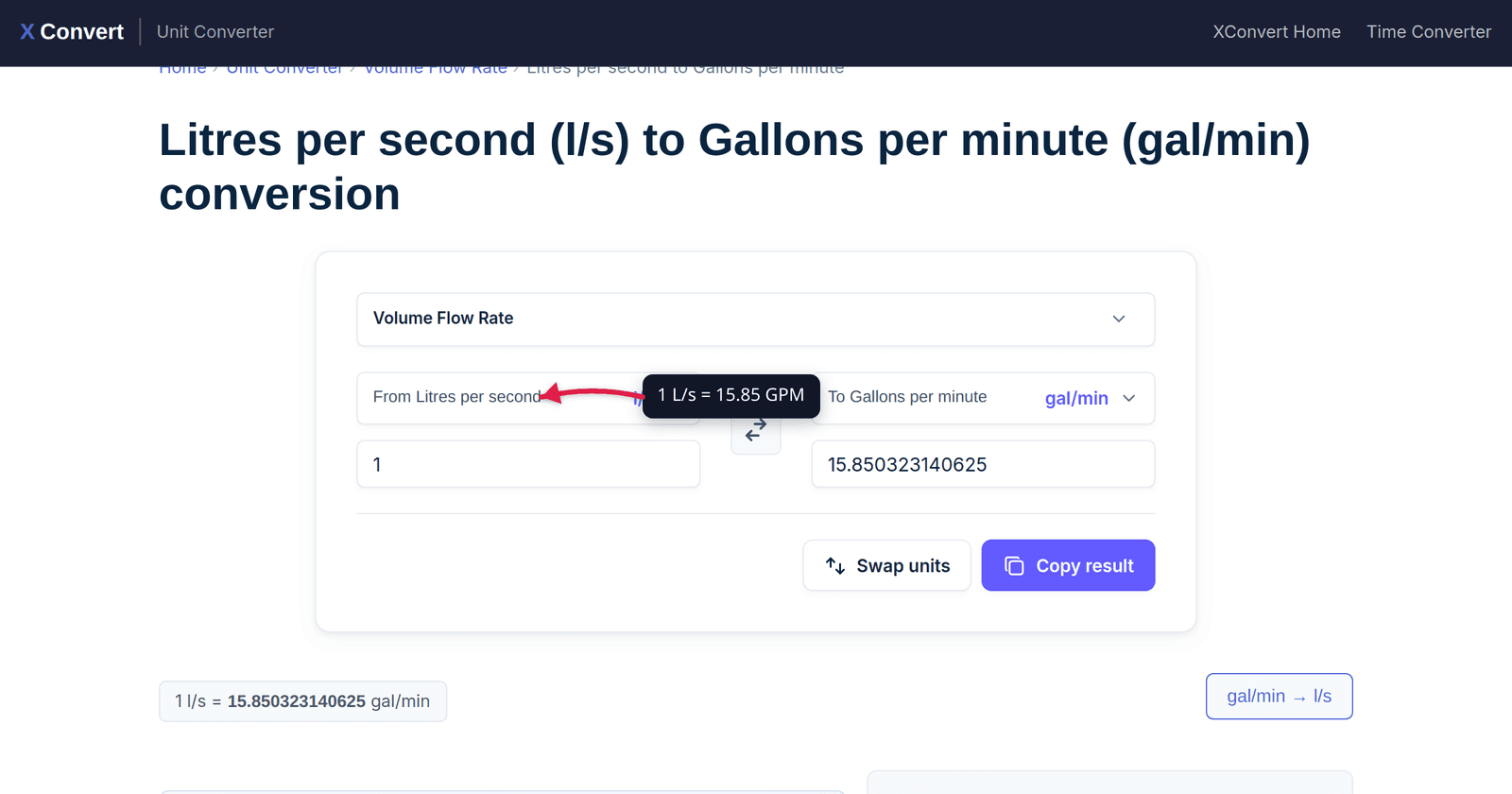
Liters per second is the SI-friendly cousin of cubic meters per hour. It’s what shows up on water-treatment skids, wastewater plants, hydraulic equipment, and process control instrumentation when the numbers are big enough that LPM gets unwieldy but small enough that m³/h sounds overblown. If you’re working with an EU- or ISO-standard spec sheet that lists flow in L/s and need to compare it to a US pump rated in GPM, this is the page.
Quick answer: Multiply L/s × 15.85 = US GPM (or × 13.20 = UK GPM). 5 L/s ≈ 79.3 US GPM. Reverse: divide GPM by 15.85 (or × 0.0631). Used heavily in industrial water treatment, district cooling, and SI-spec pump curves.
Jump to a section
- The formula and conversion factor
- Why L/s shows up where it does
- Quick reference table
- Worked example: water-treatment plant capacity
- Common engineering benchmarks
- FAQ
The formula and conversion factor
The conversion is a single multiplication:
GPM = L/s × 15.8503
L/s = GPM × 0.0630902   (or × 1/15.8503)
For higher precision, use 15.8503231415 (the exact factor from US gallons being defined as 231 in³ = 3.78541178… L). xconvert’s L/s to GPM converter carries 13 decimal places.
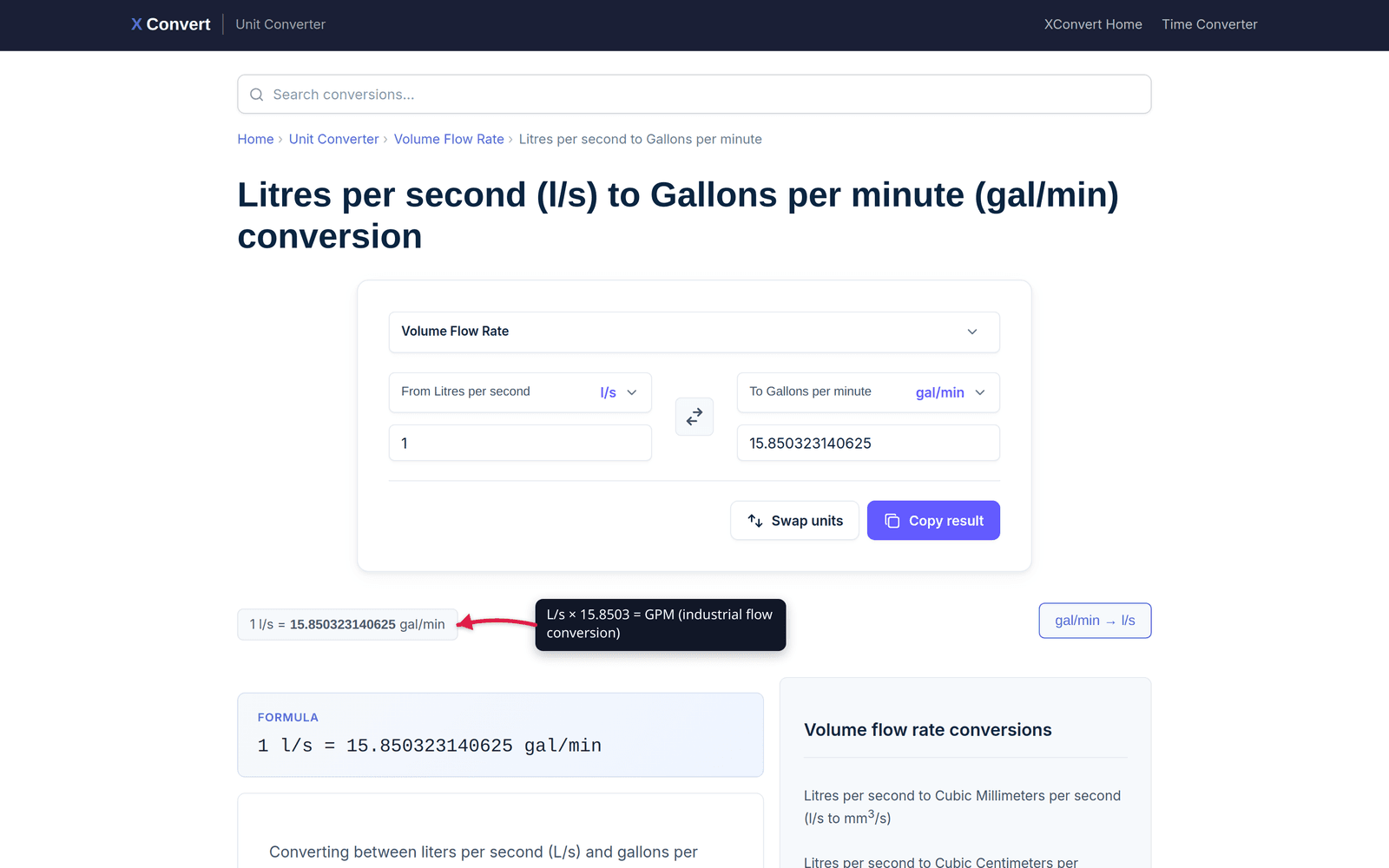
The formula derivation is straightforward: 1 L/s × (60 s / 1 min) × (1 gal / 3.78541 L) = 15.8503 gal/min. Multiplying by 60 (seconds in a minute) and dividing by 3.78541 (litres in a US gallon) gives the factor.
If you’ve memorized other flow conversions, here’s how L/s relates:
1 L/s = 60 LPM = 3.6 m³/h = 15.85 GPM = 2.119 CFMWhy L/s shows up where it does
The choice of unit is a tell about who designed the equipment:
- Water-treatment plants publish capacity in L/s (for small) or m³/h (for large). 1 L/s plant ≈ a small village; 100 L/s ≈ a mid-size town.
- Wastewater pumps are commonly rated in L/s in EU and ANZ standards, GPM in the US.
- Hydraulic systems (industrial machinery, presses) use L/s for fluid power because the flows are small (1–20 L/s) and L/s gives readable numbers.
- Drainage and stormwater design use L/s for sub-watershed catchments, m³/s for entire watersheds.
- Process instrumentation (flowmeters with 4-20 mA outputs) is often spanned in L/s because it’s an SI-derived unit and matches PLC engineering culture.
When a US plant operator inherits a European-spec instrument, the L/s readout is a constant friction. Either you re-span the instrument to GPM (if the protocol allows) or you train the operator to do the conversion mentally. The mental version: divide by 16 for a rough GPM, then add 1% (since the actual factor is 15.85, not 16).
Quick reference table
| L/s | GPM | Typical context |
|---|---|---|
| 0.1 | 1.59 | Small dosing pump |
| 0.5 | 7.93 | Hydraulic system fluid flow |
| 1 | 15.85 | Domestic water main at peak |
| 2 | 31.70 | Light commercial well pump |
| 5 | 79.25 | Small water-treatment skid |
| 10 | 158.50 | Industrial process feed |
| 25 | 396.26 | Wastewater lift station (small) |
| 50 | 792.52 | Mid-size water booster |
| 100 | 1,585.03 | Municipal water-treatment basin |
| 250 | 3,962.58 | Large industrial cooling water |
| 500 | 7,925.16 | Major pump station |
| 1,000 | 15,850.32 | Watershed-scale pump (large) |
Worked example: water-treatment plant capacity
A specification calls for a small water-treatment skid rated 8 L/s at 5 bar discharge. The available US-built pump on hand is a Goulds 3656 SP at 130 GPM at 70 psi. Will it work?
Step 1 — Convert flow:
8 L/s × 15.8503 = 126.8 GPMThe required is 126.8 GPM; the pump delivers 130 GPM. Within 3% — the system curve will shift the operating point slightly to compensate, and modulating valves can absorb the rest.
Step 2 — Convert pressure to verify head margin:
5 bar × 14.504 = 72.5 psi (required)
70 psi (available)
The pump is 2.5 psi short on head. That’s marginal. At the operating point, the pump curve might cross 70 psi at 126 GPM — barely meeting the requirement. Either confirm the operating-point head against the pump curve (not just rated head) or oversize the pump by going to a bigger frame.
This is where unit conversion isn’t just bookkeeping — it lets you make engineering judgements with confidence. Without converting, “8 L/s at 5 bar” and “130 GPM at 70 psi” feel completely different. Once converted, the comparison is direct.
Common engineering benchmarks
A few L/s numbers worth knowing:
- Small water service (residential): 0.5–1.0 L/s = 8–16 GPM
- Medium commercial water service: 5–10 L/s = 80–160 GPM
- Building chilled-water distribution: ~0.043 L/s per kW of cooling load (= 2.4 GPM/ton, ASHRAE rule of thumb)
- Storm-sewer design (urban catchment): 5–50 L/s per hectare during 10-year storm
- Wastewater lift-station typical: 10–50 L/s = 160–800 GPM
- Water-treatment plant typical: 100–1,000 L/s = 1,600–16,000 GPM
- Hydraulic press circuit: 0.5–5 L/s per actuator
- Fire pump (EU spec): 30–60 L/s = 475–950 GPM
- River flow (small creek): 1–10 L/s baseflow
- Sewage treatment per capita: 200–400 L/day per person ≈ 0.0023–0.0046 L/s per person
Frequently Asked Questions
Why isn’t L/s the SI unit for flow?
The SI unit for volumetric flow is m³/s. L/s is a derived unit (1 L = 0.001 m³, so 1 L/s = 0.001 m³/s) but allowed under the SI brochure. It survives because the numbers are friendlier in everyday engineering: a 50 L/s plant is more legible than 0.05 m³/s. For very large flows (rivers, storm sewers) m³/s starts to win.
What’s the difference between L/s and L/min?
Just a factor of 60. 1 L/s = 60 L/min = 60 LPM. The unit choice tracks the size of the system: LPM for residential and small commercial (where flows are 0.1–10 L/s), L/s for industrial and treatment (where flows are 1–1000 L/s). For very small flows (drip irrigation, single faucets), GPH or LPM gives more readable numbers.
Is there an Imperial version of L/s?
The litre is metric, so L/s is metric only. The Imperial-system equivalents are GPM (US gallon) or imp gpm (Imperial gallon). 1 L/s = 15.85 US GPM = 13.20 imp GPM. UK water-industry specifications use either L/s or m³/h depending on the era of the document.
How do I convert L/s to mass flow rate?
Multiply by fluid density. For water at 20 °C: 1 L/s × 998.2 kg/m³ = 0.998 kg/s ≈ 1 kg/s. The “1 L/s ≈ 1 kg/s” approximation is good to within 0.5% across the typical operating range of clean water systems. For other fluids (oil, ammonia, brine), use the actual density from the fluid datasheet.
Why does my flow meter read in L/s but the controller works in GPM?
Industrial flow meters often output 4–20 mA spanned in L/s (an EU-style configuration), but US-built PLCs and SCADA systems typically scale display values in GPM. The fix is in the PLC scaling: change the analog input scale factor to convert the 4–20 mA range to GPM before storing/displaying. Or change the meter’s span to GPM if the protocol allows it. Don’t do the conversion in the operator’s head — that’s where errors compound.
What’s the relationship between L/s and pipe size?
For full-pipe flow at typical velocities (1–3 m/s for water mains), the rough relationship is:
- DN50 (2") pipe at 2 m/s: ~4 L/s
- DN100 (4") at 2 m/s: ~16 L/s
- DN150 (6") at 2 m/s: ~35 L/s
- DN200 (8") at 2 m/s: ~63 L/s
- DN300 (12") at 2 m/s: ~141 L/s
These are rough — actual flow depends on pipe internal diameter and velocity, and you should use the Hazen-Williams or Darcy-Weisbach equations for friction loss in design. Use them for sanity-checks: if a spec says “DN100 at 200 L/s,” somebody made a mistake (that would require 12+ m/s velocity, which is far above the usual design ceiling).
Try it now
Convert any L/s value with the xconvert L/s to GPM converter — full precision, instant. For other flow-rate pairs (LPM, m³/h, CFM, m³/s), see the Volume Flow Rate catalog. For the broader picture of which industries use which units, our Flow Rate Conversion for HVAC and Plumbing overview is the place to start.
Related guides
- Flow Rate Conversion: GPM, LPM, m3/h, CFM Explained
- GPM to LPM: Formula, Calculator, US vs UK Gallons
- Pump Sizing: Convert Flow Rates Between Imperial and Metric
Sources
Last verified 2026-05-19.
- NIST Special Publication 811 — Unit Conversions
- BIPM — SI Brochure
- Hydraulic Institute — Pump industry standards