 By Stephanie Taylor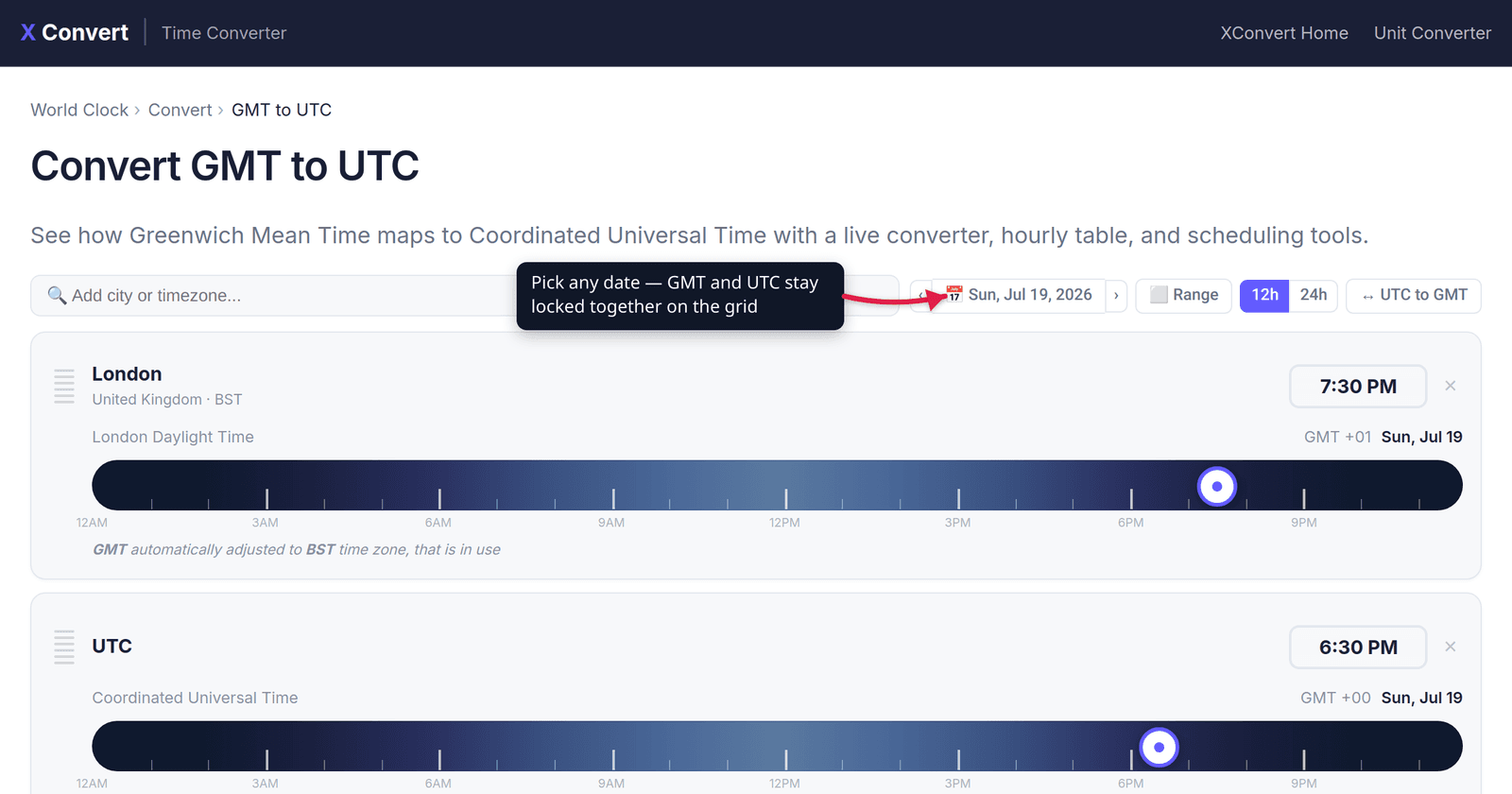
Your meeting invite says “14:00 GMT,” your server logs say “14:00 UTC,” and both clocks read exactly the same. So is there any difference at all — or are GMT and UTC just two names for one thing? The short version: for scheduling, they’re interchangeable; conceptually, they’re two very different animals — one is a time zone defined by the Sun over Greenwich, the other is the world’s atomic time standard. This guide explains what each one actually is, where the tiny technical gap lives, and the one real-world trap (hint: London) that catches people who treat “UK time” and “GMT” as synonyms. Definitions below are verified against NIST, the Royal Observatory Greenwich, and the BIPM.
Quick answer: On a clock, GMT and UTC are the same time — UTC+0. The difference is category, not clock: GMT is a time zone (the UK’s winter time, historically the mean solar time at the Greenwich meridian), while UTC is the modern time standard kept by atomic clocks and coordinated worldwide. NIST’s own guidance: the two can be considered equivalent “when fractions of a second are not important.” For anything technical — logs, APIs, aviation, scheduling across systems — say UTC.
Jump to a section
- What GMT actually is
- What UTC actually is
- So what’s actually different?
- The real-world trap: London isn’t always on GMT
- Compare GMT and UTC on xconvert
- FAQ
What GMT actually is
Greenwich Mean Time is the yearly average (“mean”) of the time each day when the Sun crosses the Prime Meridian at the Royal Observatory Greenwich — that’s the Royal Observatory’s own definition. It’s astronomical in origin: noon GMT was defined by the Sun over one specific spot in London.
GMT earned its global role at the 1884 International Meridian Conference, and from 1884 until 1972 it was the international standard of civil time. Today it survives in two ways:
- As a time zone: GMT (UTC+0) is the legal time in the United Kingdom during winter, and is used year-round in Iceland and parts of Africa and Western Europe.
- As a colloquial label for “the time at zero longitude” — which, per NIST, is in practice “a local representation of Coordinated Universal Time (UTC).”
What UTC actually is
Coordinated Universal Time is an atomic time scale, not an astronomical one. It’s computed from a worldwide ensemble of atomic clocks (NIST’s contribution alone uses cesium-beam and hydrogen-maser clocks) and coordinated internationally by the BIPM, the International Bureau of Weights and Measures. Nothing about UTC depends on the Sun or on any single place — Greenwich included.
The Earth is an imperfect clock: its rotation speeds up and slows down slightly. Astronomical time derived from actual Earth rotation is called UT1. To stop atomic time from drifting away from the planet, leap seconds are occasionally inserted into UTC, keeping the difference between UTC and UT1 below 0.9 seconds. That’s the entire technical gap between “atomic time” and “Sun time” — under a second, invisible on any calendar.
Even that is changing: Resolution 4 of the 27th CGPM (2022) decided that the tolerated UT1−UTC difference will be increased by or before 2035, effectively ending routine leap seconds; the exact new limit is due to be settled at the 28th CGPM in 2026.
So what’s actually different?
| GMT | UTC | |
|---|---|---|
| Category | Time zone (and historical standard) | Time standard |
| Defined by | Mean solar time at the Greenwich meridian | Atomic clocks, coordinated by BIPM |
| Offset | UTC+0 | The reference itself |
| Leap seconds | Follows UTC in practice | Inserted to stay within 0.9 s of UT1 |
| Who uses the name | UK (winter), Iceland, broadcasters (BBC World Service), everyday speech | Science, aviation, computing, standards, logs |
| Status | National/legal usage; replaced as the world standard in 1972 | The international standard of civil time |
The practical rule NIST gives is the one to remember: either use of GMT can be considered equivalent to UTC when fractions of a second are not important. Your 14:00 GMT call and 14:00 UTC call are the same call.
Why prefer UTC in writing anyway? Because GMT carries a second meaning — “UK time” — and that meaning is wrong for half the year, which brings us to the trap.
The real-world trap: London isn’t always on GMT
The United Kingdom only runs on GMT in winter. From the last Sunday in March to the last Sunday in October, the UK is on British Summer Time (BST, UTC+1) — verified against gov.uk, which lists the 2026 changes as March 29 and October 25.
So in July, “3 p.m. in London” is not 3 p.m. GMT — it’s 3 p.m. BST, which is 2 p.m. GMT/UTC. Meanwhile UTC never moves: it has no daylight saving, no seasons, no exceptions. If someone in the UK writes “15:00 GMT” on a summer invite, they almost always mean London wall-clock time (BST), and the invite is off by an hour for anyone who takes GMT literally. When precision matters, write UTC — or pin the time to a named city and let the calendar do the work. You can see the UK’s two clocks side by side on the GMT vs BST comparison page.
Compare GMT and UTC on xconvert
The xconvert GMT to UTC converter puts both on one hour-by-hour grid — which also makes it a quick visual proof that they align:
- Open xconvert.com/time-converter/gmt-to-utc-converter — GMT and UTC load as two horizontal hour rows for today’s date.
- Pick any date with the ‹ › arrows or the 📅 date button; the rows stay locked together because neither GMT nor UTC observes daylight saving.
- Toggle 12h / 24h to match your team’s convention.
- Click + Add City to drop a real location (London, New York, Bengaluru) onto the grid — that’s where the offsets start moving with the seasons while the UTC row stands still.
- Export a chosen slot with 📅 Add to Cal (ICS), 🗓 Google Cal, or send the whole comparison with 🔗 Share Link.
For reference cards on each zone, see the GMT time zone page and the UTC time zone page. DST rules and historical changes are tracked from the IANA timezone database, so comparisons stay correct on any date.
FAQ
Is GMT the same as UTC?
On the clock, yes — both are UTC+0 and NIST treats them as equivalent “when fractions of a second are not important.” Technically they differ in kind: GMT is a time zone rooted in mean solar time at Greenwich; UTC is the atomic time standard the world actually runs on.
Should I write GMT or UTC on a meeting invite?
UTC. GMT invites two misreadings: some readers take it as “UK time” (wrong in summer, when the UK is on BST), and some as UTC+0 (right). UTC has exactly one meaning. Better still, pin the invite to a named city so calendars convert it automatically.
Is London on GMT right now?
In July, no — the UK is on British Summer Time (UTC+1) until the last Sunday in October (October 25 in 2026). London is only on GMT between late October and late March.
When did UTC replace GMT?
GMT served as the international standard of civil time from 1884 until 1972, when UTC — defined by atomic clocks with leap-second corrections — took over. GMT lives on as the UK’s winter time zone and in everyday speech.
What is the difference between UTC and UT1?
UT1 is astronomical time measured from the Earth’s actual rotation, which is slightly irregular. UTC is atomic time nudged with leap seconds so it never drifts more than 0.9 seconds from UT1. Under a 2022 CGPM resolution, that tolerance will be loosened by 2035, ending routine leap seconds.
Does GMT or UTC ever change for daylight saving?
Never. Both stay at UTC+0 all year. What changes is which zone countries use: the UK swaps GMT for BST each summer, but GMT itself doesn’t move.
Sources
Last verified 2026-07-19.
- Royal Museums Greenwich — What is Greenwich Mean Time (GMT)? — GMT’s definition, its 1884–1972 role as the international standard, and its current use (UK winter, Iceland).
- NIST — How is UTC(NIST) related to UTC, TAI, GMT, GPS time and Zulu time? — “either use of GMT can be considered equivalent to UTC when fractions of a second are not important.”
- NIST — Leap Seconds FAQs — UTC as an atomic scale; leap seconds keep UTC within 0.9 s of UT1.
- BIPM — Resolution 4 of the 27th CGPM (2022) — the maximum UT1−UTC difference will be increased in or before 2035.
- gov.uk — When do the clocks change? — UK on GMT in winter, BST in summer; 2026 changes March 29 / October 25.