 By Stephanie Taylor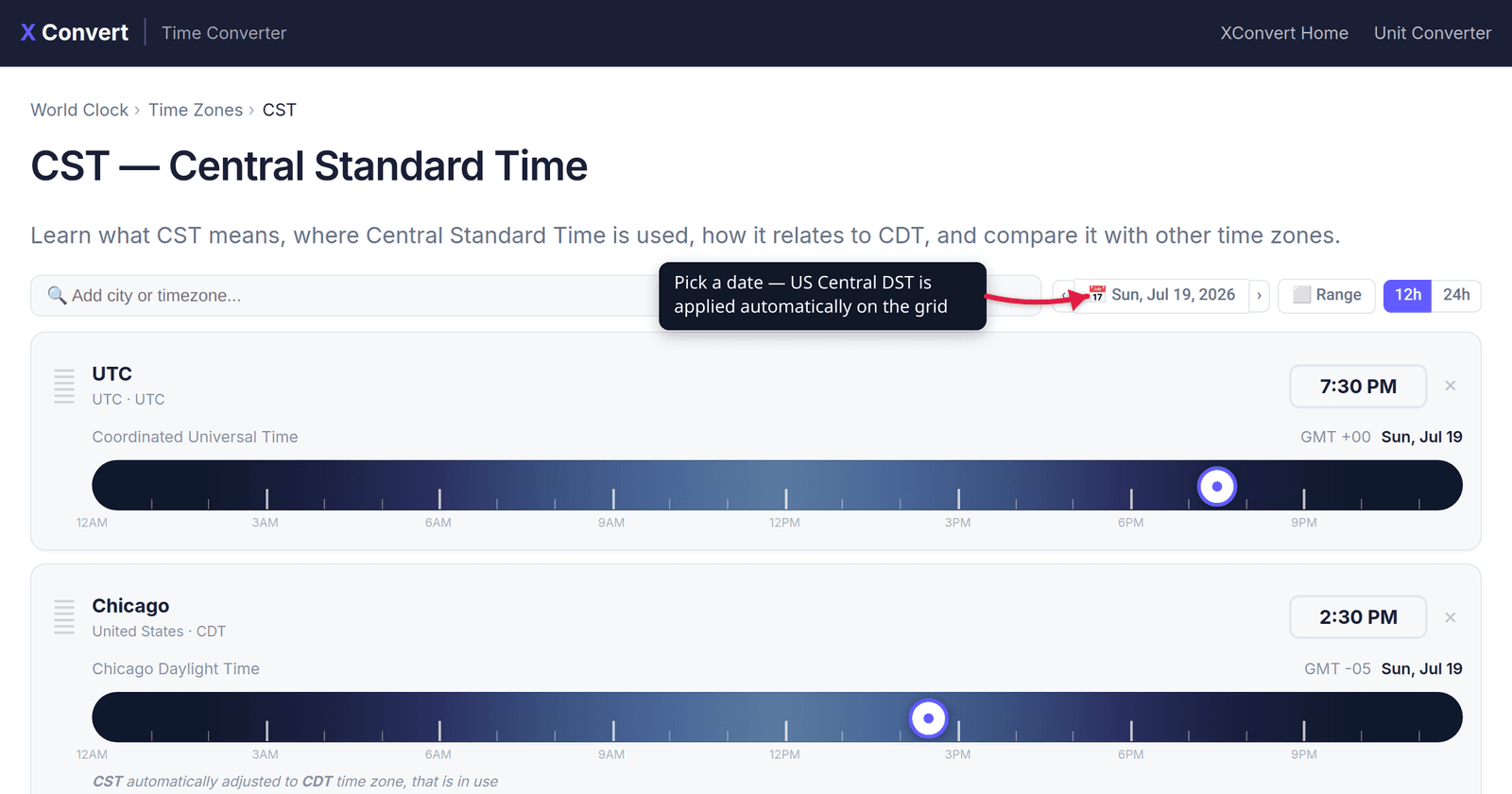
“Let’s talk at 3 p.m. CST.” Said by a colleague in Dallas, a supplier in Shanghai, or a travel agent in Havana, that sentence names three moments up to 14 hours apart — because CST is the official abbreviation of three different time zones: US Central Standard Time (UTC−6), China Standard Time (UTC+8), and Cuba Standard Time (UTC−5). This guide pins down all three, shows the actual gaps between them season by season, and gives you a habit that makes the ambiguity disappear. Every offset and DST date below is verified against NIST, the IANA timezone data, and the zones’ own national rules.
Quick answer: CST = US Central (UTC−6, becomes CDT UTC−5 in summer), CST = China Standard Time (UTC+8, never changes), and CST = Cuba Standard Time (UTC−5, becomes CDT UTC−4 in summer). Beijing is 14 hours ahead of Chicago in winter, 13 in summer; Havana is 1 hour ahead of Chicago all year. When it matters, don’t write “CST” — write the city (“3 p.m. Chicago time”) or the UTC offset.
Jump to a section
- Three zones, one abbreviation
- US Central Time (UTC−6 / −5)
- China Standard Time (UTC+8)
- Cuba Standard Time (UTC−5 / −4)
- How far apart the three CSTs are
- Compare the three CSTs on xconvert
- FAQ
Three zones, one abbreviation
Time zone abbreviations were never centrally assigned — each country named its own, and collisions were inevitable. CST is one of the worst offenders:
| “CST” | Offset | Daylight saving? | IANA reference zone |
|---|---|---|---|
| US Central Standard Time | UTC−6 | Yes → CDT (UTC−5), Mar–Nov | America/Chicago |
| China Standard Time | UTC+8 | No | Asia/Shanghai |
| Cuba Standard Time | UTC−5 | Yes → CDT (UTC−4), Mar–Nov | America/Havana |
Even “CDT” collides: it’s both Central Daylight Time (US) and Cuba Daylight Time. This isn’t unique to CST — IST likewise means India, Ireland, or Israel depending on who’s talking. Software avoids the mess by using IANA zone IDs instead of abbreviations; humans should borrow the habit.
US Central Time (UTC−6 / −5)
US Central Standard Time is UTC−6, covering Chicago, Dallas, Houston, Minneapolis, New Orleans and a broad band of North America. From the second Sunday in March to the first Sunday in November (March 8 – November 1 in 2026, per NIST) it becomes Central Daylight Time, UTC−5.
Two neighbours complicate the picture:
- Saskatchewan, Canada keeps CST (UTC−6) all year — it hasn’t changed clocks since its Time Act of 1966, so Saskatoon matches Chicago in winter and Denver in summer.
- Mexico abolished daylight saving nationally on October 30, 2022; most of the country that shares the UTC−6 offset no longer springs forward, though Baja California and 33 municipalities on the US border still follow the US schedule to stay in step with cross-border commerce.
So even within North American “Central time,” whether a place shifts in March depends on which side of a provincial or national line it sits.
China Standard Time (UTC+8)
China Standard Time is UTC+8, everywhere in China, all year. Domestically it’s called Beijing Time. The People’s Republic spans about five geographical time zones’ worth of longitude, yet runs the entire country — from Shanghai to Kashgar — on a single clock, making it the largest nation to use one time zone.
China does not observe daylight saving: it trialled DST from 1986 to 1991 and abolished it afterward, so the offset has been fixed for over three decades. (Hong Kong and Macau also sit at UTC+8.) The practical consequence for schedulers: the China side of any meeting never moves — every seasonal shift you experience with Chinese partners is your own clock changing.
Cuba Standard Time (UTC−5 / −4)
Cuba Standard Time is UTC−5, with Cuba Daylight Time (UTC−4) in summer. In 2026 Cuba’s clocks spring forward on March 8 and fall back on November 1 — the same Sundays as the United States, though Cuba makes the change at midnight rather than 2:00 a.m. (verified via timeanddate’s Cuba pages; Cuba’s exact dates have varied historically, so it’s worth re-checking in any year that matters).
Notice what those offsets mean: Cuba’s “Central” time is actually the same clock as US Eastern Time — UTC−5 in winter, UTC−4 in summer, changing on the same dates in 2026. Havana keeps New York time, not Chicago time, and sits one hour ahead of US Central all year.
How far apart the three CSTs are
| Pair | Winter | Summer (Mar 8 – Nov 1, 2026) |
|---|---|---|
| Beijing ↔ Chicago | Beijing +14 h | Beijing +13 h (Chicago on CDT) |
| Beijing ↔ Havana | Beijing +13 h | Beijing +12 h (Havana on CDT) |
| Havana ↔ Chicago | Havana +1 h | Havana +1 h (both shift together) |
The Beijing gaps illustrate why “3 p.m. CST” is dangerous: 3 p.m. in Chicago is 5 a.m. the next day in Beijing (winter) — a 14-hour miss if the abbreviation is read the wrong way.
The fix costs nothing: name the city (“3 p.m. Chicago time”, “3 p.m. Beijing time”), or give the offset (“15:00 UTC−6”), or share a converter link that shows both rows. Any of the three kills the ambiguity.
Compare the three CSTs on xconvert
xconvert has a dedicated page for each CST, so you can put the right one — or all three — on a single hour grid:
- Open the zone you were quoted: US Central, China Standard Time, or Cuba Standard Time. Each loads as a reference row on a 24-hour comparison grid.
- Click + Add City and search for your own city — the grid now shows both zones hour by hour, with day boundaries marked (Beijing’s “next day” is visible at a glance).
- Pick the meeting date with the ‹ › arrows or the 📅 date button; US and Cuban DST are applied automatically for that date, and China’s row never moves.
- Toggle 12h / 24h to match how the time was quoted.
- Export the slot with 📅 Add to Cal (ICS) or 🗓 Google Cal, or send 🔗 Share Link so the other side sees the same grid and nobody re-does the arithmetic.
DST rules and historical changes are tracked from the IANA timezone database, so even a date in an old email resolves to the offset that applied then.
FAQ
Which CST does “3 p.m. CST” usually mean?
Context decides. From North Americans it almost always means US Central; from Chinese contacts (or airline/logistics paperwork out of China) it means UTC+8; in Cuban usage it’s UTC−5. If you can’t tell from context, ask for the city — a one-line question beats a 14-hour mistake.
Does China have daylight saving time?
No. China trialled DST from 1986 to 1991 and hasn’t used it since. China Standard Time is UTC+8 every day of the year.
Is all of China really one time zone?
Yes — officially. The country spans roughly five geographic zones, but the whole mainland runs on Beijing Time (UTC+8). In far-western Xinjiang, some daily life informally runs about two hours later than the official clock suggests, but the official time is UTC+8 everywhere.
Is Cuba on the same time as New York?
Effectively yes in 2026: both are UTC−5 in winter and UTC−4 in summer, changing on the same Sundays (March 8 and November 1) — though Cuba switches at midnight, the US at 2:00 a.m. Cuba’s dates have differed from the US in some past years, so verify for the specific year.
What’s the difference between CST and CDT?
In both the US and Cuba, CST is the standard (winter) time and CDT the daylight (summer) time, one hour ahead. US: CST = UTC−6, CDT = UTC−5. Cuba: CST = UTC−5, CDT = UTC−4. China has no CDT — it’s CST year-round.
Why doesn’t Saskatchewan change its clocks?
Saskatchewan opted out by law — its Time Act of 1966 keeps the province on Central Standard Time (UTC−6) permanently. Practical effect: it shares Chicago’s clock in winter and Denver’s in summer.
Sources
Last verified 2026-07-19.
- NIST — Daylight Saving Time rules — US DST: second Sunday in March to first Sunday in November (Mar 8 / Nov 1 in 2026).
- Wikipedia — Time in China — single UTC+8 zone nationwide; DST used 1986–1991 and not since (aggregator; cross-checked against timeanddate and worlddata.info).
- timeanddate — Daylight Saving Time 2026 in Cuba — Cuba’s 2026 changes: forward March 8 at midnight, back November 1; CST UTC−5 / CDT UTC−4.
- Government of Saskatchewan — Saskatchewan Time System — the province remains on Central Standard Time year-round.
- timeanddate — Mexico Abolishes DST — DST ended nationally October 30, 2022; border municipalities and Baja California keep the US schedule.