 By James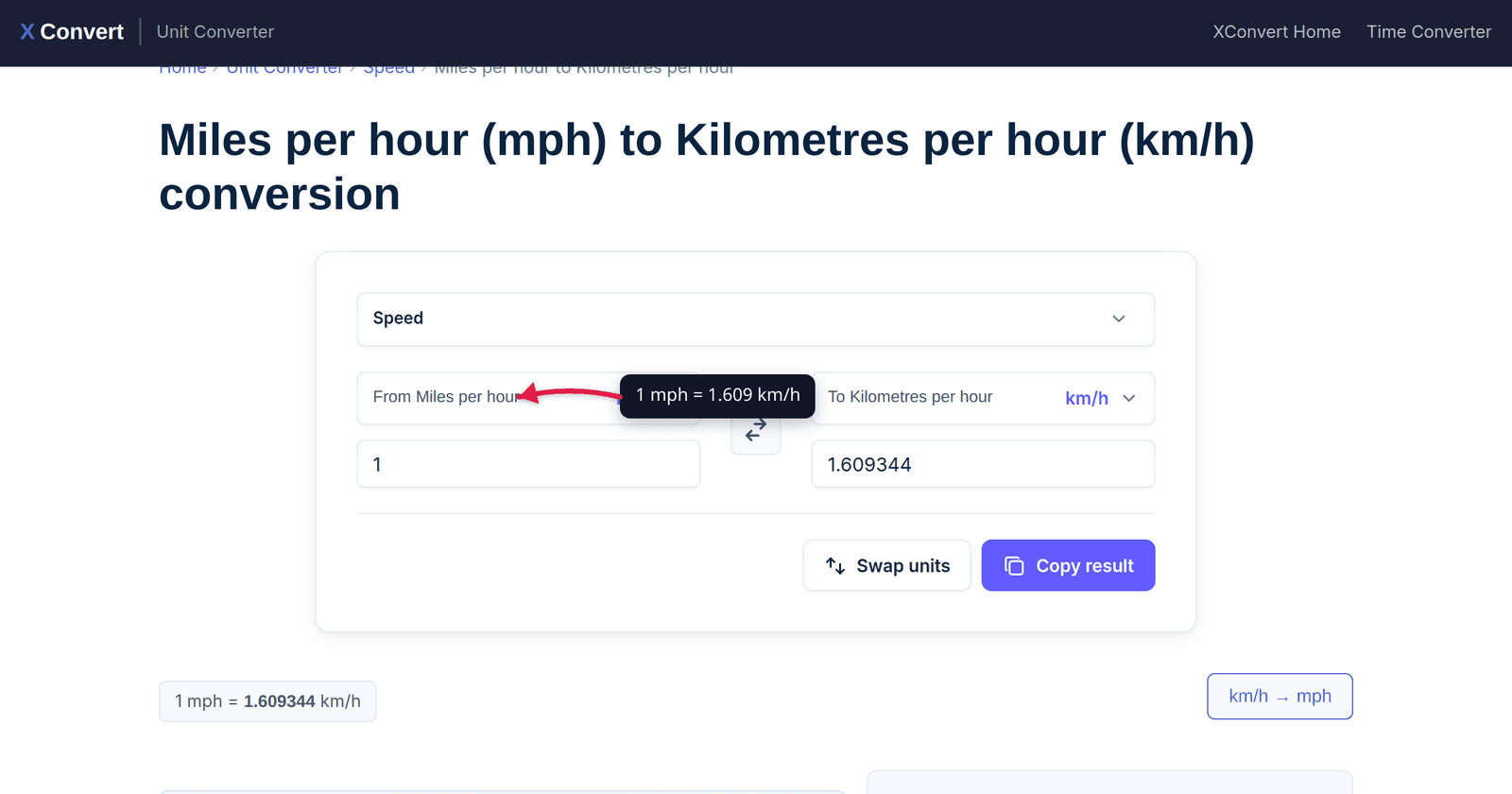
You’ve rented a car in Spain and the highway sign reads 130. Coming from the US or UK, your gut wants to slam the brakes — that can’t be 130 mph, can it? It isn’t. It’s 130 km/h, which is 81 mph. This guide gives you the conversion formula, a reference table for common European speed limits, the country list of who uses what, and the mental-math shortcuts that work when you don’t have time to pull out a calculator.
Quick answer: Multiply mph × 1.609 = km/h. A 130 km/h sign equals 80.8 mph. Mental shortcut: km/h × 0.6 ≈ mph (within 4%). The reverse: mph × 1.6 + 5% = km/h. Most of the world uses km/h; only the US, UK, Liberia, and Myanmar still post mph.
Jump to a section
- The conversion formula
- Common speed limits across Europe
- Quick reference table
- Mental conversion shortcuts
- Which countries use MPH vs KM/H
- Speedometer-reading tips for rental cars
- FAQ
The conversion formula
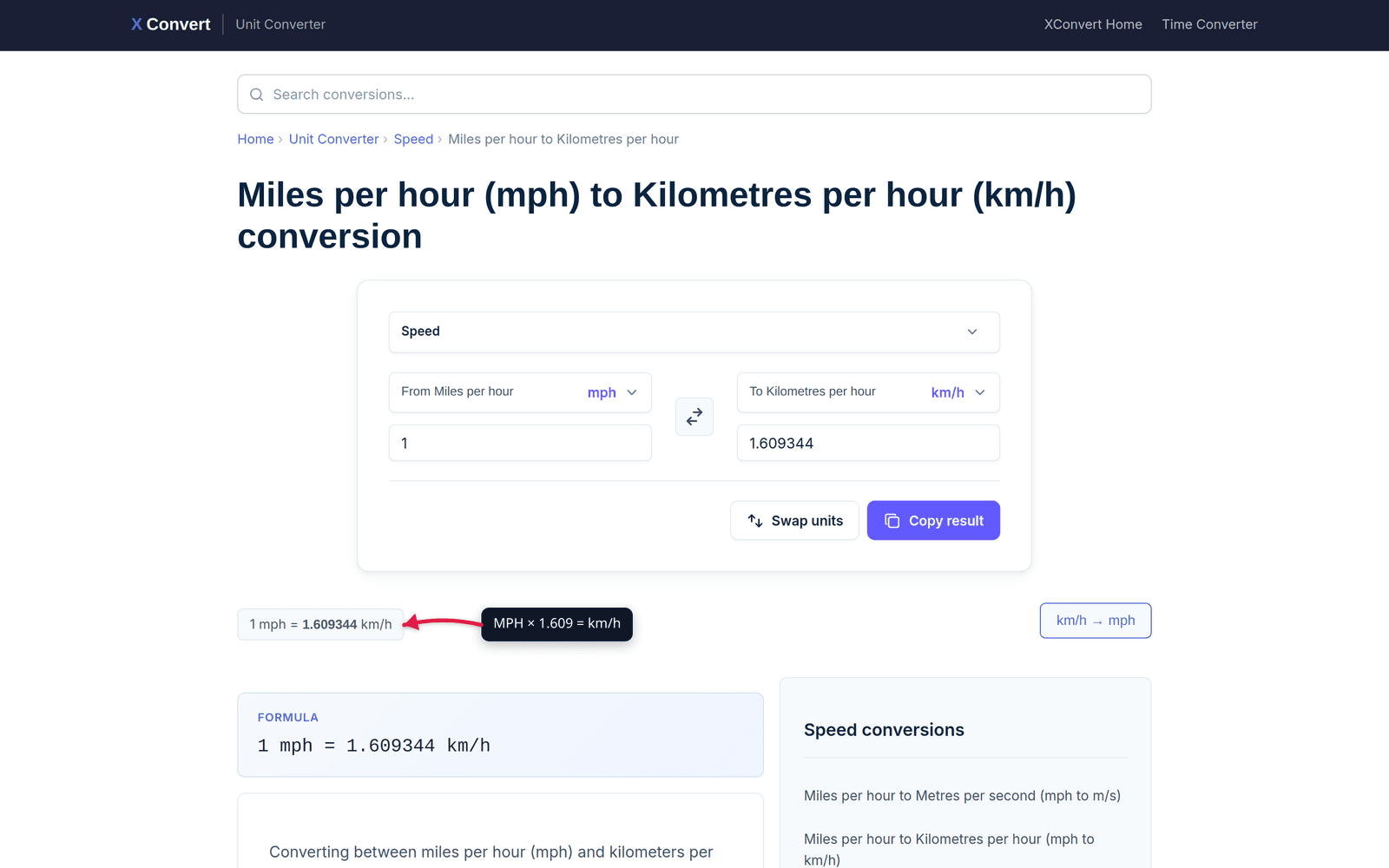
km/h = mph × 1.609344
mph  = km/h × 0.621371
Exact: 1 mph = 1.609344 km/h. The factor 1.609 (rounded to 3 decimals) introduces a 0.02% error — fine for everyday driving but use the full factor for engineering specs. The xconvert MPH to KMH converter carries 13 decimal places.
Common speed limits across Europe
The classic limits you’ll see on European road signs:
| Sign reads (km/h) | Equals (mph) | Where you’ll see it |
|---|---|---|
| 30 | 18.6 | Urban residential, school zones |
| 50 | 31.1 | Standard urban / city roads |
| 70 | 43.5 | Built-up areas with limited visibility |
| 80 | 49.7 | Older inter-city roads, some country roads |
| 90 | 55.9 | Country roads (rural national routes in France, Italy) |
| 100 | 62.1 | Faster country roads (parts of Germany, Netherlands) |
| 110 | 68.4 | Some highway sections, Spain national roads |
| 120 | 74.6 | Standard highway in Spain, Portugal |
| 130 | 80.8 | Standard highway / autoroute in France, Italy, Belgium |
| 140 | 87.0 | Some Eastern European highways (Bulgaria, parts of Poland) |
| 150 | 93.2 | Rare; some Polish autostrada |
| No limit | (Autobahn unrestricted sections) | Germany only — recommended 130 km/h (80.8 mph) |
The most common highway limit in continental Europe is 130 km/h ≈ 81 mph. The most common urban limit is 50 km/h ≈ 31 mph.
Quick reference table
For everyday mental conversions when reading a sign:
| km/h | mph (rounded) |
|---|---|
| 10 | 6 |
| 20 | 12 |
| 30 | 19 |
| 40 | 25 |
| 50 | 31 |
| 60 | 37 |
| 70 | 43 |
| 80 | 50 |
| 90 | 56 |
| 100 | 62 |
| 110 | 68 |
| 120 | 75 |
| 130 | 81 |
| 150 | 93 |
| 200 | 124 |
| mph | km/h (rounded) |
|---|---|
| 5 | 8 |
| 10 | 16 |
| 15 | 24 |
| 20 | 32 |
| 25 | 40 |
| 30 | 48 |
| 35 | 56 |
| 40 | 64 |
| 45 | 72 |
| 50 | 80 |
| 55 | 88 |
| 60 | 97 |
| 65 | 105 |
| 70 | 113 |
| 75 | 121 |
| 80 | 129 |
Mental conversion shortcuts
When you can’t reach for a calculator:
km/h → mph (rough): “Halve and add 10%.”
- 100 km/h → 50 + 5 = 55. Actual: 62. Off by 12%.
- Better: “Take 60% of the km/h number.” 100 × 0.6 = 60 mph. Actual: 62. 3% off.
km/h → mph (better): Multiply by 5/8 (= 0.625).
- 80 × 5/8 = 50. Actual: 49.7. Spot on.
- 130 × 5/8 = 81.25. Actual: 80.8. Spot on.
mph → km/h (rough): “Double and subtract 10%.”
- 60 mph → 120 − 12 = 108. Actual: 97. Off by 11%.
- Better: multiply by 8/5 = 1.6.
- 60 × 1.6 = 96. Actual: 97. Spot on.
Memorable benchmarks:
- 100 km/h ≈ 62 mph (highway equivalent)
- 60 km/h ≈ 37 mph (slow road / urban arterial)
- 30 km/h ≈ 19 mph (school zone, residential)
- 80 mph ≈ 130 km/h (US fast-highway)
- 70 mph ≈ 113 km/h (US interstate)
Which countries use MPH vs KM/H
Use MPH (miles per hour):
- United States
- United Kingdom (including road signs in mph; alongside metric system for most other measurements)
- Liberia
- Myanmar (formerly Burma) — limited road signage; increasingly metric
- Some British overseas territories (Bahamas, Bermuda, Cayman Islands, etc.)
Use KM/H (kilometers per hour):
- All of continental Europe (130+ countries)
- Canada
- Mexico
- Australia and New Zealand
- Japan
- China
- India
- Brazil
- Most of Africa
- Most of Asia
The UK is the most notable mph-using country in Europe — the rest of the continent is uniformly km/h.
Speedometer-reading tips for rental cars
Most modern rental cars have dual-scale speedometers — both km/h and mph displayed. The convention:
- In Europe: km/h is on the outer (larger) scale, mph on the inner (smaller) scale.
- In the US: mph is outer, km/h is inner.
Glance at the scale that matches the road sign you just passed, not your home country’s units. That avoids the cognitive load of mental conversion every time.
Newer rental cars with digital instrument clusters often let you toggle the primary unit. In a Renault, Peugeot, or Citroën rented in Europe, the touchscreen will offer this in Settings → Display.
Navigation apps (Google Maps, Apple Maps, Waze) usually default to the road’s local units. Google Maps in Spain shows km/h; the same app in the US shows mph. The “Speed” warning feature (which alerts you when you exceed the posted limit) uses the same local units. If your phone is set to “Imperial” units globally, the apps may override that for road context — but always double-check before relying on it.
Frequently Asked Questions
How fast is 130 km/h in mph?
130 km/h = 80.78 mph. That’s the standard French and Italian autoroute / autostrada speed limit, equivalent to between US “55 mph” and “70 mph” highway limits.
What’s 60 mph in km/h?
60 mph = 96.56 km/h. Round to 97 km/h for everyday use. This is a typical US highway cruising speed.
Is 100 km/h fast?
100 km/h = 62 mph. That’s slower than typical US interstate cruising (70+ mph) but fast for residential or urban roads anywhere. It’s the standard limit on Dutch and German non-Autobahn highways.
Why does the UK use mph if the rest of Europe uses km/h?
Historical convention. The UK adopted Imperial units (mile, gallon, ounce) early in the British Empire and maintained the road-signage tradition even after going metric for most other measurements (length, weight, temperature). Road signs use mph; speedometers in UK cars are calibrated in mph; speed cameras enforce in mph. EU membership didn’t require harmonizing this.
Does my speeding ticket use mph or km/h?
Whatever the local jurisdiction uses. A speeding ticket in France will be issued in km/h regardless of where the driver is from. A US ticket from California will be in mph. Tickets from Switzerland (km/h) sent to a UK address don’t convert to mph — they’re enforced in the issuing currency and unit.
How accurate is my car’s speedometer?
UN ECE Regulation 39 (followed in the EU and UK) requires speedometers to never under-read: indicated speed must be ≥ actual speed, and may exceed actual by up to 10% + 4 km/h. So a speedometer reading 100 km/h means actual speed is between roughly 87 and 100 km/h. The buffer is intentional: drive at the indicated speed and you’re never over the legal limit. The US has no equivalent federal numerical accuracy spec for passenger-car speedometers; manufacturer practice typically targets ±2–4 mph at highway speeds.
Can I be ticketed in mph if I’m in a km/h country?
Yes — the local unit applies. If you read a 130 km/h limit and drive at 130 mph thinking it’s the same, you’ll be doing 209 km/h — well over any limit and ticket-worthy. Always read signs in the local unit.
Try it now
Convert any speed with the xconvert MPH to KMH converter — full precision, instant. For the reverse KMH to MPH. For driving-related power conversions (engine HP to kW for European cars), see KW to HP for European Engine Specs.
Related guides
- KW to HP: Reading European Car Specs (BMW, Mercedes, Volvo)
- HP to kW for Electric Vehicles: Why EVs Use Both Units
- MPa vs Bar vs PSI: Pressure Units Explained — companion explainer for the bar/psi/kPa confusion on European tire placards.
- kJ vs kcal: Reading Food Labels Without a Calculator — same kind of US-vs-Europe unit puzzle, applied to nutrition labels.
Sources
Last verified 2026-05-19.
- NIST Special Publication 811 — Unit Conversions
- UN ECE — Vehicle Regulations (Reg 39, Speedometer)
- European Commission — Road Safety portal