 By James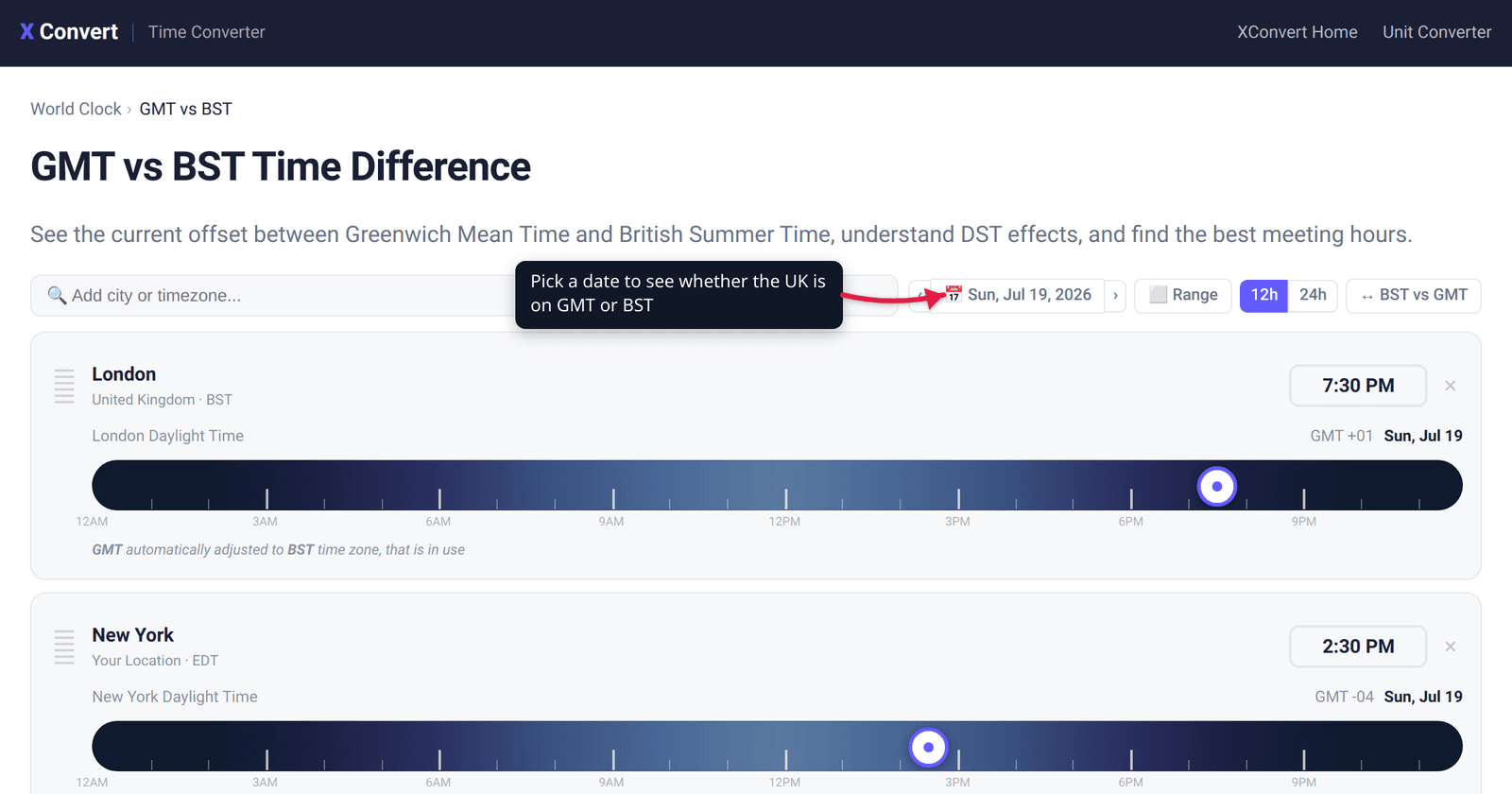
Twice a year, every clock in the United Kingdom jumps an hour — and twice a year, a wave of missed calls follows, because “UK time” quietly stops meaning what it meant the week before. If you schedule with British colleagues, clients, or family, the GMT/BST switch is worth understanding properly: which one is in force when, the exact 2026 dates, and the sneaky three-week window when London is only four hours ahead of New York instead of five. All dates and rules below are verified against gov.uk and the Royal Observatory Greenwich.
Quick answer: The UK runs on GMT (UTC+0) in winter and BST — British Summer Time (UTC+1) — in summer. Clocks go forward one hour at 1:00 a.m. on the last Sunday in March and back one hour at 2:00 a.m. on the last Sunday in October. In 2026 that’s March 29 (GMT → BST) and October 25 (BST → GMT). Right now, in July, the UK is on BST, one hour ahead of GMT/UTC.
Jump to a section
- GMT and BST: the UK’s two clocks
- When the clocks change (2026 dates)
- A short history: from Willett’s pamphlet to the 1972 Act
- The transatlantic wrinkle: the 4-hour weeks
- See GMT vs BST on xconvert
- FAQ
GMT and BST: the UK’s two clocks
GMT — Greenwich Mean Time — is UTC+0, the UK’s standard (winter) time and the historical reference from which world time was measured. BST — British Summer Time — is UTC+1, the daylight-saving time the UK switches to for the warmer seven months. Same country, same longitude, two different offsets depending on the calendar.
The names trip people up in both directions:
- In summer, UK sources sometimes write “GMT” while quoting wall-clock (BST) times — off by an hour for anyone reading it literally. If you want the technical reference time, GMT vs UTC are equivalent on the clock; if you want UK local time, the honest label from late March to late October is BST.
- BST is numerically the same offset as Central European (winter) Time, UTC+1 — but the UK is not on Central European time: when Paris and Berlin move to CEST (UTC+2) each summer, Britain moves to BST (UTC+1), so London stays one hour behind its continental neighbours all year.
When the clocks change (2026 dates)
The rule, per gov.uk: forward 1 hour at 1:00 a.m. on the last Sunday in March; back 1 hour at 2:00 a.m. on the last Sunday in October.
| Date (2026) | What happens | UK offset after |
|---|---|---|
| Sunday 29 March, 1:00 a.m. | Clocks spring forward to 2:00 a.m. — one hour is skipped | BST, UTC+1 |
| Sunday 25 October, 2:00 a.m. | Clocks fall back to 1:00 a.m. — one hour repeats | GMT, UTC+0 |
The same last-Sunday rule applies every year (2027, 2028…), so you can derive future dates without looking them up. The EU changes clocks on those same last Sundays of March and October, which keeps London–Paris at a constant hour apart; the United States does not use the same dates, which produces the wrinkle below.
A short history: from Willett’s pamphlet to the 1972 Act
British Summer Time is one of history’s more successful pamphleteering campaigns. Per the Royal Observatory Greenwich:
- 1907 — London builder William Willett publishes The Waste of Daylight, campaigning to shift clocks so summer evenings stay light.
- 1916 — Germany adopts daylight saving first; wartime Britain follows a few weeks later, along with many other combatant nations.
- 1939–1945 — Britain runs British Double Summer Time: clocks two hours ahead of GMT in summer, and kept one hour ahead even through winter.
- 1968–1971 — The UK experiments with staying one hour ahead year-round, with no autumn change. The trial is abandoned after officials found it “impossible to assess the advantages and disadvantages.”
- 1972 — The British Summer Time Act puts the modern spring-forward/fall-back arrangement on a statutory footing; the dates were later harmonised with Europe’s last-Sunday rule.
The debate never fully ended — proposals to scrap the change or move the UK permanently forward resurface regularly — but as of 2026 the twice-a-year switch is alive and well.
The transatlantic wrinkle: the 4-hour weeks
London and New York are famously five hours apart — except when they aren’t. The US springs forward on the second Sunday in March (March 8 in 2026, per NIST) while the UK waits until the last Sunday (March 29). The autumn dates mismatch too: the UK falls back October 25, the US on November 1.
| 2026 window | London | New York | Gap |
|---|---|---|---|
| Jan 1 – Mar 8 | GMT | EST | 5 hours |
| Mar 8 – Mar 29 | GMT | EDT | 4 hours |
| Mar 29 – Oct 25 | BST | EDT | 5 hours |
| Oct 25 – Nov 1 | GMT | EDT | 4 hours |
| Nov 1 – Dec 31 | GMT | EST | 5 hours |
If you run a recurring London–New York call, those two mismatch windows — three weeks in March, one week in late October — are precisely when it will land an hour off for one side. Check any UK↔US series against those dates each spring and autumn.
See GMT vs BST on xconvert
The xconvert GMT vs BST page shows both British clocks on one hour grid, with the current offset applied automatically:
- Open xconvert.com/time-converter/gmt-vs-bst — London loads on a 24-hour comparison grid, and the page notes when “GMT automatically adjusted to BST” is in effect.
- Pick a date with the ‹ › arrows or the 📅 date button — set it to March 29 or October 25 to watch the offset flip.
- Toggle 12h / 24h to taste.
- Click + Add City to add New York, Delhi, or Sydney and see how the UK change ripples against zones that switch on different dates (or never).
- Export a slot with 📅 Add to Cal (ICS) or 🗓 Google Cal, or send the grid with 🔗 Share Link.
For a reference card on Britain’s summer clock see the BST time zone page, and to convert specific times use the BST to GMT converter. DST rules and historical changes are tracked from the IANA timezone database, so even past dates resolve to the offset that actually applied.
FAQ
Is the UK on GMT or BST right now?
In July, BST (UTC+1). The UK is on GMT only from the last Sunday in October to the last Sunday in March — in 2026, from October 25 onward.
When do the clocks go back in 2026?
Sunday 25 October 2026, at 2:00 a.m., when UK clocks return to GMT. They went forward to BST on Sunday 29 March 2026 at 1:00 a.m.
Is BST the same as CET?
They share the UTC+1 offset in a numerical sense, but they’re different zones on different schedules: BST is the UK’s summer time, while UTC+1 is Central Europe’s winter time. Because both regions shift together each season, London stays one hour behind Paris and Berlin all year round.
Did the UK ever stay on BST all year?
Yes — twice, in effect. During the Second World War Britain used Double Summer Time (GMT+2 in summer, GMT+1 in winter), and from 1968 to 1971 the country trialled staying an hour ahead year-round before abandoning the experiment.
Does Ireland change its clocks on the same dates?
Yes. Ireland moves on the same last Sundays of March and October; its summer time is called Irish Standard Time (UTC+1), so Dublin and London always show the same wall-clock time.
Why is London sometimes only 4 hours ahead of New York?
Because the US changes clocks earlier in spring (second Sunday of March) and later in autumn (first Sunday of November) than the UK. In 2026 the gap narrows to 4 hours from March 8–29 and October 25–November 1.
Sources
Last verified 2026-07-19.
- gov.uk — When do the clocks change? — the 1:00 a.m. last-Sunday-in-March / 2:00 a.m. last-Sunday-in-October rule; 2026 dates March 29 and October 25; GMT in winter, BST in summer.
- Royal Museums Greenwich — British Summer Time (BST) and daylight saving — Willett’s 1907 campaign, 1916 adoption, wartime Double Summer Time, the 1968–71 experiment, and the British Summer Time Act 1972.
- NIST — Daylight Saving Time rules — US DST dates (second Sunday in March / first Sunday in November; March 8 / November 1 in 2026), used for the London–New York gap table.