 By Stephanie Taylor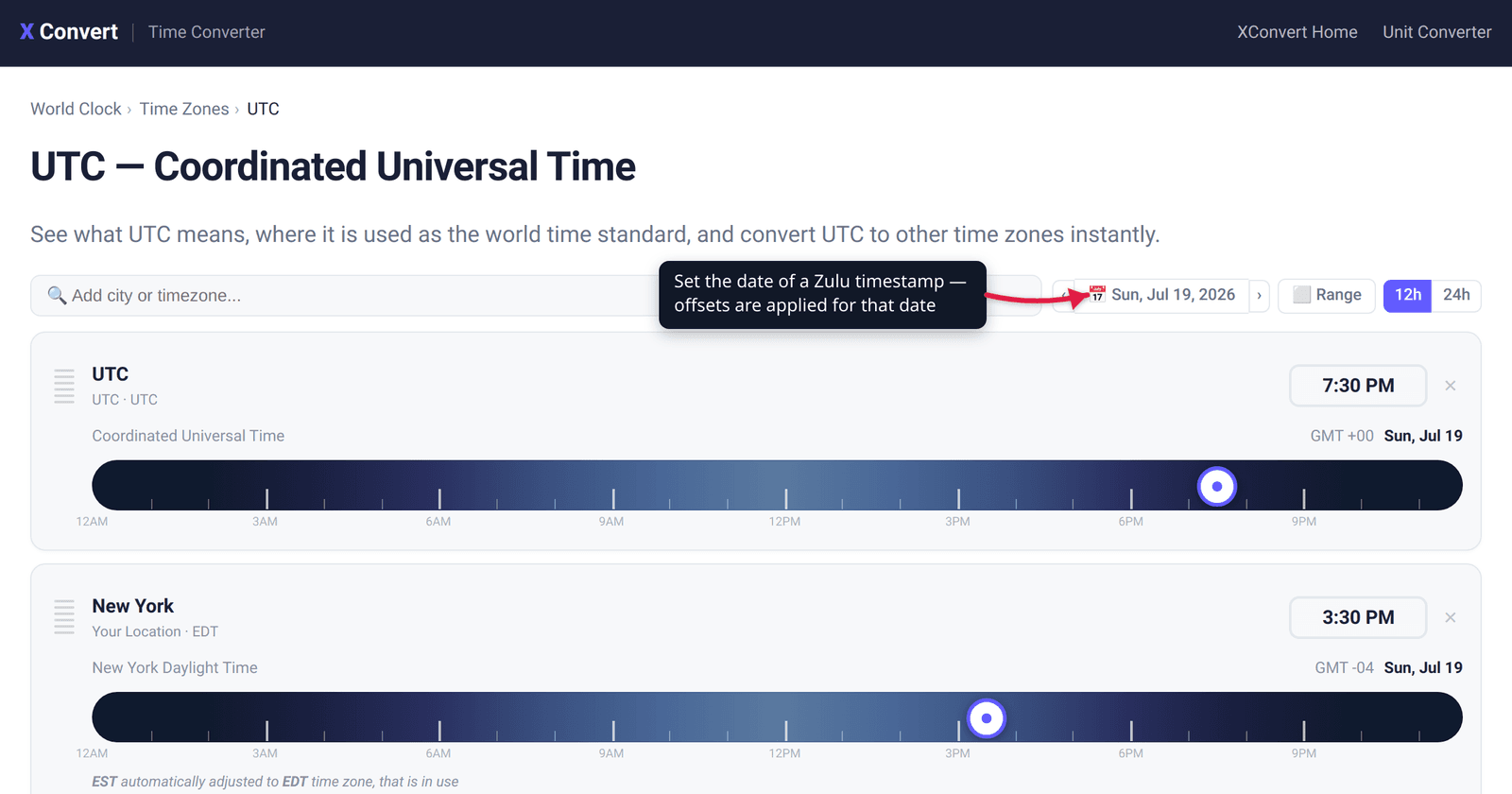
A weather report says the wind shifted at 1500Z. A flight plan departs at 0230Z. A military order is stamped 191300Z JUL 26. That trailing letter is “Zulu” — and if you’ve ever wondered what it means, the answer is refreshingly simple: Zulu time is UTC, the world’s reference clock, written in a notation built for radio. This guide explains where the Z comes from, how the full military A-to-Z zone alphabet works, why pilots and soldiers refuse to use local time, and how to convert a Zulu timestamp to your own wall clock without an off-by-one-hour error. Definitions are verified against NIST and standard military/aviation references.
Quick answer: Zulu time = UTC+0. “Z” is the letter the military assigns to the zero-meridian time zone, and “Zulu” is simply Z in the NATO phonetic alphabet — so 1500Z means 15:00 UTC. Aviation and the military run everything on it because one shared clock eliminates every time-zone and daylight-saving ambiguity. To convert: New York is Z−4 in summer and Z−5 in winter; London is Z+0 in winter and Z+1 in summer; India is Z+5:30 all year.
Jump to a section
- What Zulu time is
- The military time zones from Alpha to Zulu
- Why aviation and the military use it
- Converting Zulu to your local time
- Convert UTC/Zulu on xconvert
- FAQ
What Zulu time is
Militaries and mariners label the world’s time zones with letters. The zone at the prime meridian — offset zero — got the letter Z, and in the NATO phonetic alphabet (“Alpha, Bravo, Charlie…”) Z is spoken as “Zulu.” Per NIST, the Z zone “is equivalent to Coordinated Universal Time (UTC)”: the lettering convention dates back to nautical time zones of the 1920s and survives today in military, nautical, and aviation use.
Reading it is mechanical: a Zulu timestamp is a 24-hour time with Z appended. 0900Z is 09:00 UTC; 2130Z is 21:30 UTC. Military documents extend it into a date-time group — 191300Z JUL 26 reads as day 19, 13:00 Zulu, July 2026. However it’s written, the meaning never bends: Zulu has no daylight saving, no seasons, no local politics. It is the same instant for everyone on Earth.
Zulu, UTC, and GMT all describe the same clock for everyday purposes — the differences between the labels are historical and technical, and we’ve unpacked them in GMT vs UTC: what’s actually the difference?
The military time zones from Alpha to Zulu
The full system assigns one letter per offset, phonetic-alphabet style:
| Letter | Name | Offset | Letter | Name | Offset |
|---|---|---|---|---|---|
| A | Alpha | UTC+1 | N | November | UTC−1 |
| B | Bravo | UTC+2 | O | Oscar | UTC−2 |
| C | Charlie | UTC+3 | P | Papa | UTC−3 |
| D | Delta | UTC+4 | Q | Quebec | UTC−4 |
| E | Echo | UTC+5 | R | Romeo | UTC−5 |
| F | Foxtrot | UTC+6 | S | Sierra | UTC−6 |
| G | Golf | UTC+7 | T | Tango | UTC−7 |
| H | Hotel | UTC+8 | U | Uniform | UTC−8 |
| I | India | UTC+9 | V | Victor | UTC−9 |
| K | Kilo | UTC+10 | W | Whiskey | UTC−10 |
| L | Lima | UTC+11 | X | X-ray | UTC−11 |
| M | Mike | UTC+12 | Y | Yankee | UTC−12 |
| Z | Zulu | UTC±0 | J | Juliett | observer’s local time |
Details worth knowing: J (Juliett) is not a place — it was originally skipped (following the old convention of avoiding J because it can be confused with I) and is now used to mean “the observer’s local time.” Note that letters attach to offsets, not places: New York is Romeo (UTC−5) in winter but Quebec (UTC−4) during daylight saving. And half-hour zones like India’s UTC+5:30 have no letter at all — one more reason the letters survive mainly in military message formats while everyone else just writes UTC.
Why aviation and the military use it
Both operate across many time zones at once, at speed, where a one-hour misunderstanding can be catastrophic. A single reference clock solves three problems in one stroke:
- No zone arithmetic mid-operation. A flight crossing five zones logs everything — departure, position reports, fuel checks — against one clock. Aviation weather reports (METARs), forecasts (TAFs), NOTAMs, and flight plans are all issued in UTC/Zulu, following ICAO convention.
- No daylight-saving traps. Local clocks jump twice a year; Zulu never does. A recurring 1400Z briefing is the same instant in March as in April, even while every participant’s wall clock shifted around it.
- No ambiguity between distributed teams. “Attack at 0600” means six different things across six zones; 0600Z means exactly one. The same logic is why servers, logs, and APIs run on UTC — modern computing quietly adopted the military’s answer.
Converting Zulu to your local time
The recipe: local time = Zulu time + your UTC offset — remembering that the offset itself may change with daylight saving:
| Location | Winter | Summer | 1500Z becomes |
|---|---|---|---|
| New York | Z−5 (EST) | Z−4 (EDT) | 10:00 AM / 11:00 AM |
| Chicago | Z−6 (CST) | Z−5 (CDT) | 9:00 AM / 10:00 AM |
| Los Angeles | Z−8 (PST) | Z−7 (PDT) | 7:00 AM / 8:00 AM |
| London | Z+0 (GMT) | Z+1 (BST) | 3:00 PM / 4:00 PM |
| New Delhi | Z+5:30 (IST) | same — no DST | 8:30 PM |
| Sydney | Z+11 (AEDT — southern summer) | Z+10 (AEST — southern winter) | 2:00 AM next day / 1:00 AM next day |
(The “winter/summer” columns are northern-hemisphere seasons; Sydney’s daylight saving runs opposite, so in July it sits at Z+10.) Two classic pitfalls: forgetting which season’s offset applies (US clocks change March 8 / November 1 in 2026; the UK on March 29 / October 25), and missing a date rollover — 0230Z on the 19th is still the evening of the 18th anywhere in the Americas. When a timestamp matters, convert it with a tool that applies the right seasonal offset for that specific date rather than doing the arithmetic from memory.
Convert UTC/Zulu on xconvert
The xconvert UTC time zone page is a Zulu converter in all but name — UTC is the reference row, and your zones line up beneath it:
- Open xconvert.com/time-converter/utc-time-zone — Coordinated Universal Time loads on a 24-hour comparison grid.
- Click + Add City and add your location (and your counterpart’s) — each appears as its own hour row under the UTC row, so 1500Z reads straight down the column, date rollovers included.
- Set the date of the timestamp with the ‹ › arrows or the 📅 date button — the grid applies each city’s daylight-saving rule for that date, which is exactly the step manual conversion gets wrong.
- Toggle 24h display to match Zulu notation (or 12h if you prefer AM/PM).
- Export the moment with 📅 Add to Cal (ICS) or 🗓 Google Cal, or hand teammates the 🔗 Share Link so everyone reads the same grid.
Offsets and DST rules come from the IANA timezone database, so historical Zulu timestamps — last winter’s logs, an old METAR — resolve against the offsets that applied on that date.
FAQ
Is Zulu time the same as GMT?
For everyday purposes, yes — Zulu, UTC, and GMT all read the same on a clock, and NIST treats them as equivalent when sub-second precision doesn’t matter. Strictly, Zulu is the military label for UTC+0, GMT is a time zone; the nuances are covered in GMT vs UTC.
What time is 1200Z in New York?
8:00 a.m. EDT in summer, 7:00 a.m. EST in winter. New York is Z−4 during US daylight saving (March 8 – November 1 in 2026) and Z−5 otherwise.
Does Zulu time observe daylight saving?
Never. Zulu/UTC is constant year-round. Only your local offset from Zulu changes when your clocks spring forward or fall back.
Why is it called Zulu?
Because the zero-offset zone is lettered Z, and Z is spoken “Zulu” in the NATO phonetic alphabet. It’s radio-friendly shorthand, not a reference to any place or people.
What is J or Juliett time?
The observer’s local time. J was originally left out of the zone alphabet (J being easily confused with I), and was later repurposed to mean “local time wherever the reader is standing.”
Is military time the same as Zulu time?
No — they’re two independent conventions that often appear together. Military time is the 24-hour clock format (1830 instead of 6:30 p.m.); Zulu is a time zone (UTC+0). “1830” could be local; “1830Z” is UTC.
Sources
Last verified 2026-07-19.
- NIST — How is UTC(NIST) related to UTC, TAI, GMT, GPS time and Zulu time? — the Z zone “is equivalent to Coordinated Universal Time (UTC)”; 1920s nautical origin; still used in military, nautical, and aviation settings.
- Wikipedia — Military time zone — the full A–Z letter table, J (Juliett) as observer’s local time, and the “Juliett” spelling (aggregator; cross-checked with timeanddate’s military zones list).
- timeanddate — Zulu Time Zone (Z) — Z = UTC+0 as used in military and aviation.
- NIST — Daylight Saving Time rules — the 2026 US DST dates (March 8 / November 1) used in the conversion table.