 By James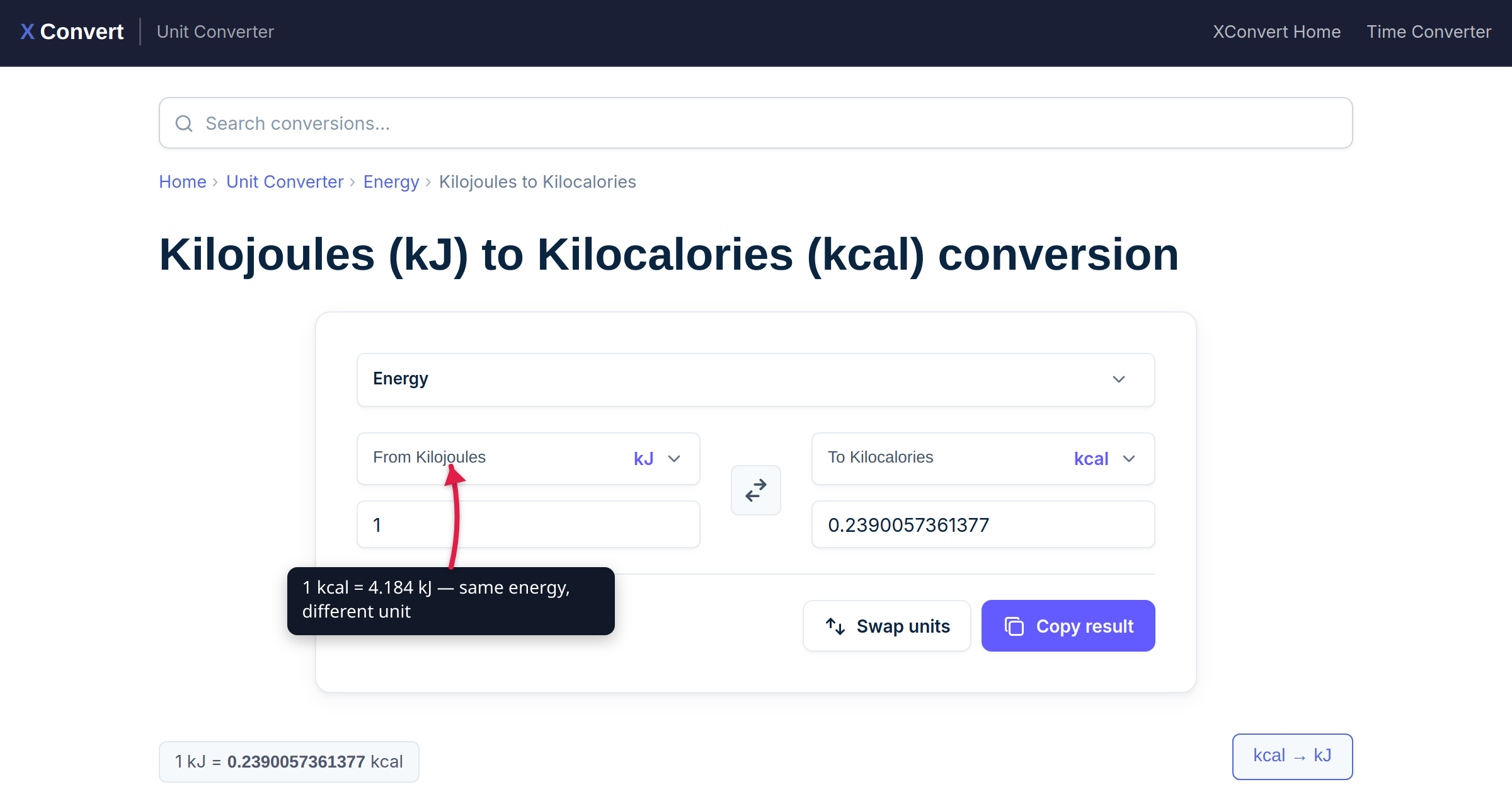
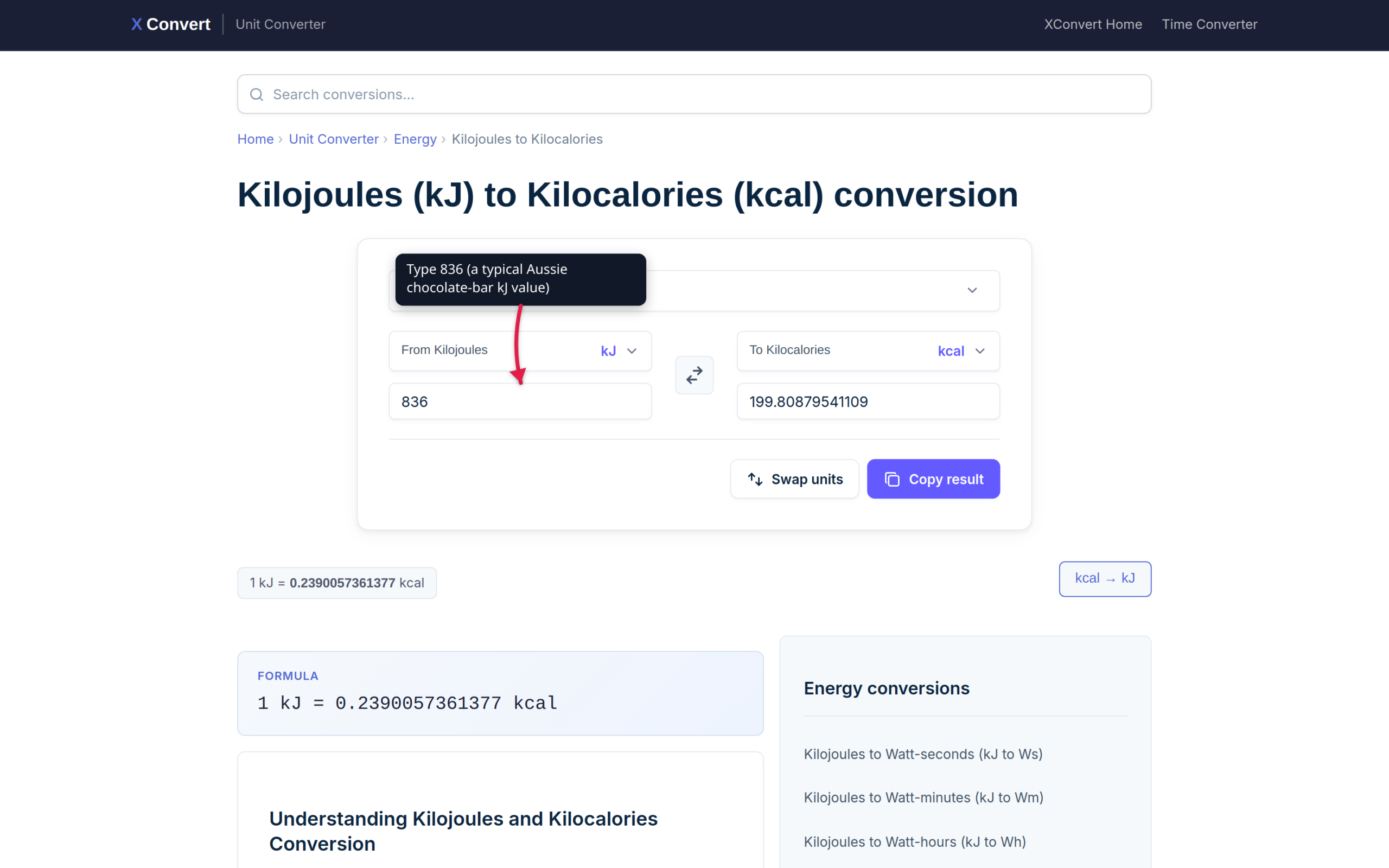
A chocolate bar wrapper says “836 kJ” in Australia and “200 cal” in the United States — and they’re describing the same energy. The reason is that kJ and kcal are both energy units, with the small-c “calorie” on US food labels actually meaning kilocalorie (kcal). This guide explains the conversion, the food-label confusion, and three ways to convert without a calculator.
Quick answer: Divide kJ by 4.184 to get kcal. 1 kcal = 4.184 kJ, exactly. So 836 kJ = 200 kcal. The fastest mental shortcut is to multiply kJ by 0.24 (accurate to within 0.5%), or divide by 4 (about 4% off).
Jump to a section
- The 4.184 ratio in one line
- Why food labels confuse “Calorie” and “calorie”
- Country-by-country: which unit appears on packaging
- EU label requirements: what the law actually says
- Three ways to convert in your head
- Worked examples — typical foods
- Macros: kJ per gram of fat, carbs, protein
- Nutrition panels: US vs EU vs Australia
- kJ and kcal burned per common exercise
- Daily energy targets by sex and age
- Switching your fitness tracker between kJ and kcal
- Use the xconvert kJ to calories tool
- FAQ
The 4.184 ratio in one line
1 kcal = 4.184 kJ (exactly, by the definition of the thermochemical calorie).
That means to convert:
- kJ → kcal: divide by 4.184 (or multiply by 0.239)
- kcal → kJ: multiply by 4.184
A more useful approximation: kJ ÷ 4 ≈ kcal. The error is about 4.4% — close enough to compare snack sizes at a glance.
Why food labels confuse “Calorie” and “calorie”
There are two “calories” in physics, separated by a factor of 1,000:
| Unit | Symbol | Value | Where it appears |
|---|---|---|---|
| calorie (gram calorie) | cal | 4.184 J | Chemistry textbooks |
| Calorie / kilocalorie | Cal or kcal | 4,184 J = 4.184 kJ | Food labels, nutrition |
When a US Nutrition Facts panel says “Calories 200”, it means 200 kilocalories — 836,800 small-c calories, or 836 kJ. The food industry adopted the capital-C convention in the early 1900s to avoid writing “200,000 calories” on every label, then quietly dropped the capital.
The result: when you read “200 calories” on a candy bar, mentally translate that to “200 kcal” or “836 kJ” — that’s what your body actually metabolises.
Country-by-country: which unit appears on packaging
| Region | Required unit on label | Optional unit shown |
|---|---|---|
| United States | Calories (= kcal) | — |
| Canada | Calories (= kcal) | — |
| EU / UK | kJ and kcal (both required) | — |
| Australia / New Zealand | kJ (primary) | kcal often shown alongside |
| Japan | kcal | — |
| China | kJ | kcal often shown |
If you’re reading a European label that lists “836 kJ / 200 kcal” per serving, those are the same energy expressed twice — not the sum.
EU label requirements: what the law actually says
Energy declarations on EU packaging are governed by Regulation (EU) No 1169/2011, the Food Information to Consumers Regulation. The rules are stricter than most shoppers realise:
- Energy must be shown in BOTH kJ and kcal, with kJ listed first. “Energy: 962 kJ / 230 kcal” is the canonical order — showing only kcal is a labelling violation in any EU member state.
- Per 100 g/mL is mandatory. A “per serving” column is optional and can sit alongside per-100 g but cannot replace it. This is why a small chocolate square and a 100 g family bar of the same brand both show an identical “Energy 2,300 kJ” per 100 g — that’s the regulatory anchor.
- Mandatory fields are exactly seven: energy, fat, saturates, carbohydrate, sugars, protein, salt. Anything else (fibre, vitamins, sodium-not-as-salt) is voluntary supplementary content.
- Reference Intake (RI): the phrase “Reference intake of an average adult (8,400 kJ / 2,000 kcal)” must appear in close proximity whenever any %-of-RI numbers are shown. The %RI scales linearly — a 460 kcal item is 23% of the 2,000 kcal RI.
UK retailers add a voluntary front-of-pack “traffic light” system (red/amber/green) that converts kJ-per-100g into a colour rating for fat, saturates, sugar, and salt. It’s not mandated by the regulation but is enforced by the major supermarkets’ own label policy. Australia uses the separate Health Star Rating instead — also voluntary, also widely adopted on retail shelves.
Three ways to convert in your head
1. Divide by 4 (fast, ~4% off)
- 1,000 kJ ÷ 4 = 250 kcal (actual: 239)
- 2,500 kJ ÷ 4 = 625 kcal (actual: 597)
2. Divide by 4, subtract 4%
- 2,500 kJ ÷ 4 = 625, minus ~25 = ~600 kcal ✓
3. Multiply by 0.24 (closest mental shortcut)
- 836 × 0.24 ≈ 201 kcal (actual: 200) ✓
- 1,500 × 0.24 ≈ 360 kcal (actual: 359) ✓
For exact values, use the kilojoules to kilocalories converter — it gives the precise figure plus a 10-row reference table.
Worked examples — typical foods
| Food (typical serving) | kJ | kcal |
|---|---|---|
| Banana (medium, 118 g) | 379 kJ | 91 kcal |
| Can of Coca-Cola (330 mL) | 580 kJ | 139 kcal |
| Slice of cheese pizza (107 g) | 1,005 kJ | 240 kcal |
| Big Mac | 2,300 kJ | 550 kcal |
| Avocado (whole, 200 g) | 1,343 kJ | 321 kcal |
| Plain croissant (60 g) | 1,067 kJ | 255 kcal |
| Olive oil (1 tbsp, 14 g) | 510 kJ | 122 kcal |
| 100 g cooked white rice | 540 kJ | 130 kcal |
| Starbucks Grande Latte (whole milk, 16 oz) | 1,005 kJ | 240 kcal |
| McDonald’s small fries (71 g) | 950 kJ | 230 kcal |
| Salmon fillet, cooked (100 g) | 880 kJ | 210 kcal |
| Oatmeal, cooked with water (100 g) | 285 kJ | 68 kcal |
Reading an Aussie meat-pie label that shows “1,800 kJ” suddenly means something: ~430 kcal, about one-fifth of a typical 2,000 kcal daily target.
Macros: how many kJ in 1 g of fat, carbs, and protein?
The Atwater factors used on every food label worldwide:
| Macronutrient | kJ per gram | kcal per gram | Notes |
|---|---|---|---|
| Fat | 37 kJ | 9 kcal | More than double protein/carbs by gram |
| Carbohydrate | 17 kJ | 4 kcal | Same as protein per gram |
| Protein | 17 kJ | 4 kcal | Same as carbs by gram |
| Alcohol | 29 kJ | 7 kcal | Often hidden in beverage labels |
| Dietary fibre | 8 kJ | 2 kcal | EU & AU only count fibre; US sets it to 0 |
This is why a tablespoon of olive oil (~14 g fat × 37 kJ = ~510 kJ) packs more energy than a tablespoon of sugar (~12 g carb × 17 kJ = ~204 kJ). It’s also why “low-fat” foods often add sugar to compensate — replacing 9-kcal-per-gram fat with 4-kcal-per-gram carb halves the macro density.
Reading nutrition panels: US vs EU vs Australia side-by-side
The same chocolate bar, labelled three ways:
| Label region | What you see | Reading guide |
|---|---|---|
| US | “Calories 230” per serving | Capital C means kcal. Multiply by 4.184 → 962 kJ. |
| EU / UK | “Energy: 962 kJ / 230 kcal” per 100 g | Both numbers shown; same energy expressed twice. |
| Australia / NZ | “Energy 962 kJ” (kcal often shown alongside) | kJ is primary; “energy” almost always means kJ. |
Three label conventions to know:
- Per serving vs per 100 g. EU labels often show both columns; serving size differs by manufacturer. Always check the column header.
- % Daily Value. US-only convention. Based on a 2,000 kcal reference adult; the percentage scales linearly (a 460 kcal item = 23% DV).
- Reference Intake (RI). EU/UK equivalent of %DV. Based on 8,400 kJ (2,000 kcal) for an average adult.
kJ and kcal burned per common exercise
The flip side of intake. Energy expended in a 30-minute session for a 70 kg adult (approximate):
| Activity | kJ burned | kcal burned |
|---|---|---|
| Walking, brisk (5 km/h) | 630 kJ | 150 kcal |
| Walking, hill / hiking | 1,250 kJ | 300 kcal |
| Cycling, leisure (15 km/h) | 1,050 kJ | 250 kcal |
| Cycling, vigorous (25 km/h) | 1,750 kJ | 420 kcal |
| Running (8 km/h) | 1,460 kJ | 350 kcal |
| Running (12 km/h) | 2,300 kJ | 550 kcal |
| Swimming, moderate | 1,260 kJ | 300 kcal |
| Weight training (moderate) | 920 kJ | 220 kcal |
| Yoga, hatha | 630 kJ | 150 kcal |
| HIIT, intense | 1,680 kJ | 400 kcal |
A 600 kJ croissant = roughly 20 minutes of brisk walking. A Big Mac (2,300 kJ) = roughly 75 minutes of running at 8 km/h. The math holds across regions even when the labels look different.
Daily energy targets by sex and age
Reference adult intake on a label is 2,000 kcal / 8,400 kJ — but the real target depends on body size, sex, and activity:
| Group | kcal/day | kJ/day |
|---|---|---|
| Sedentary adult woman | 1,600–2,000 | 6,700–8,400 |
| Active adult woman | 2,000–2,400 | 8,400–10,000 |
| Sedentary adult man | 2,000–2,400 | 8,400–10,000 |
| Active adult man | 2,400–3,000 | 10,000–12,600 |
| Teenager (14–18) | 1,800–3,200 | 7,500–13,400 |
| Toddler (2–3) | 1,000–1,400 | 4,200–5,900 |
Most fitness trackers (Apple Health, Fitbit, Garmin) default to kcal in the US/UK and to kJ in Australia. The number you see on your watch and the number on a packet of pasta are the same unit — once you’ve converted.
Switching your fitness tracker between kJ and kcal
Apple Health, Fitbit, Garmin, and most other fitness apps default to the energy unit of your region — kcal in the US/UK, kJ in Australia/New Zealand. If you’ve travelled, changed device locale, or just want your watch numbers to match your food labels, every major tracker exposes a toggle:
Apple Health (iPhone) — open the Health app → Browse tab → Activity → Active Energy → tap Unit → choose Calories or Kilojoules. The change syncs to the Apple Watch Activity rings and the Workout app automatically.
Apple Watch (direct) — on the watch, Settings → Workout → Units of Measure → Energy → Kilojoules (or Kilocalories). Useful when the phone isn’t handy.
Fitbit — open the Fitbit app → tap your profile picture → Fitbit Settings → App Settings → Date, Time & Units → tap Energy under “Units of Measurement” → pick kJ or kcal. Sync your device afterwards so the on-wrist display matches.
Garmin Connect — Garmin doesn’t expose a top-level “energy unit” toggle the way Apple and Fitbit do; the energy display follows the broader Settings → Display Settings → Measurement Units preference (Statute / Metric). To force kJ specifically on Garmin watches that support data fields, install the free Kilojoules field from the Connect IQ Store and add it to your activity profile.
Strava and MyFitnessPal — neither lets you switch the unit on activity or food-log views; both hard-code kcal for US accounts and kJ for Aus/NZ accounts. The workaround is to convert manually (× 4.184) or use the unit-aware Apple Health export as the source of truth.
If your tracker shows “calories” without a qualifier, it means kilocalories regardless of brand — same unit as on a US food label.
Use the xconvert kJ to calories tool
If you need an exact figure — for recipe scaling, dietary tracking, or comparing two products with different unit conventions — open xconvert’s kilojoules to kilocalories converter. Type any number of kilojoules in the left box; the right box updates instantly with the food-label kcal value. The page shows the exact formula and a 10-row reference table.
Other related converters on xconvert:
- Kilojoules to calories — outputs the small-c gram calorie (1 kcal = 1,000 cal). Use this for chemistry / physics, not food labels.
- Kilocalories to kilojoules — reverse direction, food-label safe.
- Joules to calories — physics homework.
Related explainer articles on the xconvert blog:
- MPa vs Bar vs PSI: pressure units explained — three pressure scales for the same physical quantity, same kind of unit-system puzzle.
- KW to HP: reading European car specs — the engine-power equivalent of the kJ/kcal regional divide.
- MPH to KM/H for driving in Europe — speed-unit reading guide for the same kind of border-crossing problem.
FAQ
Are “Calories” and “kcal” the same thing?
Yes — on food labels, “Calories” (capital C) means kilocalories. 200 Cal on a US Nutrition Facts panel = 200 kcal = 836 kJ. The capitalisation distinction is rarely observed, so most people use “calories” and “kcal” interchangeably in everyday speech.
Why does Australia use kJ on labels?
Australia and New Zealand adopted the metric system fully and follow the international SI convention — joules are the SI unit of energy. The Food Standards Code (FSANZ) requires kJ as the primary unit on packaging. Kilocalories may be displayed alongside but cannot replace kJ.
Is the conversion factor exactly 4.184?
Yes — the thermochemical calorie is defined as exactly 4.184 J. There’s also a slightly different “International Table calorie” of 4.1868 J used in some engineering contexts, and the “15-degree calorie” of 4.1855 J. For nutrition, food labels, and consumer use, 4.184 is the standard.
How do I convert kcal back to kJ?
Multiply by 4.184. Quick mental check: multiply by 4 and add ~5%. A 200 kcal snack is 200 × 4 = 800, plus 5% = 840 kJ (actual: 836).
Why does my fitness tracker show “calories” but not kJ?
Fitness apps inherit the US convention. Apple Health, Fitbit, Garmin, and most American-developed apps display “calories” meaning kcal. European apps (Polar, Suunto) often show kJ as well. Check your app’s regional settings — some let you switch the unit.
Are food calories the same as exercise calories?
Yes — both are kcal. When a treadmill shows “burned 350 cal,” it means 350 kcal of energy expended, the same kcal unit on your food label. Eating 350 kcal and burning 350 kcal cancel out at a thermodynamic level (the real-world picture involves metabolism, but the units match).
What’s the difference between kJ, kcal, and joules?
The joule (J) is the SI base unit of energy. A kilojoule (kJ) is 1,000 joules. A kilocalorie (kcal, or “food Calorie”) is 4,184 joules = 4.184 kJ. Joules appear in physics problems; kJ on European food labels; kcal on US labels and exercise displays.
Can I just multiply by 0.24 instead of dividing by 4.184?
Yes — 1/4.184 = 0.239, so multiplying by 0.24 gives you kcal from kJ within 0.5% accuracy. For mental arithmetic, kJ × 0.24 = kcal is the most accurate shortcut. Divide-by-4 is faster but ~4% off.
Why does my fitness watch show a different calorie burn than the gym treadmill?
The watch estimates from heart rate × age × weight × VO₂-max curve; the treadmill estimates from speed × incline × your entered weight. Different inputs, different formulas, different errors. Treadmills typically over-report by 10–25% because they assume an “average” runner’s economy and don’t account for fatigue. Wrist-based heart-rate watches under-report for wrist-position-sensitive activities (weights, cycling, paddling) by 10–20%. For relative tracking — comparing today vs yesterday — pick one device and stick with it; the absolute number is noisier than any device implies.
What’s BMR vs TDEE, and how do they relate to the 2,000 kcal label number?
Basal Metabolic Rate (BMR) is what your body burns at complete rest — typically 5,500–7,500 kJ (1,300–1,800 kcal) for adult women and 6,700–9,200 kJ (1,600–2,200 kcal) for adult men. Total Daily Energy Expenditure (TDEE) adds activity on top: BMR × 1.2 (sedentary) up to BMR × 1.9 (very active). The “2,000 kcal / 8,400 kJ” reference on food labels is a midpoint TDEE for an “average” adult — not your BMR and not your personal target. Online calculators that use the Mifflin–St Jeor or Harris–Benedict equations give a better personal estimate; precision-minded users do a two-week food-log calibration on top.
Sources
Last verified 2026-05-23.
- Regulation (EU) No 1169/2011 — Food Information to Consumers — kJ-first energy declaration and 8,400 kJ Reference Intake rule.
- FDA — Food Labeling and Nutrition — US “Calories” convention on the Nutrition Facts panel.
- Food Standards Australia New Zealand — Nutrition Panel Calculator — Aus/NZ kJ-primary requirement.
- BIPM — SI Brochure (Joule definition) — primary definition of the joule.
- UK Food Standards Agency — Nutrition labelling — UK implementation of EU 1169 and traffic-light front-of-pack guidance.
- Apple Support — Change health units on iPhone — kJ/kcal toggle path on iOS Health app.