 By James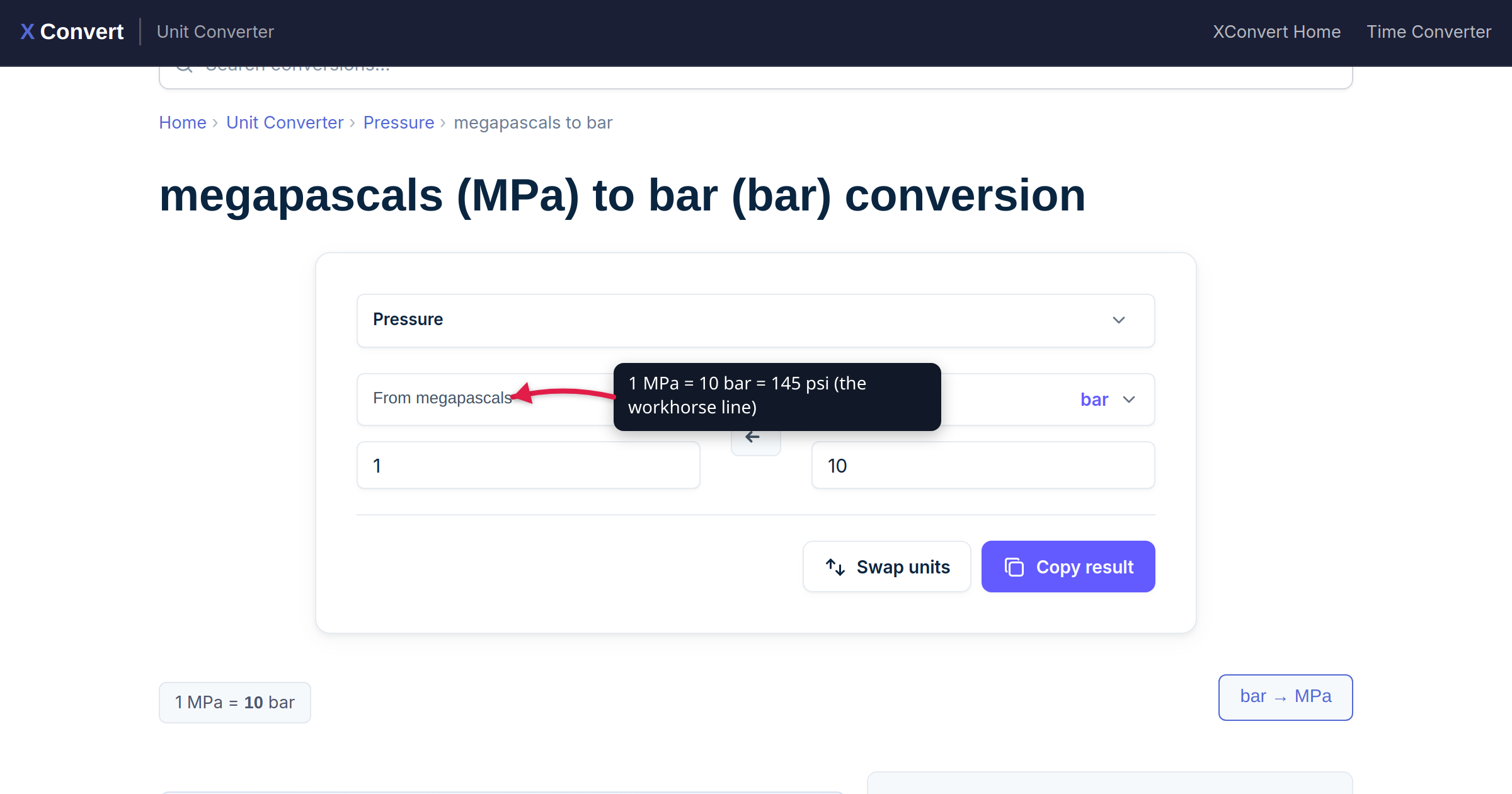
A car tire reads “32 psi” in the US, “2.2 bar” in Germany, and “220 kPa” on a Japanese gauge — three different numbers, identical pressure. Pressure is the unit-conversion field where mismatched conventions create the most confusion in engineering, automotive maintenance, scuba diving, and hydraulics. This guide explains MPa, bar, psi, kPa, and atm — the five units you actually meet — with a single conversion matrix, the ratios in plain English, and the real-world contexts where each unit dominates.
Quick answer: 1 MPa = 10 bar = 145.04 psi = 1,000 kPa ≈ 9.869 atm. The fastest mental shortcut: bar and psi differ by a factor of ~14.5 (e.g., 2 bar ≈ 29 psi). MPa to bar is exactly ×10. Hydraulics use MPa, automotive uses bar or psi, scuba uses bar, US plumbing uses psi.
Jump to a section
- The one conversion matrix
- What pressure actually is (1 sentence)
- Which unit each industry uses
- Mental-math shortcuts for each pair
- Worked examples — tires, scuba, hydraulics
- Use the xconvert pressure tool
- FAQ
The one conversion matrix
Five pressure units in one table. Read down a column to find equivalents of “1 unit of X” in every other.
| 1 MPa | 1 bar | 1 psi | 1 kPa | 1 atm | |
|---|---|---|---|---|---|
| MPa | 1 | 0.1 | 0.006895 | 0.001 | 0.10133 |
| bar | 10 | 1 | 0.06895 | 0.01 | 1.01325 |
| psi | 145.04 | 14.504 | 1 | 0.14504 | 14.696 |
| kPa | 1,000 | 100 | 6.895 | 1 | 101.325 |
| atm | 9.8692 | 0.98692 | 0.06805 | 0.00987 | 1 |
Most useful conversion lines to memorise:
- 1 MPa = 10 bar = 145 psi — the workhorse line of pressure conversion.
- 1 bar ≈ 14.5 psi — within 1% of “1 bar = 1 atmosphere”, close enough for most everyday use.
- 1 atm = 1.01325 bar ≈ 14.696 psi — sea-level atmospheric pressure.
- kPa is just bar × 100, or psi × 6.895.
What pressure actually is (one sentence)
Pressure is force per unit area. 1 pascal = 1 newton per square metre. That makes pascals tiny — atmospheric pressure on Earth is ~101,325 pascals — so engineering and consumer measurements switched to multiples: kilo- (×1,000), mega- (×1,000,000), and the legacy “bar” (= 100,000 Pa, set up so that 1 bar ≈ 1 atmosphere).
Which unit each industry uses
| Industry / context | Primary unit | Why |
|---|---|---|
| Automotive (US) | psi | US convention; tire gauges, oil pressure |
| Automotive (Europe / Asia) | bar or kPa | EU adopted bar/kPa; Japan uses kPa on dash |
| Hydraulics (industrial) | MPa | Smaller numbers than bar at high pressure |
| Pneumatics / compressors | bar (Europe), psi (US) | Same equipment, different label |
| Scuba diving | bar | International standard; tanks rated in bar |
| Plumbing (US) | psi | Residential water 40–80 psi |
| Plumbing (Europe) | bar | Residential water 2–6 bar |
| Meteorology / weather | hPa (= mbar) | Barometric pressure 980–1040 hPa typical |
| Tire pressure (global) | psi, bar, kPa | All three appear on gauges and door placards |
| Medical (BP) | mmHg | Legacy unit, not in this matrix; 1 atm = 760 mmHg |
Two reads from the table: pressure-unit choice is mostly regional, not technical. The same compressor sold in Texas and Berlin reads psi or bar depending on where it ships. Second: hydraulics chose MPa specifically because 70 MPa is more readable than 700 bar or 10,000 psi.
Mental-math shortcuts for each pair
MPa ↔ bar
- × 10 / ÷ 10. That’s it. 2.5 MPa = 25 bar. 70 bar = 7 MPa. Exact.
bar ↔ psi
- bar × 14.5 ≈ psi. Within 0.3% of the true value.
- psi × 0.07 ≈ bar. Slightly more inaccurate (1.8% off). For better: psi ÷ 14.5 = bar.
- Worked: 32 psi tire → 32 / 14.5 = 2.2 bar (actual: 2.207).
MPa ↔ psi
- MPa × 145 ≈ psi. Within 0.03%.
- psi × 0.0069 ≈ MPa, or psi ÷ 145 = MPa.
kPa ↔ psi
- kPa × 0.145 ≈ psi. A 220 kPa tire reads as 220 × 0.145 = 32 psi.
- psi × 6.9 ≈ kPa.
bar ↔ atm
- Treat them as equal for casual work. 1 atm = 1.01325 bar; the error is 1.3%.
Worked examples — tires, scuba, hydraulics
Tire pressure across labels
A typical sedan door placard reads “32 psi (front) / 30 psi (rear)” in the US. The same car in:
- Germany: “2.2 bar / 2.1 bar”
- Japan: “220 kPa / 210 kPa”
- France: “2.2 bar” (most common) or “220 kPa”
All three describe identical pressures. If you’ve rented a car abroad and the manual is in metric, multiply bar by 14.5 to get the psi number your gauge displays.
Scuba tank charge
A standard recreational aluminium 80-cubic-foot tank is rated 3,000 psi = 207 bar = 20.7 MPa. Dive computers and pillar-valve gauges across the world use bar as the international standard, so US divers travelling abroad will read in bar. A “full” tank reads 200 bar (sometimes 207), “reserve” at 50 bar, “empty” at 30 bar.
Industrial hydraulic press
A 500-tonne hydraulic press operates at 350 bar = 35 MPa = 5,076 psi. Hydraulics engineers default to MPa because 35 is easier to handle than 5,076. The matching pump and seals are typically rated in MPa on European-built equipment and psi on US-built equipment — same fluid, same physical pressure, different number on the spec plate.
Weather report barometric pressure
Sea-level barometric is around 1,013 hPa = 1.013 bar = 14.7 psi = 0.1013 MPa. Forecasters use hectopascals (hPa) because they map 1:1 with the older millibar (mbar) unit — “1,013 mbar” and “1,013 hPa” are identical.
Household water mains
US municipal water: typically 40–80 psi = 2.8–5.5 bar = 280–550 kPa. European water: typically 2–6 bar = 29–87 psi = 200–600 kPa. A 6 bar EU tap is roughly 87 psi — at the high end of US municipal supply.
Use the xconvert pressure tool
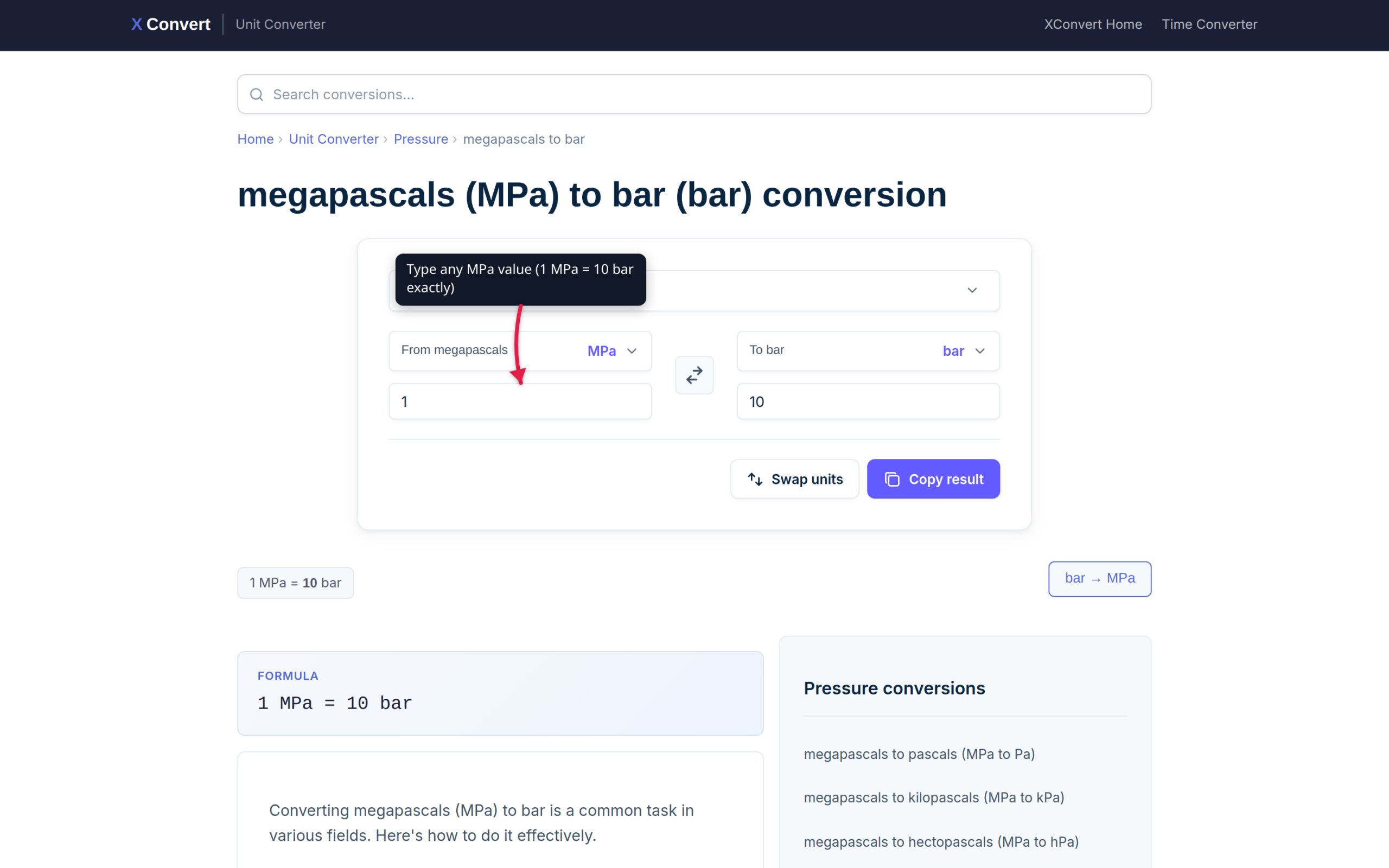
For exact conversions across any pair, use xconvert’s megapascals to bar converter. The tool covers all five units in this guide (MPa, bar, psi, kPa, atm) plus mmHg, Torr, and inches of mercury. Type any number; the matching column updates instantly.
Other pressure pair converters on xconvert:
- Bar to PSI — the most common car-tire conversion.
- PSI to bar — reverse direction.
- MPa to kPa — engineering documents.
- kPa to psi — dashboard tire readouts (kPa) → US gauge (psi).
- hPa to inches of mercury — barometric pressure / weather.
FAQ
Is 1 bar the same as 1 atmosphere?
Almost — but not exactly. 1 atm = 1.01325 bar (the difference is 1.3%). The bar was defined to be close to one atmosphere for convenience. For casual use (tire pressure, scuba), treat them as equal. For engineering or scientific work, use the exact ratio.
Why do car tires use psi in the US but bar in Europe?
Convention. The US adopted Imperial units in the early 20th century when tire-pressure gauges were standardised; Europe adopted the bar (and later kPa) because both are metric-friendly. Modern cars sold globally often print all three on the door placard (psi / bar / kPa) so the same vehicle works in any market.
What pressure unit do scuba divers use?
Bar is the international standard for scuba. Dive computers, tank pressure gauges, and dive tables across the world use bar. US recreational tanks are still rated and stamped in psi (3,000 psi service pressure), so divers convert: 3,000 psi ÷ 14.5 = 207 bar.
Is psi the same as psia or psig?
No — those distinguish reference points. psia is absolute pressure (referenced to a perfect vacuum). psig is gauge pressure (referenced to atmospheric). Tire gauges, blood-pressure cuffs, and most consumer devices show psig. The difference is 1 atm (14.696 psi). A “32 psi” tire is 32 psig — its absolute pressure is 46.7 psia. Engineering datasheets always specify.
How do I convert kPa to psi for my tire pressure?
Multiply kPa by 0.145 to get psi. Examples: 220 kPa = 32 psi; 240 kPa = 35 psi; 280 kPa = 41 psi. Or divide kPa by 6.895 for the same result.
Why is MPa used for hydraulics instead of bar?
Readability at high pressure. A typical hydraulic press operates at 35 MPa — write that as 350 bar or 5,076 psi and the numbers grow harder to handle. MPa keeps engineering spec sheets in the 1–100 range across most real systems, which is easier for designers and operators.
Are bar and millibar related to barometric pressure?
Yes — that’s literally where the name came from. The bar was defined in 1909 by meteorologist Wilhelm Bjerknes for atmospheric science. 1 millibar (mbar) = 1 hectopascal (hPa) = 0.001 bar. Weather reports use hPa today, but the units are exactly equivalent.
What’s the difference between Pa, kPa, and MPa?
Just decimal place. 1 MPa = 1,000 kPa = 1,000,000 Pa. The pascal is the SI base unit but it’s tiny — atmospheric pressure is ~101,325 Pa — so engineering uses kPa (consumer / automotive) and MPa (industrial / hydraulics) almost exclusively.
Related guides
- kJ vs kcal: Reading Food Labels Without a Calculator — same kind of multi-region unit puzzle, this time for energy on food labels.
- HP to kW for Electric Vehicles: Why EVs Use Both Units
- KW to HP: Reading European Car Specs (BMW, Mercedes, Volvo)
- MPH to KM/H for Driving in Europe: Speed Limit Reference
- Flow Rate Conversion: GPM, LPM, m3/h, CFM Explained
Sources
Last verified 2026-05-19.
- NIST Special Publication 811 — Unit Conversion Factors
- BIPM — The International System of Units (SI Brochure)
- ISO 80000-4 — Quantities and units, mechanics