 By James
 A weather report for an Atlantic crossing flashes “wind 040° at 28 kt”; a car-driven mind reaches for km/h or mph. A cruise-ship bridge clock reads “speed over ground 22 kn”; the same passenger checking Google Maps wants a familiar number. Knots are everywhere in aviation and maritime navigation but nowhere on a car dashboard — and the conversion to km/h is exactly 1.852. This guide explains the conversion, where you’ll meet it, the Beaufort and Saffir–Simpson wind scales translated into both units, and why the knot survived the metric revolution that swept almost everything else.
Quick answer: 1 knot = 1.852 km/h exactly. Multiply knots by 1.852 to get km/h; divide km/h by 1.852 to get knots. Mental shortcut: double the knots and subtract about 8% (28 kn × 2 = 56, −8% ≈ 52 km/h; actual: 51.9). A 25 kn breeze = ~46 km/h, a 64 kn hurricane = ~119 km/h.
Jump to a section
- The exact 1.852 ratio (and why it’s exact)
- Where you’ll actually see knots
- Mental-math shortcuts
- Conversion reference table (knots ↔ km/h)
- Worked examples — boats, planes, storms
- The Beaufort wind scale in knots and km/h
- Hurricane categories (Saffir–Simpson) in knots and km/h
- Why aviation and maritime never switched
- Reading a marine or aviation weather forecast
- Use the xconvert knots to km/h tool
- FAQ
The exact 1.852 ratio (and why it’s exact)
km/h = knots × 1.852          (exact)
knots = km/h ÷ 1.852          (exact)
The reason this number is exact: a knot is defined as one nautical mile per hour, and the international nautical mile was set at exactly 1,852 metres by the International Hydrographic Organization in 1929. The choice wasn’t arbitrary — one nautical mile corresponds to one minute of latitude on the Earth’s surface. That geometric meaning is why charts, GPS positions, and great-circle distances are easier to compute in nautical miles than in statute miles or kilometres.
The US held out with a slightly different “US nautical mile” until 1954, and the UK until 1970 — both eventually adopted the international 1,852-metre definition that ICAO and IMO use today.
Where you’ll actually see knots
Three contexts cover almost every knot reading a non-specialist will encounter:
1. Marine navigation. Boat speed, ocean-current speed, tidal-stream speed, wind speed in marine forecasts — all in knots. The IMO mandates knots for vessel speed worldwide; recreational sailors follow the same convention because every chart and every other boat is using it.
2. Aviation. All ICAO-regulated aircraft report indicated airspeed, true airspeed, and ground speed in knots. Wind speed at altitude in METAR/TAF reports is in knots. Even US pilots flying domestically in Cessnas use knots — the international standard reaches into general aviation.
3. Weather forecasts. Hurricane and tropical-cyclone wind speeds are reported in knots by the National Hurricane Center, the World Meteorological Organization, and most national weather services. The Beaufort scale (force 1–12) is defined in knots first, then translated to other units. News outlets convert to mph or km/h for the general public, but the source data is knots.
A useful contrast: car speedometers, road speed limits, and ground transportation are universally in mph or km/h — never knots. If you see knots on something that drives on a road, something’s wrong.
Mental-math shortcuts
For a quick estimate without a calculator:
Fast and rough — double and round down (knots → km/h). Double the knot value and shave off about 8%. The exact ratio is 1.852, so doubling gives you 2× — about 8% too high.
- 30 kn × 2 = 60 → minus 8% ≈ 55 km/h (actual: 55.6) ✓
- 50 kn × 2 = 100 → minus 8% ≈ 92 km/h (actual: 92.6) ✓
Slower but more accurate — multiply by 1.85.
- 30 kn × 1.85 = 55.5 km/h (actual: 55.56)
- 100 kn × 1.85 = 185 km/h (actual: 185.2)
km/h to knots, fast — halve and add 8%.
- 100 km/h ÷ 2 = 50 → plus 8% ≈ 54 knots (actual: 53.99)
- 60 km/h ÷ 2 = 30 → plus 8% ≈ 32 knots (actual: 32.40)
The 8% adjustment is what separates a rough estimate from a useful one. For most plain-English contexts (“how fast is a 40-knot gale?”), doubling is good enough.
Conversion reference table (knots ↔ km/h)
| Knots | km/h | What it feels like |
|---|---|---|
| 5 | 9.3 | Walking pace, light air on water |
| 10 | 18.5 | Slow jog, light coastal breeze |
| 15 | 27.8 | Slow cycling, gentle sailing wind |
| 20 | 37.0 | Fast cycling, brisk sailing wind |
| 25 | 46.3 | Suburban driving, small-craft warning territory |
| 30 | 55.6 | Highway slow, gale-force territory begins |
| 40 | 74.1 | Highway driving, strong gale |
| 50 | 92.6 | Fast highway, storm-force wind |
| 64 | 118.5 | Hurricane threshold (Category 1) |
| 83 | 153.7 | Hurricane Category 2 |
| 96 | 177.8 | Hurricane Category 3 |
| 113 | 209.3 | Hurricane Category 4 |
| 137 | 253.7 | Hurricane Category 5 lower bound |
| 150 | 277.8 | Airliner cruise headwind possible |
| 250 | 463.0 | Jet airliner approach speed |
| 500 | 926.0 | Jet airliner cruise speed |
| 600 | 1,111.2 | Concorde cruise speed (Mach 2) |
The reference table covers everything from “is there wind?” through “Category 5 hurricane” through “jet airliner ground speed.” Note that hurricane category boundaries are defined in mph by the National Hurricane Center but routinely reported in knots in international forecasts.
Worked examples — boats, planes, storms
| Scenario | Knots | km/h |
|---|---|---|
| Average sailing yacht (cruising) | 6–8 kn | 11–15 km/h |
| Recreational motorboat (planing) | 25–35 kn | 46–65 km/h |
| Container ship (commercial cruise) | 20–22 kn | 37–41 km/h |
| Aircraft carrier (top speed, US Nimitz-class) | 30+ kn | 56+ km/h |
| Cessna 172 (cruise speed) | 122 kn | 226 km/h |
| Boeing 737 (cruise speed) | 453 kn | 839 km/h |
| Airbus A380 (cruise speed) | 488 kn | 904 km/h |
| Concorde (cruise speed, Mach 2.04) | 1,176 kn | 2,179 km/h |
| Hurricane Helene (2024, peak sustained) | 120 kn | 222 km/h |
| Hurricane Patricia (2015, peak — strongest Atlantic basin) | 185 kn | 343 km/h |
| Jet-stream wind (typical) | 100–150 kn | 185–278 km/h |
These translate intuitively the other way too: a forecast of “wind 25 kn from the southwest” means a brisk 46 km/h breeze — strong enough to fly a small kite but not enough to ground commercial flights.
The Beaufort wind scale in knots and km/h
The Beaufort scale was devised in 1805 by Royal Navy officer Sir Francis Beaufort to standardise sea-state observations. Modern marine weather forecasts still cite Beaufort force numbers, especially in European waters. The full scale:
| Force | Description | Knots | km/h | Sea state |
|---|---|---|---|---|
| 0 | Calm | <1 | <2 | Mirror-smooth |
| 1 | Light air | 1–3 | 2–6 | Ripples |
| 2 | Light breeze | 4–6 | 7–11 | Small wavelets |
| 3 | Gentle breeze | 7–10 | 12–19 | Large wavelets, scattered whitecaps |
| 4 | Moderate breeze | 11–16 | 20–30 | Small waves, frequent whitecaps |
| 5 | Fresh breeze | 17–21 | 31–39 | Moderate waves, many whitecaps |
| 6 | Strong breeze | 22–27 | 40–50 | Large waves, foam crests, spray |
| 7 | Near gale | 28–33 | 51–61 | Sea heaps up, foam streaks |
| 8 | Gale | 34–40 | 62–74 | Moderately high waves, breaking crests |
| 9 | Strong gale | 41–47 | 75–87 | High waves, dense foam |
| 10 | Storm | 48–55 | 88–102 | Very high waves, surface white |
| 11 | Violent storm | 56–63 | 103–117 | Exceptionally high waves |
| 12 | Hurricane | 64+ | 118+ | Air filled with foam and spray |
A “Force 8 gale” — common in winter North Atlantic shipping forecasts — is 34–40 kn, which is roughly 62–74 km/h (about highway-driving speed). Force 12 is the hurricane threshold and is the same speed (64 knots = 118 km/h) as Saffir–Simpson Category 1.
Hurricane categories (Saffir–Simpson) in knots and km/h
The Saffir–Simpson Hurricane Wind Scale is defined by the National Hurricane Center using 1-minute sustained wind speed. Categories in knots and km/h (the NHC publishes mph as primary; this table converts):
| Category | Sustained wind (kn) | km/h | mph (primary) | Damage |
|---|---|---|---|---|
| Tropical Storm | 34–63 | 63–117 | 39–73 | Some damage |
| Category 1 | 64–82 | 119–153 | 74–95 | Some damage |
| Category 2 | 83–95 | 154–177 | 96–110 | Extensive damage |
| Category 3 | 96–112 | 178–208 | 111–129 | Devastating |
| Category 4 | 113–136 | 209–251 | 130–156 | Catastrophic |
| Category 5 | 137+ | 252+ | 157+ | Catastrophic |
So when a meteorologist says “100-knot hurricane” that’s roughly 185 km/h or 115 mph — solidly Category 3. 150 knots would be a strong Category 4 at 278 km/h / 173 mph. The strongest measured Atlantic-basin hurricane (Patricia 2015) peaked at 185 knots = 343 km/h.
Why aviation and maritime never switched
When most of the world adopted metric units in the 19th and 20th centuries, knots survived in aviation and at sea for three concrete reasons:
1. The unit is geometrically natural for navigation. A nautical mile equals one minute of latitude. A pilot or navigator plotting a course on a chart can read distance directly from the latitude grid — no conversion factor needed. Switching to km/h would mean every chart, every navigation aid, every flight plan changes — and the geometric convenience would be lost.
2. International interoperability already settled the question. ICAO mandated knots and feet for aviation in 1944. IMO mandates knots for maritime. Changing one country (or even one continent) would create dangerous ambiguity in air traffic control hand-offs and ship-to-ship communication. So every country, including thoroughly metric ones (France, Germany, Japan), uses knots in aviation and shipping.
3. Aviation weather is global. A pilot crossing from European to North American airspace doesn’t want their headwind report to change units. Wind in knots, altitude in feet, distance in nautical miles — uniform worldwide. The metric system never offered a strong enough advantage to overcome the switching cost.
The exception: Russia and most former Soviet states use metric units in aviation domestically (km/h, metres for altitude). Pilots crossing into Russian airspace get a unit conversion as part of the airspace entry procedure. Outside that region, knots are universal.
Reading a marine or aviation weather forecast
A typical marine forecast line:
SW WINDS 15 TO 25 KT, SEAS 4 TO 7 FT, WAVES 6 SEC
That reads as: south-westerly winds 15 to 25 knots (28–46 km/h), seas 4 to 7 feet (1.2–2.1 m), with 6-second wave period. For a small boat, that’s marginal conditions; for a yacht over 30 ft, comfortable.
An aviation METAR report looks like:
KSFO 250056Z 26012KT 10SM CLR 18/10 A2998
The 26012KT means wind from 260° (west-southwest) at 12 knots — that’s 22 km/h. ATC will give your taxi-out and takeoff instructions assuming you read knots; the conversion to km/h is purely for your personal mental picture.
For both forecast types, you don’t need to convert if you’ve internalised the equivalents: a 25-knot wind is “highway slow”; a 50-knot wind is “highway fast” — about right for the felt speed.
Use the xconvert knots to km/h tool
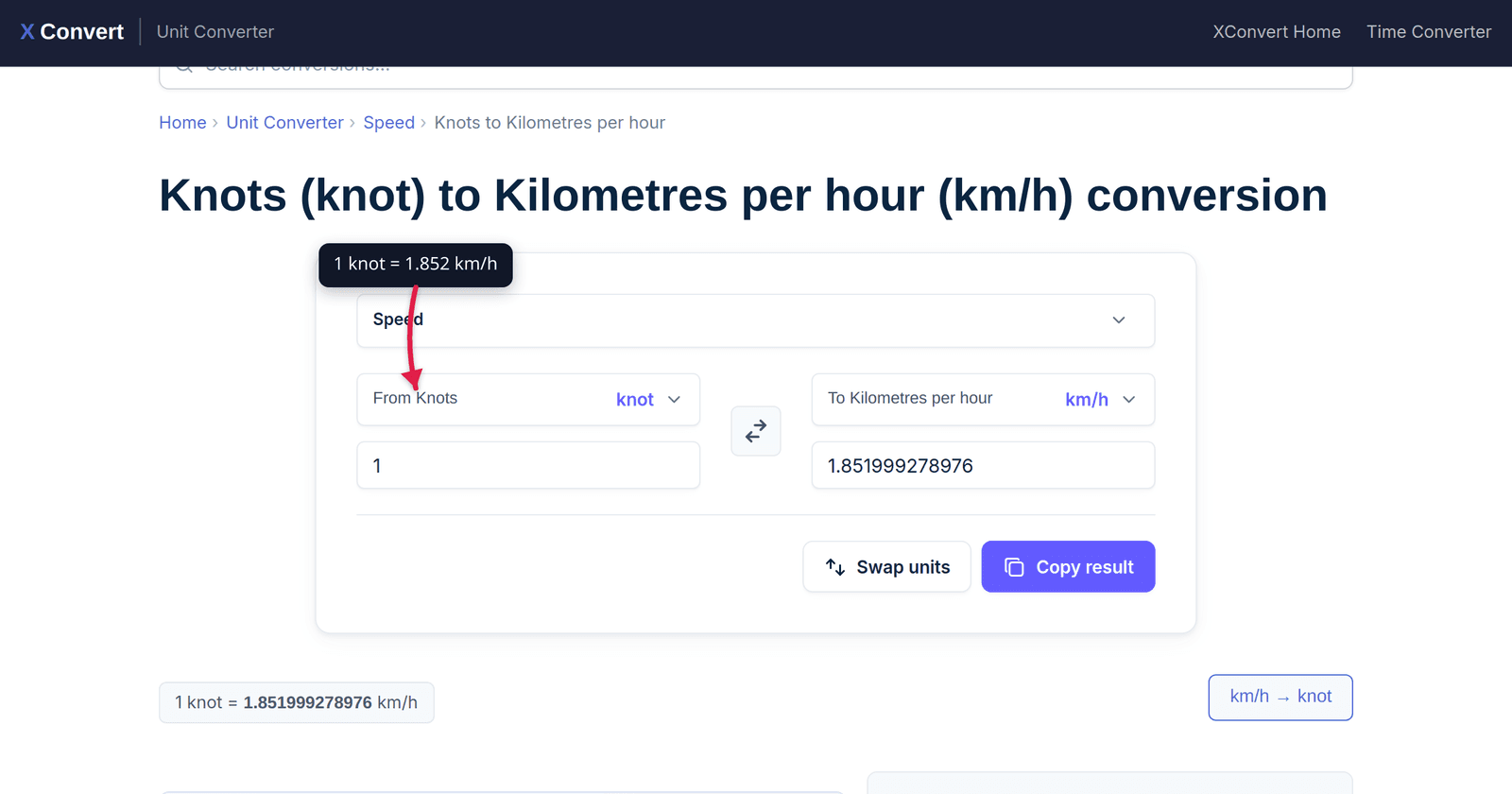
For precise conversions — adjusting for a published gust value, sizing a wind generator, comparing two meteorological reports — use xconvert’s knots to kilometres per hour converter. Type any number of knots in the left box; the right box shows km/h to full precision. The page also offers the reverse km/h to knots direction and related conversions:
- Knots to mph — for US-localised reading
- Knots to m/s — for SI scientific contexts (oceanography, fluid mechanics)
- Knots to ft/s — for some US engineering contexts
Related explainer articles on the xconvert blog:
- MPH to KM/H for Driving in Europe — the road-vehicle counterpart of this puzzle.
- MPa vs Bar vs PSI: Pressure Units Explained — three pressure units that all measure the same physical quantity, similar cross-region puzzle.
- kJ vs kcal: Reading Food Labels Without a Calculator — energy-unit equivalent of the knots/kmh nautical-vs-metric divide.
FAQ
Is “knots per hour” correct?
No. A knot is already a speed (one nautical mile per hour). Saying “knots per hour” is like saying “miles-per-hour per hour” — that’s an acceleration, not a speed. Marine and aviation texts always write “knots” or “kn” to mean speed; “knots per hour” appears in casual writing but is technically wrong.
What’s the abbreviation: kn, kt, or kts?
- kn is the IEEE / ISO recommended abbreviation.
- kt is the ICAO-recommended abbreviation, dominant in aviation.
- kts appears in informal writing (especially American sailing publications) but isn’t standardised.
You’ll see all three in different contexts; treat them as equivalent.
How does a knot relate to mph?
1 knot = 1.15078 mph (or roughly +15%). So 100 knots ≈ 115 mph. The conversion factor is the ratio of the nautical mile (1,852 m) to the statute mile (1,609.344 m). For precise conversion, use xconvert’s knots to mph tool.
Why is a nautical mile 1,852 metres?
Because one minute of latitude on the Earth’s surface is approximately 1,852 m at the standard reference latitude. The Earth isn’t a perfect sphere, so the exact length varies slightly with latitude (1,843 m at the equator, 1,862 m at the poles); the 1,852 m value is an international average set by the International Hydrographic Organization in 1929. Before that, the US, UK, and other maritime nations each used slightly different “nautical mile” values.
Do car GPS speedometers ever show knots?
Standard car GPS units don’t — they default to mph or km/h depending on locale. Marine and aviation GPS units show knots as the default. Some smartphone apps for boating (Navionics, Aqua Map) display speed in knots; standard mapping apps (Google Maps, Waze) don’t offer the option.
What’s the difference between “indicated airspeed” and “ground speed” in aviation?
Indicated airspeed (IAS) is what the pitot tube measures — speed through the air. Ground speed (GS) is speed across the ground (IAS adjusted for wind). Both are reported in knots. A plane with 250 kn IAS flying into a 50 kn headwind has 200 kn GS. ATC tracks ground speed; the pilot flies indicated airspeed.
What’s the relationship between knots and Mach number?
Mach number is the ratio of true airspeed to the local speed of sound, which varies with altitude and temperature. At sea level (15°C), Mach 1 ≈ 661 knots; at typical airliner cruise altitude (FL360 / 36,000 ft), Mach 1 ≈ 573 knots. So Mach 0.85 cruise (typical Boeing 737 / Airbus A320) is roughly 487 knots true airspeed at altitude.
Sources
Last verified 2026-05-25.
- International Hydrographic Organization — sets the international nautical mile definition (1,852 m exact).
- ICAO — Annex 5: Units of Measurement — mandates knots for aviation worldwide.
- IMO — International Maritime Organization — knots as the universal vessel-speed unit.
- NIST Special Publication 811 — Conversion Factors — primary US reference for unit conversion.
- National Hurricane Center — Saffir-Simpson scale — hurricane category wind-speed thresholds.
- NOAA Ocean Service — What is a nautical mile? — plain-English explanation of the knot/nautical-mile relationship.
- Royal Meteorological Society — Beaufort wind scale — full Beaufort scale with descriptions and equivalents.